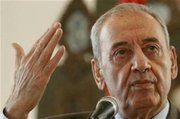
 BEIRUT Daily Star: Speaker Nabih Berri declared Thursday that no Parliament session can take place without him, and warned that while the Lebanese Army would remain united during a widely feared domestic political crisis, the Internal Security Forces (ISF) might split. Appearing on the country’s most influential political talk show, the Lebanese Broadcasting Corporation’s "Kalam al-Naas," Berri warned that despite what some in the March 14 camp might think, Parliament cannot convene to elect a new president without him.
"Because I called for a parliamentary session on September 25, they cannot meet … without me or by virtue of law as they think," said Berri, quoting Article 73 of the Constitution. The speaker vowed to continue calling for a session, even after October 24, which marks a deadline of 10 days before President Emile Lahoud’s (extended) mandate expires and said: "I have the right!" "There are hundreds of legitimate [candidates] among the Maronites, so why can’t we agree on one?" he asked.
Berri also expressed disappointed at the "delays" from the majority camp in responding to his initiative. "By delaying, the intensity of the initiative dies down," said Berri, who nonetheless insisted that he would push his compromise proposal to the very end. Citing a poll of 600 Beirutis from all sects conducted on Thursday, Berri said 76 per cent backed his initiative, with support strongest among Shiites (99 per cent) and lowest among Druze (55 per cent).
Berri also expressed "discomfort" at a statement by UN Middle East envoy Terje Roed-Larsen, who opined that if the two thirds-quorum is not present, a president should be elected by absolute majority and should fulfill all UN resolutions, particularly 1559. "The Lebanese are in great disagreement over 1559, so why raise that controversial point at this crucial time?" asked Berri, who added that he received a telephone call from UN Secretary Ban Ki-moon, who assured him that what Roed-Larsen said will be "discussed and studied."

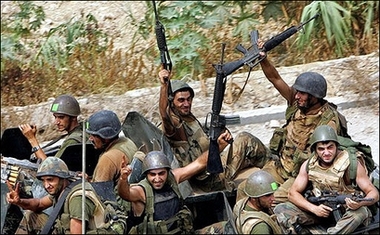 Lebanese soldiers searched through devastated buildings and scorched bushes along the Mediterranean coastline in northern Lebanon on Monday, hunting for fugitives a day after the army crushed the remnants of a militant group and ended a three-month siege at a Palestinian refugee camp.Meanwhile, the body of the leader of the militant Fatah Islam group, Shaker al-Absi, was identified by his wife at a hospital in the port city of Tripoli, said Nasser Adra, the hospital’s director. Two captured militants also identified the body as Absi’s.
 However, Adra told The Associated Press that the hospital could not officially confirm the identity, which would have to come from the judicial authorities after a DNA test.Absi, a Palestinian linked to the late leader of Al Qaeda in Mesopotamia, Abu Musab al-Zarqawi, had not been seen or heard from since early in the fighting that erupted May 20.The army searched Monday for Fatah Islam fighters who may have escaped the battle on Sunday at the Nahr al Bared camp. Patrol boats were looking for bodies in the sea. Military helicopters flew over the camp in low reconnaissance runs, as smoke from smoldering fires rose into the sky.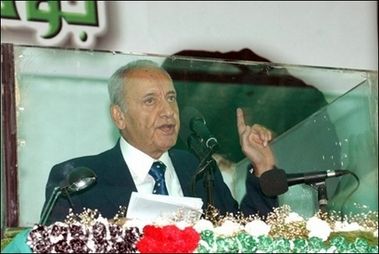
 By Yara Bayoumy BEIRUT (Reuters) – In a cinema industry traditionally dominated by the theme of war, "Caramel", a film by Lebanese director Nadine Labaki, shies away from conflict and instead brings to light social dilemmas faced by Lebanese women. "Caramel", or "Sukkar Banat" as the movie is titled in Arabic, revolves around the lives of five Lebanese women, each burdened with their own social and moral problems.
  Relatives of Fatah Islam’s deputy commander Shehab al-Qaddour known as Abu Hureira, who was killed on July 31 in clashes with Lebanese security forces, hold his body, wrapped with a white shroud during his funeral in the northern port city of Tripoli, Lebanon Saturday, Sept. 1, 2007. The No. 2 commander of al-Qaida-inspired Islamic militants battling Lebanese troops in a Palestinian refugee camp in northern Lebanon for more than three months was buried on Saturday, a month after his death. (AP Photo)