A “suspicious” man arrested by the Internal Security Forces on Wednesday in the Beirut southern suburb of Haret Hreik has turned out to be a renowned Lebanese rapper. “He raised suspicions due to his beard and was taken for interrogation while his car was inspected and it did not contain any explosives,” al-Jadeed […]
GlobalData, a London-based consultancy company, said Tuesday that international oil firms were still keen to bid for Lebanon’s offshore gas exploration despite the delays in an expected auction and political instability. “Lebanon’s first offshore bidding round has generated significant interest from oil firms, and while ongoing political instability has led to its third […]
A suicide bombing rocked on Tuesday Beirut’s southern suburbs for the second time this month, leaving at least four people dead, the state-run National News Agency reported. Red Cross Operations Director George Kettaneh told local TV stations that at least two people died in the blast that hit the Haret Hreik district. But NNA said four […]
economist.org edition – Print edition
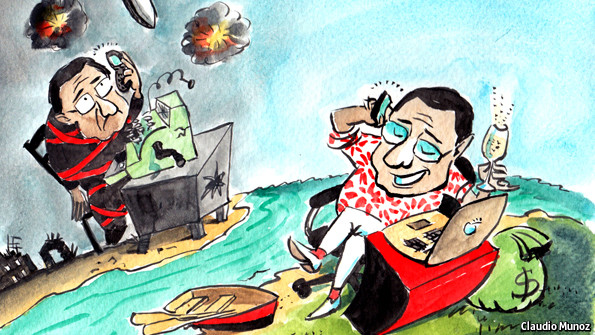
ON A recent flight from Beirut to Addis Ababa, Lebanese businessmen were swapping stories. “Business is excellent in Angola,” declared one. “I hear it’s good in Ghana?” inquired another. Flights out of Lebanon buzz with optimism. For Lebanese businessfolk, the juiciest opportunities are abroad.
More people of Lebanese origin live outside Lebanon than in it (perhaps 15m-20m, compared with 4.3m). Many have done well. Carlos Slim, a Lebanese-Mexican telecoms tycoon, is the richest man in the world. Carlos Ghosn, a French-Lebanese-Brazilian, is the boss of both Renault (a French carmaker) and Nissan (a Japanese one). Nick Hayek, a Swiss-Lebanese, runs Swatch, the biggest maker of Swiss watches.
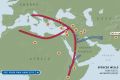
Lebanese people have long had wanderlust. Ancient Phoenician merchants roamed the Mediterranean, setting up cities such as Carthage and Cadiz. In the past century and a half, waves of Lebanese have left for the Americas and west Africa. Lebanon’s long civil war prompted many more to pack. Some 7m Lebanese and their descendants now live in Brazil, 3m in the United States and at least 250,000 in west Africa. They do everything from running restaurants to dealing in diamonds. By and large, they find business easier elsewhere than back in their fragile motherland.
Fadi Nahas, for example, has lived in Turkey since the late 1980s, when Lebanon’s war was still smouldering. He runs 15 companies that store and transport fruit and other perishables. Like many Lebanese, he is multilingual, speaking Arabic, Turkish, English, Italian, Spanish and French. “We’re like the Swiss with the number of languages we speak,” says Mr Nahas. “But tell me the last time they had to deal with a bomb or a power cut?”
BEIRUT: Garbage piled up on the streets of the capital and other parts of the country over the weekend, with waste collectors still unable to address the problem due to an ongoing sit-in by activists at the landfill serving Beirut and Mount Lebanon. Places such as Hamra and Hay al-Sellom were among the […]
As the trial of suspects in the assassination of Rafiq Hariri begins, I confess to having mixed feelings about the process that led us to this stage. Despite the optimism in March 14, the trial comes across as one that makes the best of a process that should have gone differently. Supporters of […]
BBC news, By Lyse Doucet:
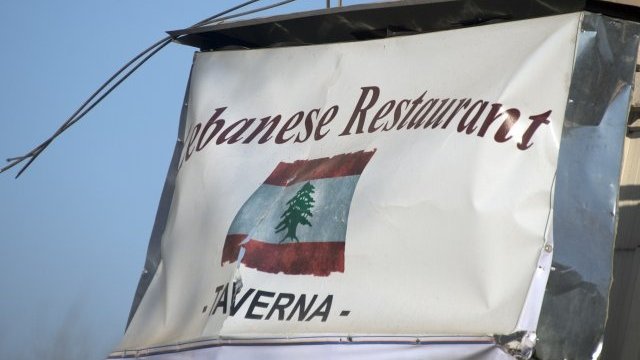
Kamal Hamade made the best chocolate cake in Kabul, the best Lebanese food and, he thought, the best evacuation plan.
But the plan wasn’t good enough to save him and others who died with him when the Taliban attacked his Taverna du Liban restaurant tucked away in a quiet street of one of the Afghan capital’s oldest neighbourhoods.
But his safety measures did save many lives.
And Kamal is reported to have grabbed a gun from his office to take on his assailants. He was shot dead defending his beloved restaurant.
I would not have expected him to act any differently. His Taverna had come under attack before. He always told me he had his gun at the ready to help defend his patch and the people who made it the special place it was.
When some of his staff were arrested a few years ago in a local dispute, Kamal insisted on going to jail with them because he thought his presence would get them out more quickly. It worked.
Lebanese men watch the opening of the trial in absentia of four members of the Hezbollah Shiite movement accused of murdering former Lebanese premier Rafiq Hariri in 2005 at a cafe in the southern Lebanese city of Sidon on January 16, 2014 (AFP Photo/Mahmoud Zayyat ) The website of the U.N.-backed Special […]
The opening session of the Special Tribunal for Lebanon trials witnessed a recollection of the bloody scenes of February 14, 2005, as the incidents of that day were demonstrated through pictures, videos and the oversized maquette of the crime scene which was placed in the middle of the courtroom. These scenes evoked feelings […]
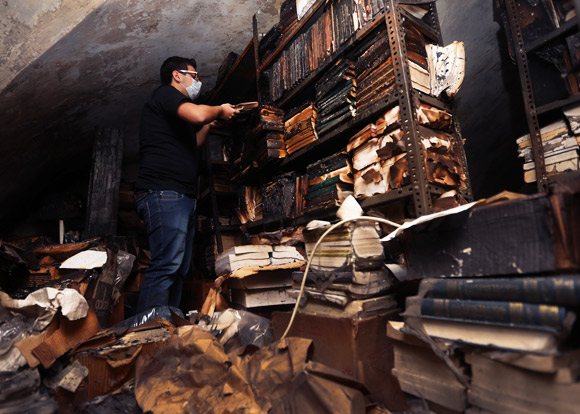
New York Times – On a Friday night shortly after New Year’s, a group of men broke into an antiquarian bookshop in the northern Lebanese city of Tripoli and set it on fire. The shop belonged to Father Ibrahim Sarrouj, a Greek Orthodox priest. A longtime resident of Tripoli’s old Serail neighborhood, he had amassed a large collection of books—rare first editions of scholarly texts, novels in different languages, dictionaries, encyclopedias, out-of-print magazines—in the forty-plus years since he opened for business. The fire burned for under an hour before it was discovered, but an untold number of books were destroyed.
Tripoli is a mess. Just a few miles from the Syrian border and comprising a religiously mixed population, it’s become one of the most dangerous places in Lebanon. Sunnis and Alawites—variously at odds since the Lebanese civil war and now feeling the stakes of their feud deepened by the existential conflict next door—lob mortars and rocket-propelled grenades at each other’s neighborhoods while car bombs explode outside congregational mosques. A preponderance of religious and political powerbrokers in the city has made it difficult for the Lebanese Army to establish order. Radical Islamists—previously a kooky fringe in Lebanese politics—attract more support each day from Tripolitans incensed by Hezbollah’s involvement on the side of the Assad regime in the Syrian civil war, which has brought over a million refugees into Lebanon. Meanwhile, the princes of the alleyways (as neighborhood strongmen are sometimes called) vie for influence with the city’s other grandees, including two Sunni billionaire politicians and a former security czar.
Population Movements to Keserwan - The Khazens and The Maans
ما جاء عن الثورة في المقاطعة الكسروانية
ثورة أهالي كسروان على المشايخ الخوازنة وأسبابها
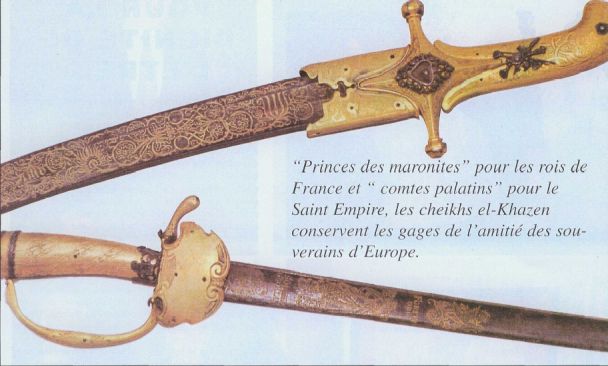
Origins of the "Prince of Maronite" Title
Growing diversity: the Khazin sheiks and the clergy in the first decades of the 18th century
Historical Members:
Barbar Beik El Khazen [English]
Patriach Toubia Kaiss El Khazen(Biography & Life Part1 Part2) (Arabic)
Patriach Youssef Dargham El Khazen (Cont'd)
Cheikh Bishara Jafal El Khazen
Patriarch Youssef Raji El Khazen
The Martyrs Cheikh Philippe & Cheikh Farid El Khazen
Cheikh Nawfal El Khazen (Consul De France)
Cheikh Hossun El Khazen (Consul De France)
Cheikh Abou-Nawfal El Khazen (Consul De France)
Cheikh Francis Abee Nader & his son Yousef
Cheikh Abou-Kanso El Khazen (Consul De France)
Cheikh Abou Nader El Khazen
Cheikh Chafic El Khazen
Cheikh Keserwan El Khazen
Cheikh Serhal El Khazen [English]
Cheikh Rafiq El Khazen [English]
Cheikh Hanna El Khazen
Cheikha Arzi El Khazen
Marie El Khazen