
by dailyStar.com.lb
BEIRUT: East Lebanon residents protested for the third day in a row Sunday against Syrian labor in the country, claiming it is undercutting their business. State media reported that residents of the Zahle district town of Ali al-Nahri called for “decisive decisions” to resolve what they called “the overexpansion of Syrian labor” that jeopardizes the Lebanese. Protesters called on officials to resolve the “crisis of [hosting] Syrian refugees who admit they do not want to return to their country even after the Syrian crisis ends.” Thousands of Syrians have fled the war since 2011, with 1.01 million Syrian refugees registered in Lebanon with U.N. humanitarian agency UNHCR, though Lebanese officials estimate the number to be upward of 1.5 million. There is little documented evidence that large numbers of Syrians do not wish to go home if a political agreement is made to end fighting and allow their return. Several Lebanese officials have called for the return of refugees to safe zones in Syria. “[In Lebanon] their food is guaranteed, they get free health care and there is a boom in donations,” one protester said, adding that “this is the reason they are undercutting [Lebanese] businesses.”
In addition to the refugees, there are many Syrians who are legal residents and allowed to work according to a predefined list of professions issued by the Labor Ministry. Protesters claimed that most businesses in the towns of the central Bekaa Valley “belong to Syrians, and it seems that there is no longer room for us in our own country.” A number of Lebanese towns, including the Mount Lebanon town of Hadath, have closed businesses owned by Syrian refugees, pursuant to Labor Ministry decrees. Others have enforced curfews, forcing Syrians to remain indoors after nightfall.
by bloomberg, Lebanese Prime Minister Sa’ad Hariri said on Tuesday he expects the government to pass a draft state budget within days, …
by Allan Smith - business insider
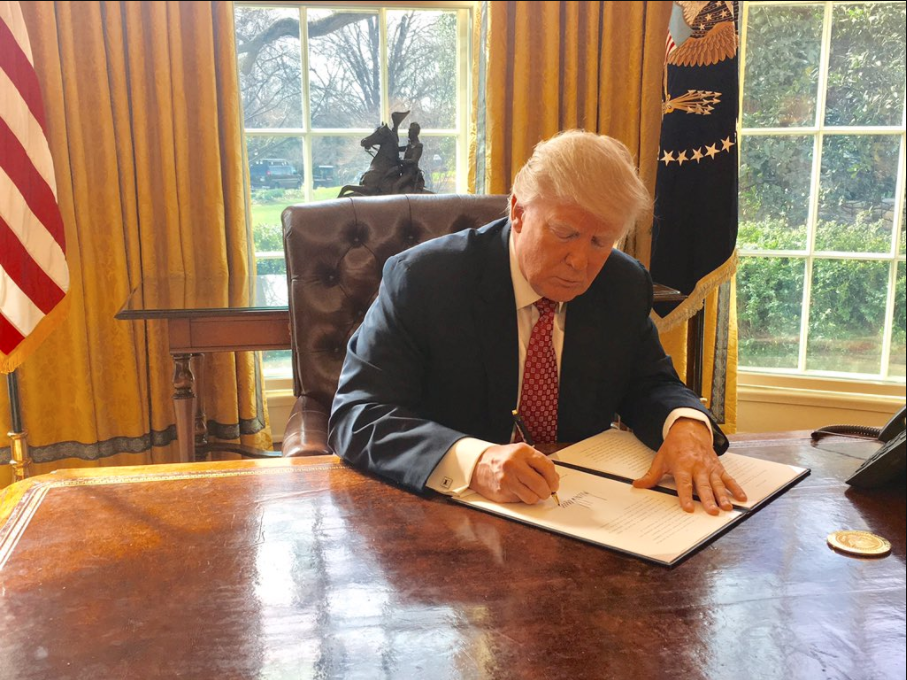
The latest executive order temporarily barring travel from a slew of majority-Muslim nations has a few added caveats that its controversial initial rendering did not. Senior administration officials highlighted those points in the hour before President Donald Trump signed the new order on Monday. Secretary of State Rex Tillerson, Homeland Security Secretary John Kelly, and Attorney General Jeff Sessions also held brief remarks about the revised travel ban.
The major differences are as follows:
1. Iraq is removed from the list
The new order singles out Sudan, Iran, Somalia, Yemen, Syria, and Libya. Citizens from those nations will be exposed to the 90-day hold on issuances of visas, just as they were in the original order that Trump signed in late January. Iraq, however, which appeared on the first list, has been removed. During the Monday press call, a Homeland Security official said this was because the Iraqi government agreed to provide the US with additional information about its citizens. "Iraq is no longer one of those countries because we have received firm commitments from the government of Iraq over the last several weeks since the first executive order was issued about increased cooperation with the United States in terms of information sharing," the Homeland Security official said. "We have received adequate assurance from the government of Iraq that we will be able to do the kind of vetting a screening of its nationals that the president of the United States has directed."
2. Existing visa holders will not be subjected to the ban
The original order's failure to distinguish a position on existing visa holders from those countries led to mass chaos at airports in the immediate aftermath of its implementation. Kelly, the secretary of homeland security, said soon after its implementation that Green Card holders would not be affected by the travel ban. This time, existing visa holders are exempt from the beginning. The 90-day period applies to citizens of those six nations seeking new visas.
3. Religious minorities are no longer given preferential treatment
The new travel ban will not give preferential treatment to religious minorities, such as Syrian Christians, applying as refugees. That provision had given critics reason to believe that the initial order was intended to serve as a de facto "Muslim ban," something Trump had touted along the campaign trail, though he wavered from it at various times.
4. Syrian refugees are no longer singled out
The new order retains a 120-day ban on entry to the US by all refugees, but that group now also includes Syrian refugees, who were previously facing an indefinite ban on entry into the US.
5. The rollout will occur in 10 days
Instead of being implemented immediately, the new executive order will take effect March 16, giving the government a full 10 days to adjust and prepare. "You should not see any chaos, so to speak, or alleged chaos, at airports," a Homeland Security official said in the press call, later adding, "There aren't going to be folks stopped tonight from coming into the country pursuant to this executive order." That position runs contrary to what Trump tweeted once a federal judge placed a nationwide stay on the original order. "If the ban were announced with a one week notice, the 'bad' would rush into our country during that week," he wrote. "A lot of bad 'dudes' out there!"
by RT – The Lebanese government has banned a new pop video by a model-turned-popstar due to its erotic overtones, igniting debate …




Population Movements to Keserwan - The Khazens and The Maans
ما جاء عن الثورة في المقاطعة الكسروانية
ثورة أهالي كسروان على المشايخ الخوازنة وأسبابها
Origins of the "Prince of Maronite" Title
Growing diversity: the Khazin sheiks and the clergy in the first decades of the 18th century
Historical Members:
Barbar Beik El Khazen [English]
Patriach Toubia Kaiss El Khazen(Biography & Life Part1 Part2) (Arabic)
Patriach Youssef Dargham El Khazen (Cont'd)
Cheikh Bishara Jafal El Khazen
Patriarch Youssef Raji El Khazen
The Martyrs Cheikh Philippe & Cheikh Farid El Khazen
Cheikh Nawfal El Khazen (Consul De France)
Cheikh Hossun El Khazen (Consul De France)
Cheikh Abou-Nawfal El Khazen (Consul De France)
Cheikh Francis Abee Nader & his son Yousef
Cheikh Abou-Kanso El Khazen (Consul De France)
Cheikh Abou Nader El Khazen
Cheikh Chafic El Khazen
Cheikh Keserwan El Khazen
Cheikh Serhal El Khazen [English]
Cheikh Rafiq El Khazen [English]
Cheikh Hanna El Khazen
Cheikha Arzi El Khazen
Marie El Khazen