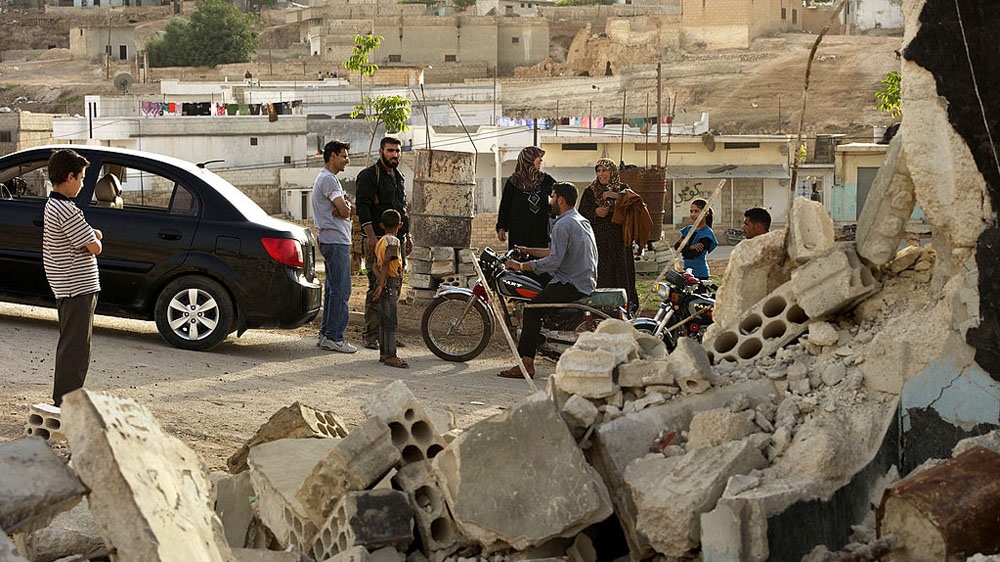
Lebanon’s infrastructure is creaking under the strain of the influx of 1.5 million Syrian refugees, a Scottish charity helping to provide vital support has warned. The labour market, housing, education, health services and even food security have been put at risk after the country’s population ballooned by 37% since the beginning of Syria’s civil war.
Through its partner Caritas Lebanon, the Scottish Catholic International Aid Fund (Sciaf) is providing funding to help stop the most vulnerable refugees and poorest Lebanese people from falling through the cracks. Sciaf director Alistair Dutton said: “Lebanon is still finishing rebuilding itself after 40 years of civil war. It was already a struggle and now things are completely overstretched.
“I think the Lebanese people have been incredibly impressive keeping the border open. They talk about one another as their brothers and sisters, they want them to come, and yet they are very frightened about what it could do to them economically.” Father Paul Karam, president of Caritas Lebanon, said Lebanon’s economy is approaching breaking point.

By catholicherald.co.uk
Three archbishops from Iraq and Syria were refused entry into the UK despite being invited by the country’s Syriac Orthodox Church. Archbishop Nicodemus Daoud Sharaf of Mosul, Archbishop of St Matthew’s Timothius Mousa Shamani and Archbishop Selwanos Boutros Alnemeh of Homs and Hama, were all refused UK visas which would have enabled them to attend the consecration of the UK’s first Syriac Orthodox Cathedral, last month.
Prince Charles, who has long championed the cause of persecuted Christians in the Middle East, was a guest of honour at the event at St Thomas Cathedral and a personal letter was read from the Queen. The bishops were told that they were refused entry because they did not have sufficient funds to support themselves and because they might not leave the UK.
Lord Alton of Liverpool, said he was incredulous when he heard the news. He said: “When the Syrian Orthodox Patriarch told me that these two bishops had been refused visas to come to the UK for the consecration of the new Syrian Orthodox cathedral I greeted it with incredulity and disbelief. Its a decision that brings shame on our country.
“These amazingly courageous bishops come from the Mosul region of Iraq – where Christians have been beheaded, crucified, raped and either forcibly converted or forced to flee as their possessions have been seized by radical Islamists. It adds insult to injury that the UK would refuse admission to men who pose no threat and whose community has suffered so much – especially when we still fail to bring to justice Jihadists who have committed genocide.”
In an editorial, the Daily Express condemned the decision, saying: “While we appreciate the necessity of efficient border controls, surely it can’t be beyond the wit of a Home Office pencil-pusher to realise that these men of the cloth were a special case?
“Last week we learned that 650,000 immigrants made their way to Britain, the highest level yet. And yet somehow, while letting all these in, officials contrived to ban these three wise men who have risked their lives for the Christian faith.

This article represents the opinion of the author and not khazen.org - It was published by The New York - By Robin Wright & interviewed by Robin Wright
Across Lebanon, Hezbollah runs special cemeteries—some with their own Facebook pages—for its fighters. I recently visited several of them, including the new Garden of Zeinab, named after the Prophet Muhammad’s granddaughter, where I counted a hundred and fifteen recent graves. Each was covered with a long white marble slab that detailed the fighter’s life; the headstone showed a large color photograph. Khodor Safa, nineteen, was in the front row. He died in September, “performing his jihadi duties,” the grave said. His slab was decorated with three votive candles, artificial white flowers, and a small Koran. Nearby, a large balloon offering “Congratulations”—for martyrdom—was attached to the grave of Ali Hussein Wehbi. Several families tended to other gravestones, dusting them off, laying flowers, or sitting alongside them in plastic chairs made available to visitors.
Some two thousand Hezbollah fighters have died and at least six thousand have been wounded since 2012, when the Shiite movement intervened in Syria’s civil war, on behalf of President Bashar al-Assad. That’s a staggering proportion, given the size of its deployment: Hezbollah keeps about five thousand fighters in Syria, with another three thousand deployed as needed, according to Lebanese officials and sources close to Hezbollah. Losses have been especially heavy since last summer, when the battle for Aleppo, once Syria’s commercial hub and largest city, escalated. Hezbollah had to recruit hard to replenish its ranks. The scuttlebutt in Beirut is that standards have been lowered, training expedited, and religious indoctrination made less rigorous.
Naim Qassem, a cleric who wears a white turban and has a trim beard to match, is Hezbollah’s second-in-command. From Hezbollah’s public-relations office, two fighters drove me, in a black Chevrolet S.U.V. with draperies on the windows, to meet Qassem in Beirut’s poor southern suburbs, the movement’s stronghold. The flags of Hezbollah and Lebanon were in a corner of the meeting room; a plate of dates and almonds was on a table. Attendants brought in rotating trays of tea, juice, and water as we talked. I asked Qassem if the intervention was worth the increasing costs, human and political.
“Since in the West you like to use metaphors and examples, I will give you one,” he said. “You have a house, and in this house there is a fighter, his wife, and children, and there is an enemy attacking this house. You have a garden and a wall, and a hundred metres away you have an olive grove. Is it better to protect the olive trees or the house? Near the olive grove the fighter will die. But if they get to the house, the house will be destroyed and everyone will die. We went to Syria, near the olive trees.” Qassem added, “We believe that as important as the losses or the sacrifices in Syria are, they are much less than if Syria had disintegrated.”

I fear I may have been the victim of persistent auditory and visual hallucinations throughout the election. After all, I’m pretty sure I heard Democratic presidential candidate Hillary Clinton promise– not once, but several times over the course of many months– that she would accept the results of the 2016 presidential election.
I then seem to recall that after her loss to Donald Trump, she followed through on that promise. “We must accept this result and then look to the future,” she said (or did she?). “Donald Trump is going to be our president. We owe him an open mind and the chance to lead.”
But I find that hard to reconcile with what I’ve seen since then: namely, Clinton and her campaign doing everything in their power to delegitimize Trump’s victory and work towards getting the results of the election overturned.
First, it was the quixotic attempt by Green Party candidate Jill Stein to challenge the results of the election in three states, which would’ve then handed Clinton the election. The Clinton campaign should have been content to let Stein defraud hapless supporters out of millions of dollars on behalf of a recount doomed to fail. But instead, the Clinton campaign announced that they were joining the effort.
Then there was the Clinton campaign’s statement Monday, announcing that they were backing efforts for members of the electoral college to receive intelligence briefings about the government’s conclusion that Russians hacked the DNC in an effort to elect Trump. “Electors have a solemn responsibility under the Constitution and we support their efforts to have their questions addressed,” said campaign chairman John Podesta. Again, the request comes at the same time that Clinton supporters are calling on electors to ignore their state’s results in order to stop Trump.
You can see why I’m questioning my own sanity: the Clinton campaign’s stance is all over the map. They aren’t contesting the election… but they do support a recount? They put out a statement saying they believe it’s mathematically impossible for them to win… but they think it’s worth spending millions for voters learn exactly how much they lost by?




Population Movements to Keserwan - The Khazens and The Maans
ما جاء عن الثورة في المقاطعة الكسروانية
ثورة أهالي كسروان على المشايخ الخوازنة وأسبابها
Origins of the "Prince of Maronite" Title
Growing diversity: the Khazin sheiks and the clergy in the first decades of the 18th century
Historical Members:
Barbar Beik El Khazen [English]
Patriach Toubia Kaiss El Khazen(Biography & Life Part1 Part2) (Arabic)
Patriach Youssef Dargham El Khazen (Cont'd)
Cheikh Bishara Jafal El Khazen
Patriarch Youssef Raji El Khazen
The Martyrs Cheikh Philippe & Cheikh Farid El Khazen
Cheikh Nawfal El Khazen (Consul De France)
Cheikh Hossun El Khazen (Consul De France)
Cheikh Abou-Nawfal El Khazen (Consul De France)
Cheikh Francis Abee Nader & his son Yousef
Cheikh Abou-Kanso El Khazen (Consul De France)
Cheikh Abou Nader El Khazen
Cheikh Chafic El Khazen
Cheikh Keserwan El Khazen
Cheikh Serhal El Khazen [English]
Cheikh Rafiq El Khazen [English]
Cheikh Hanna El Khazen
Cheikha Arzi El Khazen
Marie El Khazen