@Tyre – #LiveLoveLebanon
Topped with an enormous cross that lights up at night, the bell tower was inaugurated at the weekend after a decade of construction. Both the church and mosque are prominent features of the Beirut city center that is still being rebuilt from the civil war, and are located near the frontline that divided Christian east Beirut from Muslim west Beirut during the conflict.
Archbishop Paul Matar said the idea of building a bell tower at Saint George Cathedral was a dream since its construction in 1894. It was originally supposed to be 75 meters high, the same size as the tower at Rome's Basilica di Santa Maria Maggiore that inspired the cathedral's design. But instead, Matar said he shaved three meters off the design in what he described as a message of coexistence.
"When the mosque was built we were happy there would be a mosque and a church near each other. This is the slogan of Lebanon," he said in an interview at his offices in Beirut. "So therefore I wanted the tower's height to be at the same height as the mosque, so there is solidarity and harmony," he said. The cathedral belongs to Lebanon's Maronite Christian church, the biggest Christian community in the country.
After the guns fell silent, years were spent rebuilding the cathedral and dozens of other damaged or destroyed churches in Beirut, holding up the start of work on the tower, Matar said. In terms of their size, al-Amin mosque and tower have broken new ground for religious buildings in Beirut. Critics say both are out of scale with the city's other places of worship.

I’ve visited the Lebanon three times in the last quarter century. The first occasion, in 1993, followed the end of the 1975-1990 civil war, when Beirut was still in ruins and the old Mercedes cars picked their way gingerly around the rubble. By 2003, in times of uneasy peace, the SUVs had moved in; Beirut’s enduring zest for both business and pleasure was again evident (the country consumed three million bottles of wine in that year, almost half of it imported). My latest visit, a couple of weeks ago, concluded with hornet-like Ferraris noisily out-darting each other in the small hours of a Saturday morning as they zipped past the serenely restored Phoenicia hotel and the gleaming new office blocks nearby.
Khazen History


Historical Feature:
Churches and Monasteries of the Khazen family

St. Anthony of Padua Church in Ballouneh
Mar Abda Church in Bakaatit Kanaan
Saint Michael Church in Bkaatouta
Saint Therese Church in Qolayaat
Saint Simeon Stylites (مار سمعان العامودي) Church In Ajaltoun
Virgin Mary Church (سيدة المعونات) in Sheilé
Assumption of Mary Church in Ballouneh
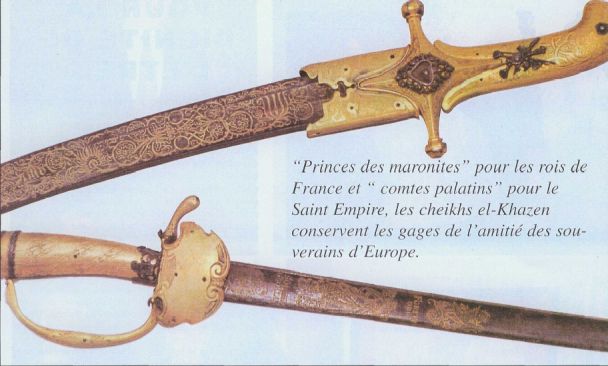
1 - The sword of the Maronite Prince
2 - LES KHAZEN CONSULS DE FRANCE
3 - LES MARONITES & LES KHAZEN
4 - LES MAAN & LES KHAZEN
5 - ORIGINE DE LA FAMILLE
Population Movements to Keserwan - The Khazens and The Maans
ما جاء عن الثورة في المقاطعة الكسروانية
ثورة أهالي كسروان على المشايخ الخوازنة وأسبابها
Origins of the "Prince of Maronite" Title
Growing diversity: the Khazin sheiks and the clergy in the first decades of the 18th century
Historical Members:
Barbar Beik El Khazen [English]
Patriach Toubia Kaiss El Khazen(Biography & Life Part1 Part2) (Arabic)
Patriach Youssef Dargham El Khazen (Cont'd)
Cheikh Bishara Jafal El Khazen
Patriarch Youssef Raji El Khazen
The Martyrs Cheikh Philippe & Cheikh Farid El Khazen
Cheikh Nawfal El Khazen (Consul De France)
Cheikh Hossun El Khazen (Consul De France)
Cheikh Abou-Nawfal El Khazen (Consul De France)
Cheikh Francis Abee Nader & his son Yousef
Cheikh Abou-Kanso El Khazen (Consul De France)
Cheikh Abou Nader El Khazen
Cheikh Chafic El Khazen
Cheikh Keserwan El Khazen
Cheikh Serhal El Khazen [English]
Cheikh Rafiq El Khazen [English]
Cheikh Hanna El Khazen
Cheikha Arzi El Khazen
Marie El Khazen