By Dennis Sadowski
Catholic News Service
BALTIMORE (CNS) -- Maronite Bishop Gregory J. Mansour called on the bishops of the United States to bring wider attention to the persecution of Christians in the Middle East to their parishes and political leaders. Addressing the fall general assembly of the U.S. Conference of Catholic Bishops Nov. 15, the Maronite leader said he hoped that the new four-year strategic plan adopted by the conference earlier in the day would incorporate a robust advocacy for religious freedom in the rest of the world.
"People do look to America and religious freedom is our greatest freedom and we ought to be able to export it ...The more we export it throughout the world, the happier our world will be," said Bishop Mansour, who heads the Eparchy of St. Maron in Brooklyn, New York. While referring to the acts of kidnapping, torture and killings by the Islamic State group in Iraq and Syria, Bishop Mansour said that attention must be given to attacks on the religious freedom of Christians throughout the Middle East.
He encouraged the bishops to take several steps to "increase our communion with our brothers and sisters there" including raising funds for the humanitarian work of organizations such as Catholic Relief Services, Aid to the Church in Need, the Catholic Near East Welfare Association and the Knights of Columbus. He also said the U.S. church could play a major role in developing a plan with Catholic bishops around the world to rebuild churches and restore the livelihoods of Christians in the region.
A third suggestion revolved around the possibility of organizing a program in which U.S. parishes match up with parishes to create bonds of unity and solidarity. Such an effort, he said, could be extended to Orthodox, Protestant and other Christian congregations. Bishop Mansour also called for advocacy with the U.S. Department of State to boost aid for refugees and displaced people who do not find their way to established camps but are taken in by individual families, hospitals and churches.

By AFP
Lebanon’s powerful Shiite movement Hezbollah today denied quotes in a Lebanese newspaper attributed to its second-in-command Sheikh Naim Qassem saying it had become “an army”.
“Hezbollah’s press bureau wishes to clarify that what was published Wednesday in the As-Safir newspaper did not appear in the text delivered by the deputy secretary-general of Hezbollah,” the group said in a statement.
The denial came after the newspaper quoted Qassem as saying in an address: “We now have a trained army and the Resistance (Hezbollah) does not need to rely on guerrilla tactics.” As-Safir’s article came after images shared widely on social media showed Hezbollah conducting a military parade in Syria, where it is fighting to bolster President Bashar al-Assad’s forces.
The photos of Hezbollah’s military parade allegedly featuring US-made armored vehicles in the Syrian city of Qusayr published by media close to the organization raised questions the US State Department had to confront during a daily press briefing on Tuesday.
The US equipment on the photos appear to be the M113 armored personnel carriers that have been in service since 1960 and “are extremely common in the region,” Trudeau noted. The State Department spokeswoman also noted that “the Lebanese military has publicly stated that the M113s depicted online in the Hezbollah military parade were never part of their equipment roster.”
The images provoked controversy in Lebanon, where the Shiite movement is a divisive force, as well as concern from Washington, which deems Hezbollah a “terrorist” group. The group said its denial also invalidated a previous “clarification” in which its press office told AFP that Qassem’s quote was in fact: “We have become more than a guerrilla movement but less than an army.”
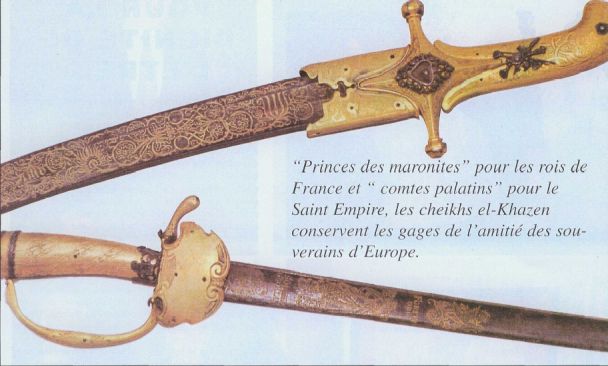
Population Movements to Keserwan - The Khazens and The Maans
ما جاء عن الثورة في المقاطعة الكسروانية
ثورة أهالي كسروان على المشايخ الخوازنة وأسبابها
Origins of the "Prince of Maronite" Title
Growing diversity: the Khazin sheiks and the clergy in the first decades of the 18th century
Historical Members:
Barbar Beik El Khazen [English]
Patriach Toubia Kaiss El Khazen(Biography & Life Part1 Part2) (Arabic)
Patriach Youssef Dargham El Khazen (Cont'd)
Cheikh Bishara Jafal El Khazen
Patriarch Youssef Raji El Khazen
The Martyrs Cheikh Philippe & Cheikh Farid El Khazen
Cheikh Nawfal El Khazen (Consul De France)
Cheikh Hossun El Khazen (Consul De France)
Cheikh Abou-Nawfal El Khazen (Consul De France)
Cheikh Francis Abee Nader & his son Yousef
Cheikh Abou-Kanso El Khazen (Consul De France)
Cheikh Abou Nader El Khazen
Cheikh Chafic El Khazen
Cheikh Keserwan El Khazen
Cheikh Serhal El Khazen [English]
Cheikh Rafiq El Khazen [English]
Cheikh Hanna El Khazen
Cheikha Arzi El Khazen
Marie El Khazen