
by Alexandra Talty, When the Hells Angels arrived in Beirut this spring, they showed up at the Four Seasons, located in the upscale neighborhood of Zaytouna Bay, whose clean and empty streets are sprinkled with high-end hotels and swim clubs. The unlikely setting was the site of the Harley-Davidson Owner’s Group (HOGs) annual general assembly. Given Harley-Davidson’s appeal to the upper middle class, the Four Seasons was not an unusual location for a HOGs event, but few expected the presence of the world’s most notorious motorcycle club.
Marwan Tarraf, the 47-year-old founder of Lebanon’s first Harley dealership, recognized the outlaws instantly because of their signifying tattoos and heavy chains. Approaching three “full-time” Angels, whom he assumed were Germans of Lebanese descent, he asked why they were there. When Angels expressed interest in opening a chapter in Beirut, he explained a few things about the country to them.
“It would be like going to Somalia and trying to start an outlaw group,” Tarraf tells me. “There are militias with 10,000 armed men in them. The rulers of those militias are basically ruling the country.”
From a spate of trendy repair shops to the plethora of biker bars, motorcycles are having their moment in Beirut. What began as a few men in the 1970s and 80s drawn to the abandon of the road and the freedom of a world outside of politics has now become a subculture in its own right.
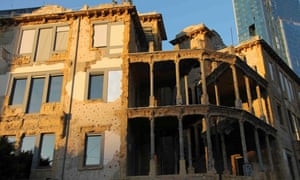
TheGuardian, by John Brunton - Despite being in a conflict zone, Beirut is somehow rising like a phoenix from the ashes. The past 12 months have seen the reopening of the Sursock Museum, a contemporary art gallery supervised by renowned French architect Jean-Michel Wilmotte, and the inauguration of Aishti, a cutting-edge art foundation that rivals the Punta della Dogana in Venice. In September, the doors will open to Beit Beirut (beitbeirut.org), a museum and arts centre dedicated to the memory of decades of conflict.
It’s housed in an imposing neo-Ottoman villa on the former “green line” between Muslim and Christian Beirut and served as a sniper bunker during the civil war. Its crumbling, half-destroyed state has been deliberately preserved, complete with bullet holes and shell pockmarks. Youssef Haidar, the architect of the project, says: “The new museum will hopefully be a step towards replacing the mass amnesia here for what has happened in the past, so that we can come to terms with our uncertain, but promising and wishful future.”
These new museums are just a small part of what is happening in the Lebanese capital. While the guidebooks talk up luxury hotels and haute couture in the restored downtown area, a host of bars and restaurants, local designer boutiques and art galleries are popping up in the more bohemian neighbourhoods of Mar Mikhael, Badaro and Gemmayzeh.

PARIS — The designer Karen Chekerdjian is known in her native Lebanon for modernist objects made with traditional materials and techniques. Now, two exhibitions in Paris — at the Institut du Monde Arabe and at the private Dutko Gallery — offer a close look at an artist who addresses the divide between art and function, and the wider gap between Western and Arab cultures.
The show at the Institut du Monde Arabe, “Respiration,” opened on May 30 and runs until Aug. 28. The exhibition at the Dutko with the same title closed on Sunday, with pieces offered for sale through August.
“The idea was to show the positive elements of the Arab world,” said Philippe Castro, the chief adviser to Jack Lang, the president of the institute and a former French culture minister. “Today, that can only be shown through Arab art. There is real creativity coming out of the Arab world, especially Lebanon. Given the geopolitical context, we felt it was important to give a voice to this narrative.”

Lebanese authorities said Monday that a bomb blast the previous day that damaged the headquarters of Lebanon's second biggest bank specifically targeted that financial institution. However, Interior Minister Nouhad Machnouk warned against casting blame before an investigation is finished.
Reuters, A powerful bomb has exploded outside the headquarters of the Lebanese Blom Bank in central Beirut, causing damage and injuries but no fatalities, the Interior Minister said.
Key points:
- Lebanon's banking sector has been at centre of US financial attack against Hezbollah
- Blom Bank has closed accounts belonging to members of Hezbollah
- Interior Ministry says its clear the bank itself was the target
There were no immediate claims of responsibility.
The Lebanese banking sector has been at the centre of an escalating crisis since the United States passed a law targeting the finances of Hezbollah The powerful Shiite Muslim group has launched verbal attacks on the central bank over the implementation of the act in Lebanon. Blom Bank is one of the banks that has closed accounts belonging to people suspected of links to Hezbollah.




Population Movements to Keserwan - The Khazens and The Maans
ما جاء عن الثورة في المقاطعة الكسروانية
ثورة أهالي كسروان على المشايخ الخوازنة وأسبابها
Origins of the "Prince of Maronite" Title
Growing diversity: the Khazin sheiks and the clergy in the first decades of the 18th century
Historical Members:
Barbar Beik El Khazen [English]
Patriach Toubia Kaiss El Khazen(Biography & Life Part1 Part2) (Arabic)
Patriach Youssef Dargham El Khazen (Cont'd)
Cheikh Bishara Jafal El Khazen
Patriarch Youssef Raji El Khazen
The Martyrs Cheikh Philippe & Cheikh Farid El Khazen
Cheikh Nawfal El Khazen (Consul De France)
Cheikh Hossun El Khazen (Consul De France)
Cheikh Abou-Nawfal El Khazen (Consul De France)
Cheikh Francis Abee Nader & his son Yousef
Cheikh Abou-Kanso El Khazen (Consul De France)
Cheikh Abou Nader El Khazen
Cheikh Chafic El Khazen
Cheikh Keserwan El Khazen
Cheikh Serhal El Khazen [English]
Cheikh Rafiq El Khazen [English]
Cheikh Hanna El Khazen
Cheikha Arzi El Khazen
Marie El Khazen