At the eastern edge of the rural Bekaa Valley, where the rocky hillsides are stippled with cherry trees, a generations-old kinship with Brazil has imbued two Lebanese villages with a Latino spirit. Lusi and Sultan Yaacoub are home to more than one thousand Brazilian nationals, many of whom speak Portuguese as fluently as they do Arabic.
The villages are deeply influenced by Brazilian culture, but this is not apparent at first glance. The Islamic call to prayer reverberates through the zigzag alleys five times a day and the pale stone houses resemble any others in the Bekaa Valley.
But residents mix Portuguese and Arabic in nearly every conversation and the local cuisine is unmistakably Brazilian. Though there are no official statistics, one municipal council representative said "99 percent" of the community are Brazilian nationals. Almost everyone said they had lived in South America at some point.

Don't believe everything you hear.
But, compounding my lack of awareness, the U.S. Department of State had put up a roadblock in the form of a Lebanon travel warning. And yet, it has warnings out for Mexico, Colombia, the Philippines, Turkey, Israel… the list goes on. I’ve been to Mexico three times this year. Why should Lebanon be any different? Furthermore, my sister said she was conscious of where was safe to venture and where was not. Attacks such as the one in November 2015 have specifically targeted Shiites in the Beirut suburbs, not tourist areas in the city. I admit that knowledge made me feel safer.

Beirut-Future Movement is still confounded by the severe loss it suffered in the municipal elections in Tripoli, the capital of the North and Lebanon’s second largest city.
Resigned Justice Minister Ashraf Rifi, who fought the elections alone against a coalition of political parties and Tripoli personalities, achieved an unexpected victory last month. The shock that Future suffered from compelled its leaders to launch a campaign of self-criticism to review the mistakes which it had committed and which had led to a drop in popular support for the movement – not just in northern Lebanon but also in the capital Beirut where the results of the municipal polls were disappointing.
Unlike many other political parties, Future, which is led by former Prime Minister Saad Hariri, has admitted to making mistakes. Interior Minister Nouhad al-Mashnouq, who is a party member, has called on the movement to learn from those blunders ahead of next year’s parliamentary elections. The changes in people’s temperament have not only affected the Future Movement but also the rest of the political parties from the March 8 and 14 rival camps.
While Hariri hasn’t directly commented on the results of the municipal elections, the ongoing activity at this residence in Beirut suggests that he has launched a mission to rectify the miscalculations.

“It also pushed the Future Movement to take the stances it had taken to get close to the Syrian line,” he said.The remarks drew criticism from Future MP Ammar Houri, who earlier Saturday told a local radio station that Machnouk's comments are "merely a personal analysis." He also called for bridging gaps within the movement and restructuring it.
But Machnouk stood by his remarks, writing on Twitter: "It is true I don't represent the Future [Movement] in what I [previously] said, but my words represent the hidden conscience of the movement."
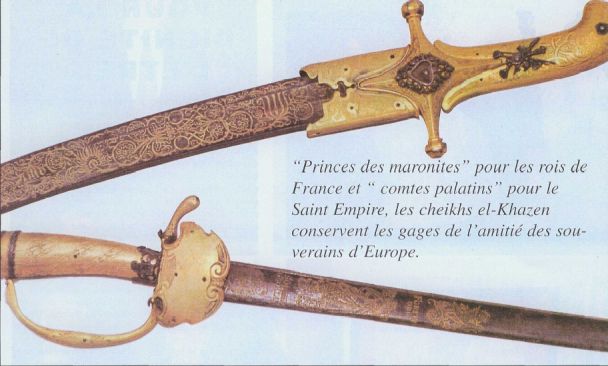
Population Movements to Keserwan - The Khazens and The Maans
ما جاء عن الثورة في المقاطعة الكسروانية
ثورة أهالي كسروان على المشايخ الخوازنة وأسبابها
Origins of the "Prince of Maronite" Title
Growing diversity: the Khazin sheiks and the clergy in the first decades of the 18th century
Historical Members:
Barbar Beik El Khazen [English]
Patriach Toubia Kaiss El Khazen(Biography & Life Part1 Part2) (Arabic)
Patriach Youssef Dargham El Khazen (Cont'd)
Cheikh Bishara Jafal El Khazen
Patriarch Youssef Raji El Khazen
The Martyrs Cheikh Philippe & Cheikh Farid El Khazen
Cheikh Nawfal El Khazen (Consul De France)
Cheikh Hossun El Khazen (Consul De France)
Cheikh Abou-Nawfal El Khazen (Consul De France)
Cheikh Francis Abee Nader & his son Yousef
Cheikh Abou-Kanso El Khazen (Consul De France)
Cheikh Abou Nader El Khazen
Cheikh Chafic El Khazen
Cheikh Keserwan El Khazen
Cheikh Serhal El Khazen [English]
Cheikh Rafiq El Khazen [English]
Cheikh Hanna El Khazen
Cheikha Arzi El Khazen
Marie El Khazen