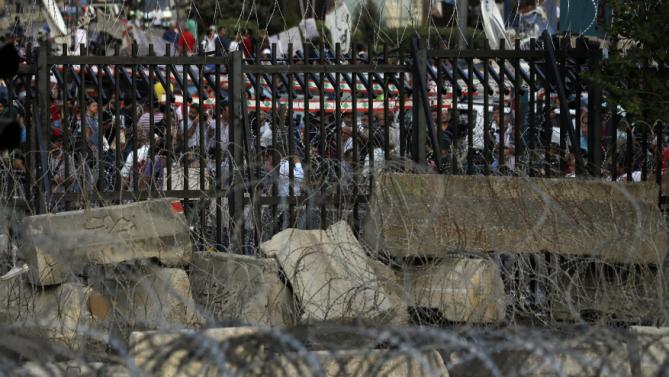
Lebanese anti-government protesters are seen behind metal barricades and other reinforcements that were installed as extra security measures around the Lebanese government building after anti-government protesters removed barbed wire barriers during recent demonstrations, in Beirut, Lebanon, Wednesday, Sept. 2, 2015. Lebanon's Interior Minister Nohad Machnouk warned protesters Wednesday against staging sit-ins or attacks targeting state institutions, saying such actions will no longer be tolerated. Machnouk spoke a day after a group of protesters marched into the Environment Ministry in Beirut, occupying a floor of the building in a drawn-out standoff with security forces that lasted nine hours. (AP Photo/Hassan Ammar)
Jamie Dettmer, voice of America
As anti-government street protests continue to rock Lebanon’s capital, the country’s political elites are scrambling to find a way to quell rising public anger over alleged government incompetence and graft.
In a crisis that has grown out of lacking municipal services, analysts say there are now signs that a group of lawmakers may be backing the idea of appointing Lebanese army chief Jean Kahwaji as president, a post that has not been filled for more than a year.
Tensions came to a boil over two weeks ago when security forces opened fire on thousands of mainly youthful demonstrators who took to the streets to protest, initially against uncollected garbage piling up in Beirut. The protests quickly spawned a movement with expanded demands that now threatens the fragile sectarian power-sharing arrangements underpinning Lebanon since the end of its 15-year-long civil war in 1990.

The Guardian
The Jeita Grotto lies around 11 miles north of Beirut, in the Nahr al-Kalb valley. It is an extraordinary site which could be one of the wonders of the world but remains an intimate experience. It comprises two interconnecting karstic limestone caves, spanning 5½ miles.
There is a huge concentration of crystallised formations and extraordinary stone shapes, such as stalactites, stalagmites, columns, ponds and draperies.

Euronews, Police in Lebanon moved in to clear protesters who had staged a sit-in at the environment ministry. Their action highlighting an ongoing rubbish disposal crisis was the latest in a series of protests at the country’s political paralysis.
The demonstrators called for the resignation of Environment Minister Mohamad Al Machnouk.
Police moved in after protesters ignored an ultimatum from the authorities to leave.
The head of Green Party, who witnessed what happened, sympathises with their cause but not their methods.“We deplore state institutions being taken hostage. We can’t accept people entering state buildings like this. Our cause is purely environmental,” Nada Zaarour said angrily.
Outside the building hundreds more demonstrated.

Al Bawaba
The cumulative value of outward greenfield foreign direct investment (FDI) from Lebanon totaled $7.2 billion between January 2003 and May 2015, according to figures released by fDi Markets.Lebanon was the seventh largest source of greenfield FDI in nominal terms among 19 Arab countries during the covered period, behind the UAE ($297.4 billion), Bahrain ($68.4 billion), Kuwait ($66.5 billion), Qatar ($47.5 billion), Saudi Arabia ($41.4 billion) and Egypt ($19.8 billion).




Population Movements to Keserwan - The Khazens and The Maans
ما جاء عن الثورة في المقاطعة الكسروانية
ثورة أهالي كسروان على المشايخ الخوازنة وأسبابها
Origins of the "Prince of Maronite" Title
Growing diversity: the Khazin sheiks and the clergy in the first decades of the 18th century
Historical Members:
Barbar Beik El Khazen [English]
Patriach Toubia Kaiss El Khazen(Biography & Life Part1 Part2) (Arabic)
Patriach Youssef Dargham El Khazen (Cont'd)
Cheikh Bishara Jafal El Khazen
Patriarch Youssef Raji El Khazen
The Martyrs Cheikh Philippe & Cheikh Farid El Khazen
Cheikh Nawfal El Khazen (Consul De France)
Cheikh Hossun El Khazen (Consul De France)
Cheikh Abou-Nawfal El Khazen (Consul De France)
Cheikh Francis Abee Nader & his son Yousef
Cheikh Abou-Kanso El Khazen (Consul De France)
Cheikh Abou Nader El Khazen
Cheikh Chafic El Khazen
Cheikh Keserwan El Khazen
Cheikh Serhal El Khazen [English]
Cheikh Rafiq El Khazen [English]
Cheikh Hanna El Khazen
Cheikha Arzi El Khazen
Marie El Khazen