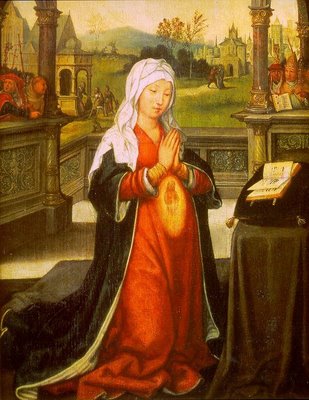
Behold, I was brought forth in iniquity, and in sin did my mother conceive me. Psalm 51:5
Many people today deny the reality of original sin. Modern thinkers claim that evolution disproves it. Some object to the idea of inheriting sin from our parents, while others simply deny sin itself. Some Christians claim that the Bible never teaches it and so on. However G.K. Chesterton while still an Anglican wrote in his book, Othrodoxy, that original sin is the most obvious of all Christian doctrines.
According to the Catechism of the Catholic Church (CCC), the doctrine of original sin is in some sense the reverse side of the doctrine of Redemption (CCC 389). In Genesis 2-3, God created man in His Image and established our first parents - Adam and Eve - in His friendship. This friendship included Sanctifying grace - the gift of holiness and eternal life. Adam, however, freely chose to live apart from God by trusting instead in the knowledge of good and evil - wanting to be like gods. Adam rejected God through disobedience and lost this friendship for himself and us. This loss is original sin (Gen 3:22ff; CCC 396-399).
The concept of original sin is not exclusively Catholic. Even though some Evangelical Protestants may shutter at the term, they readily acknowledge the fall of mankind and accept Jesus Christ as their Savior. Now without original sin, there would be no need for a Savior. The story of Adam and Eve found in the Book of Genesis is inherited from our Hebrew heritage (Gen. 3). Even the ancient Greek pagans had an inkling idea of original sin and imperfectly expressed it in the tale of "Pandora's Box."
Naked I came from my mother's womb, and naked shall I return; the Lord gave and the Lord has taken away; blessed be the name of the Lord! Job 1:21
Perhaps the most popular argument against the existence of God is based on the timeless question: "If there is truly a good God, then why is there evil in the world?" Typically the argument runs as: "Since our world is full of evil and a good, all-powerful God would never allow for evil, God therefore cannot exist." This argument involves more emotion (usually anger) than reason, but the question is important to consider. It can be phrased many ways and a few will be considered here.
First we must consider the meaning of evil. There are two kinds of evil: moral and physical. Moral evil is willful sin, while physical evil is natural harm. Examples of moral evil are murder, adultery, fornication, theft, sorcery, abortion...(Didache 2:2). Examples of physical evil are famine, illness, natural disasters and death. Now evil is not something in itself, but a lack of something that should be present, e.g. a lie lacks in truth. God does not create evil since it is not a thing to be created. Evil is an imperfection, lack or void in God's creation.
Focusing first on moral evil, the question could be phrased as: "If there is a good God, then why did He create morally evil people?" In considering this question, we must realize that God does not create evil people (Gen. 1:26-31). Being all-knowing, God does knowingly create people who will be sinners, but knowledge and control are different. God created us with the gift of free will - the ability to willfully choose Him or reject Him. We choose to sin - to reject God - through willful disobedience. This rejection is a void in God's plan for us.
Perhaps the only bright democratic light in this dark crisis surrounding Syria is the unexpected growth of a cross-border, large-scale and ultimately …
The Obama administration has maintained that its response to the Assad regime’s use of chemical weapons also reflects on the US posture …
Population Movements to Keserwan - The Khazens and The Maans
ما جاء عن الثورة في المقاطعة الكسروانية
ثورة أهالي كسروان على المشايخ الخوازنة وأسبابها
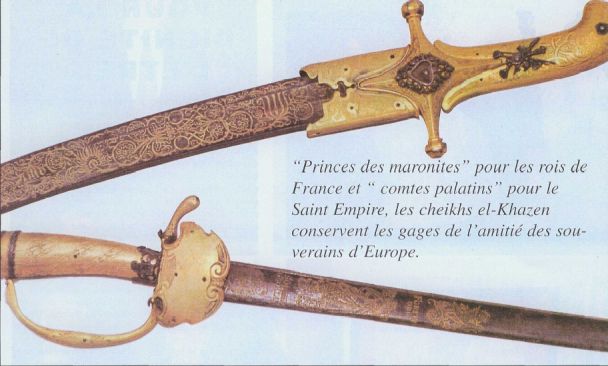
Origins of the "Prince of Maronite" Title
Growing diversity: the Khazin sheiks and the clergy in the first decades of the 18th century
Historical Members:
Barbar Beik El Khazen [English]
Patriach Toubia Kaiss El Khazen(Biography & Life Part1 Part2) (Arabic)
Patriach Youssef Dargham El Khazen (Cont'd)
Cheikh Bishara Jafal El Khazen
Patriarch Youssef Raji El Khazen
The Martyrs Cheikh Philippe & Cheikh Farid El Khazen
Cheikh Nawfal El Khazen (Consul De France)
Cheikh Hossun El Khazen (Consul De France)
Cheikh Abou-Nawfal El Khazen (Consul De France)
Cheikh Francis Abee Nader & his son Yousef
Cheikh Abou-Kanso El Khazen (Consul De France)
Cheikh Abou Nader El Khazen
Cheikh Chafic El Khazen
Cheikh Keserwan El Khazen
Cheikh Serhal El Khazen [English]
Cheikh Rafiq El Khazen [English]
Cheikh Hanna El Khazen
Cheikha Arzi El Khazen
Marie El Khazen