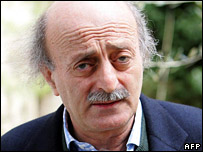
 Beirut, Asharq Al-Awsat- Walid Junblatt, head of the Democratic Gathering bloc in the Lebanese parliament, has continued his campaign against the Syrian regime, which he described as a "family regime." He rejected any settlement with this regime "after the assassinations and assassination attempts it carried out in Lebanon." Junblatt explained to Asharq al-Awsat some aspects of the telephone interview conducted with him by the newspaper Washington Post two days ago, considering that the talk that he called on the United States to invade Syria was a "hasty interpretation" of what he said, but at the same time he called for change in Syria "because the Syrian people deserve this." Junblatt said "the Syrian regime's filibustering with regard to an international trial and its exertion of pressure on some parties in Lebanon regarding this subject is aimed at escaping an international solution similar to the trial of Serbian leader Slobodan Milosivic.
He emphasized that "the only solution is this method (international trial), which will put both Syria and Lebanon at ease." Junblatt explained that the his talk that the Americans came to Iraq in the name of the majority does not mean that invasion is the solution, considering this "a hasty interpretation" of his talk, but he stressed that "one day there must be democratic change in Syria that will give the people the chance (to govern themselves). Until now the regime in Syria is a family regime and not the regime of the Ba'th Party or the regional command of that party. The Syrian people deserve a chance to govern themselves."
Asked whether he supported change, regardless of the method, Junblattt said: "Syria has capacities and efficiencies that can carry out a democratic and peaceful change." He strongly rejected the "blackmail" practiced by the Syria regime, which is telling the international community "either us or chaos." He cited several examples of the downfall of regimes similar to the Syrian regime, such as the collapse of the former USSR and its satellite regimes.
 5 January 2006, Lebanon: Latest charge against human rights lawyer Dr Muhamad Mugraby must be dropped and all harassment against him ceaseHuman rights lawyer Dr Muhamad Mugraby is due to appear before the Military Court in Beirut on 9 January charged with slandering the
KUWAIT CITY: Kuwait and other GCC states have decided to implement strict measures while recruiting workers from Lebanon and Syria and some other unidentified states, reports Al-Seyassah daily quoting reliable sources. This came in response to news reports which said the GCC states have received intelligence information from Beirut and Damascus that the Lebanese security forces had seized from unidentified persons 500 blank Lebanese passports during the withdrawal of Syrian forces from Lebanon on April 26, 2005. Security authorities in the GCC states believe unscrupulous persons might use such passports to carry out hostile actions against GCC states. |
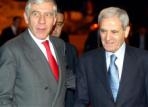 By Alaa Shahine, BEIRUT (Reuters) - Foreign Secretary Jack Straw urged Syria on Wednesday to cooperate with a U.N. inquiry into the assassination of former Lebanese Prime Minister Rafik al-Hariri and respect the sovereignty of its smaller neighbour.Straw made his comments as diplomats said Syria had agreed to allow U.N. investigators to interview its foreign minister over the killing but was still considering a request for a meeting with President Bashar al-Assad.
"We urge and continue to urge Syria to cooperate fully with those (U.N.) resolutions in particular with the United Nations investigation into the assassination," Straw said at a joint news conference with Lebanese Prime Minister Fouad Siniora."What we want to see is the government of Syria ... meeting its international obligations ... including the full recognition of the Lebanon as a sovereign, independent state."Straw was the most senior British official to visit Lebanon since Hariri's assassination in February.The killing sparked weeks of street protests that forced Syria to bow to international pressure to withdraw its troops from Lebanon in April, ending a three-decade military presence and years of political domination.




Population Movements to Keserwan - The Khazens and The Maans
ما جاء عن الثورة في المقاطعة الكسروانية
ثورة أهالي كسروان على المشايخ الخوازنة وأسبابها
Origins of the "Prince of Maronite" Title
Growing diversity: the Khazin sheiks and the clergy in the first decades of the 18th century
Historical Members:
Barbar Beik El Khazen [English]
Patriach Toubia Kaiss El Khazen(Biography & Life Part1 Part2) (Arabic)
Patriach Youssef Dargham El Khazen (Cont'd)
Cheikh Bishara Jafal El Khazen
Patriarch Youssef Raji El Khazen
The Martyrs Cheikh Philippe & Cheikh Farid El Khazen
Cheikh Nawfal El Khazen (Consul De France)
Cheikh Hossun El Khazen (Consul De France)
Cheikh Abou-Nawfal El Khazen (Consul De France)
Cheikh Francis Abee Nader & his son Yousef
Cheikh Abou-Kanso El Khazen (Consul De France)
Cheikh Abou Nader El Khazen
Cheikh Chafic El Khazen
Cheikh Keserwan El Khazen
Cheikh Serhal El Khazen [English]
Cheikh Rafiq El Khazen [English]
Cheikh Hanna El Khazen
Cheikha Arzi El Khazen
Marie El Khazen