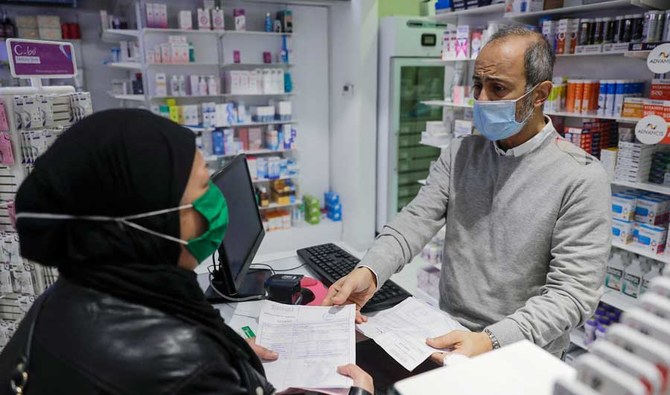
By NAJIA HOUSSARI -- arabnews.com -- BEIRUT: Doctors and pharmacists raised their voices on Monday in protest against the lack of medicine amid the deteriorating Lebanese currency crisis. In a growing spate of crises, shortages of fuel and medicine continued over the weekend. These materials, as well as the food supply, are imported. Food prices have soared. The price of sunflower oil has jumped by over 1,100 percent since the summer of 2019. The price of beef and rice has risen by 627 percent and 545 percent respectively over the same period. The price of eggs has shot up by 450 percent, with labneh (Strained yogurt) costs jumping 275 percent. Lebanese TV and social media circulated images of people screaming in the streets for milk and medicine, and electricity to save seriously ill children, who need oxygen devices in their homes.
Pharmacist Samer Soubra told Arab News: “People come to the pharmacy to ask for simple medicines, such as ear drops, but I do not have them.” Soubra added: “I think that importers have a stockpile of medicines, but they refrain from distributing them to put pressure on the Banque du Liban to continue subsidizing medicine. “There is no political decision yet to lift subsidies on medicine. It’s chaos. “I expect within 10 days the scream will rise because sick people will get worse without treatment.” Dr. Ismail Sukkarieh, a gastroenterologist, told Arab News: “A colleague of mine, a cardiologist, was not able to install a spring into a patient’s artery because there was no blood thinner and left him at the mercy of those who trade in people’s health.” Dr. Sukkarieh pointed out that “the most missing medicines are those related to arterial hypertension and blood clots, and we do not know the reason.” He asked: “How can I believe the importers who say that their drug stores are empty? It is a blackmail operation against the Banque du Liban.” Dr. Sukkarieh held “those concerned with resolving the drug crisis responsible for any harm to, or death of any patient.”
by middleeastmonitor.com — Lebanon is suffering from an acute shortage of imported drugs, particularly for chronic diseases, amid a lack of foreign …

By BARIA ALAMUDDIN -- arabnews.com -- If we don’t believe in change, we will never witness it. One of the principal obstacles to the revolutionary transformations required for Lebanon to survive as a state is the cynicism that perceives real change to be impossible — that corrupt elites will always cling to power, and nothing can be done about Hezbollah’s traitorous agenda. A symbolic blow was struck against this prevailing cynicism when Beirut’s Engineers Syndicate elected its general assembly. Despite supposed rivals such as the Free Patriotic Movement (FPM), the Future Movement, Hezbollah and the Lebanese Forces collaborating in a ploy to retain control, they were swept aside, as nearly 80 percent of votes went to “Syndicate Revolts” candidates affiliated with the uprising. If the votes of 60,000 engineers from across Lebanon’s social spectrum can be replicated in national elections, the mind boggles at the implications!
We have run out of adjectives to adequately describe the rage and despair felt by ordinary Lebanese. All conventional factions have suffered crippling blows to popularity and credibility, and President Aoun, Gebran Bassil and the FPM have found that the depths of public enmity and loathing they command are practically limitless. Even Hezbollah and Amal, whose grassroots support was always taken for granted, have encountered unprecedented disenchantment. In an indication of how far the political class has fallen, investigating judge Tariq Bitar announced legal proceedings last week against a range of politicians, including acting Prime Minister Hassan Diab, over last year’s Beirut port explosion. It is thus no surprise that established factions are keen to see elections delayed for as long as possible, despite intense popular demands that they should be held immediately, as possibly the only route out of the crisis. Experts fear there will be efforts to delay the vote beyond the constitutionally mandated date of May 2022.
حينها، يتمكّن اللبنانيون من إنتاج قيادات سياسية جديدة، فيما تشفى القيادات السياسية القديمة من “متلازمة الترهيب”، وحينها، أيضاً يستطيع لبنان أن ينأى …




Population Movements to Keserwan - The Khazens and The Maans
ما جاء عن الثورة في المقاطعة الكسروانية
ثورة أهالي كسروان على المشايخ الخوازنة وأسبابها
Origins of the "Prince of Maronite" Title
Growing diversity: the Khazin sheiks and the clergy in the first decades of the 18th century
Historical Members:
Barbar Beik El Khazen [English]
Patriach Toubia Kaiss El Khazen(Biography & Life Part1 Part2) (Arabic)
Patriach Youssef Dargham El Khazen (Cont'd)
Cheikh Bishara Jafal El Khazen
Patriarch Youssef Raji El Khazen
The Martyrs Cheikh Philippe & Cheikh Farid El Khazen
Cheikh Nawfal El Khazen (Consul De France)
Cheikh Hossun El Khazen (Consul De France)
Cheikh Abou-Nawfal El Khazen (Consul De France)
Cheikh Francis Abee Nader & his son Yousef
Cheikh Abou-Kanso El Khazen (Consul De France)
Cheikh Abou Nader El Khazen
Cheikh Chafic El Khazen
Cheikh Keserwan El Khazen
Cheikh Serhal El Khazen [English]
Cheikh Rafiq El Khazen [English]
Cheikh Hanna El Khazen
Cheikha Arzi El Khazen
Marie El Khazen