
by HAFED AL-GHWELL -- arabnews.com -- Despite external and domestic pressure to form a new Lebanese government, endless jockeying for key ministerial posts continues while the country remains on a slow path to implosion. If it is not the financial crisis that wiped out savings, it is an economic crisis that has decimated jobs and the viability of most small businesses. If it were not the Aug. 4 port blast that made thousands of homes uninhabitable and shut down hundreds of businesses, it is a pandemic that has shattered mobility and overwhelmed a dismal public health system. If it is not the governance crisis that has eroded confidence in political leadership, it is worsening sectarian fragmentation justifying a defense of the status quo instead of efforts to secure a future all Lebanese can share. All these issues affect every Lebanese regardless of age, sect, religion, status, political affiliation, level of education or any other demographic division. Yet surprisingly, there is little momentum and even less political will to find solutions.
Decades of close French-Lebanese ties have placed Paris at the forefront of developments in Lebanon’s political leadership. Virtual donor meetings are reminiscent of the post-civil war aid conferences; now, as then, funds will vanish, without any reforms against a backdrop of further civil unrest. Granted, French President Emmanuel Macron’s carrot of funding in exchange for reform does indicate wariness of a repeat of the 1990s post-civil war reconstruction fiasco if the same faces remain in power. Unfortunately, the changes Macron seeks are doomed to fail given the glacial pace of Lebanese governance crippled by incessant political wrangling. No carrot or stick can guarantee the Lebanese political elite will implement the desperately needed reforms in governance, finance, politics and the economy. Demanding the formation of a government of independent technocrats, however, necessary, will simply exacerbate gridlock and political wrangling. The same applies to calls for judiciary reforms and a commitment to elections within a year under new election laws. They run counter to how Lebanon’s political “old guard” have consistently tied their legitimacy and fortunes to how much political power they can wield in defense of their own interests.

by Washington – Elie Youssef -- aawsat.com/ -- American sources revealed that they had from the start believed that the border negotiations between Lebanon and Israel would not reach any tangible results. The sources, which were in contact with the State Department team that sponsored the negotiations, said that the talks were “hastily” arranged. They revealed that they had urged the team against being hasty in launching the negotiations months before the American election. The team had sought a “political victory” in beginning the marine border talks, but the Trump administration’s defeat in the election means that it will not be employed for any political gain. Moreover, the sources said the team failed in understanding the “mentality” of the Lebanese side of the negotiations. They explained that they underestimated the reasons that could motivate the Lebanese to “accept any settlement that could help them resolve their crippling economic crisis.”
Indeed, the reality on the ground showed that the ruling Lebanese class does not care in the slightest about easing the crisis and is happy to leave the country in the hands of an armed group – Hezbollah – that is following a non-Lebanese agenda. “It was evident that the Lebanese negotiators will not offer a free gift” to Trump when he leaves office, said the sources. They would rather offer it to Joe Biden’s administration amid Iran’s hopes that it could salvage the 2015 nuclear deal or end US economic sanctions against it, they continued.
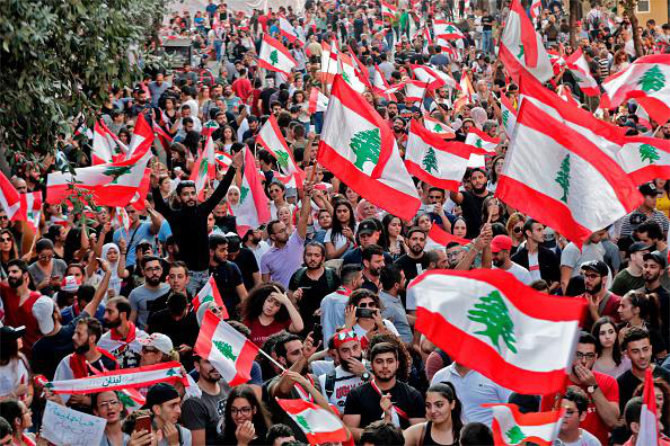
By NAJIA HOUSSARI - arabnews.com -- BEIRUT: Lebanese Army troops were deployed near the home of parliamentary Speaker Nabih Berri on Saturday as protesters targeted people they believe are a “privileged elite.” Groups of demonstrators have followed political and economic leaders into restaurants and cafes to protest and accuse them of theft. They include former minister Adnan Kassar, the wife of the governor of the Banque du Liban, Nada Riad Salameh, and the secretary-general of the Future Movement, Ahmad Hariri. There was further anger on Saturday when video footage emerged of bodyguards for Hariri, cousin of Prime Minister-designate Saad Hariri, apparently attacking protesters inside an upmarket Italian restaurant in Beirut. Twitter user Usamaibn Munqid said: “The whole Lebanese political elite needs to be jailed whether it is Hariri, Aoun, Berri and many more.”
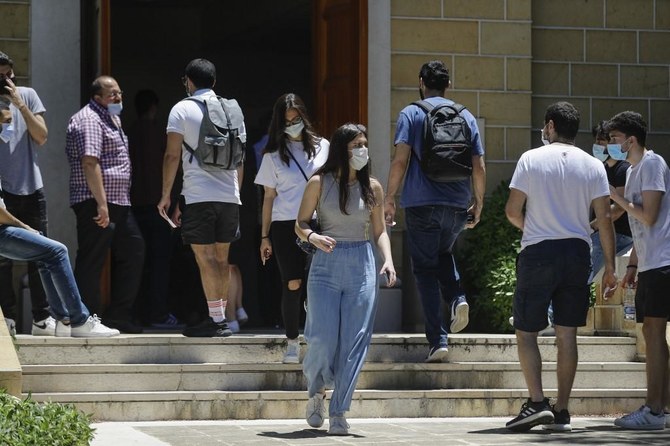
by NAJIA HOUSSARI -- arabnews -- BEIRUT: Student movements at Lebanese universities and independent civic groups are reorganizing themselves with the goal of changing the ruling authority in Lebanon. Secular and independent clubs affiliated with the Mada network in Lebanon’s universities launched the “Declaration of Lebanese Students” on Saturday, in light of “the unprecedented risks threatening students, especially the crisis of the dollarization of tuition fees.” That dollarization has seen tuition fees start to massively increase at institutions across the country, following decisions to adopt the Lebanese Central Bank’s new exchange rate of 3,900 Lebanese pounds to the dollar. The American University of Beirut (AUB) saw its tuition costs increase 160 percent alone as a result. Lebanon has been in the grip of a currency crisis ever since the pound, previously pegged at 1,500 to the dollar, began to devalue rapidly as a consequence of political and economic mismanagement, blamed by many on the country’s elite. Student elections at a number of private universities in Lebanon resulted in a series of unprecedented victories for independents, especially secular representatives, on representative councils this year, after decades of being held by students from the country’s ruling parties.
The representative of the Secular Club at Saint Joseph University, student Charbel Shaya, said: “The independent, unified student movement has turned the tables after student representation was confiscated by parties in power. I believe that networking between us has led to achievement, and the time has come to fight the battle of refusing the dollarization of tuition fees as a prelude to rejecting what the parties committed against us as people.” Qamar Suleiman, a medical student at the University of Balamand, said: “Political awareness in universities is one of the means for change. Politics controls the corners of our lives, and engaging in student elections is a step toward creating independent secular groups that believe in social justice to improve student life and protect their rights. “We want to impose a truly progressive and clear political discourse that establishes grounds for individuals capable of practicing political life in a sound manner after graduation,” he added. “The parties in power make us pay for things that we did not commit, but rather they did.” Manal Suleiman, an engineering student at Notre Dame University, said: “Universities are the ones that should fear their students, just as governments should fear their people. Students today are reclaiming their role through independent student movements that aim for change.” And Jad Al-Hani, from the AUB, said: “The retreat of the (main) parties in the student elections at the university was a declaration of defeat. The first battle we will fight is the battle against dollarizing tuition fees. We are headed toward an escalation in the coming days.”




Population Movements to Keserwan - The Khazens and The Maans
ما جاء عن الثورة في المقاطعة الكسروانية
ثورة أهالي كسروان على المشايخ الخوازنة وأسبابها
Origins of the "Prince of Maronite" Title
Growing diversity: the Khazin sheiks and the clergy in the first decades of the 18th century
Historical Members:
Barbar Beik El Khazen [English]
Patriach Toubia Kaiss El Khazen(Biography & Life Part1 Part2) (Arabic)
Patriach Youssef Dargham El Khazen (Cont'd)
Cheikh Bishara Jafal El Khazen
Patriarch Youssef Raji El Khazen
The Martyrs Cheikh Philippe & Cheikh Farid El Khazen
Cheikh Nawfal El Khazen (Consul De France)
Cheikh Hossun El Khazen (Consul De France)
Cheikh Abou-Nawfal El Khazen (Consul De France)
Cheikh Francis Abee Nader & his son Yousef
Cheikh Abou-Kanso El Khazen (Consul De France)
Cheikh Abou Nader El Khazen
Cheikh Chafic El Khazen
Cheikh Keserwan El Khazen
Cheikh Serhal El Khazen [English]
Cheikh Rafiq El Khazen [English]
Cheikh Hanna El Khazen
Cheikha Arzi El Khazen
Marie El Khazen