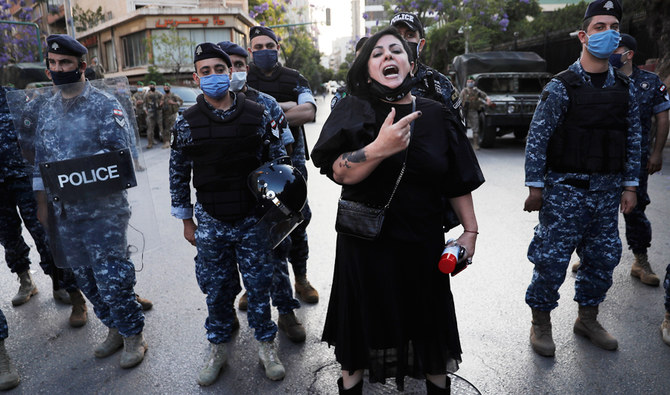
by arabnews.com -- NAJIA HOUSSARI -- BEIRUT: An increasing number of activists in Lebanon are being arrested amid mounting criticism on social media of the government’s handling of the country’s worsening economy. In the latest such incident, activist Michel Chamoun was arrested on Thursday by state security for writing comments on social media that were deemed humiliating to President Michel Aoun. Dozens of protesters blocked the main road linking Beirut to Jbeil and Tripoli, demanding the immediate release of Chamoun and chanting slogans and insults against Aoun and Free Patriotic Movement leader Gebran Bassil. This led to clashes with security forces before army commandos and military police intervened. An army officer and a number of protesters were injured.
On Thursday evening, Chamoun was released after Melhem Khalaf, head of the Beirut Bar Association, intervened. Chamoun said he was released due to pressure from the protesters, and prior to his release he had “to sign a pledge not to insult the president of the republic anymore.” But he insisted: “I will criticize anyone I want as we live in a democratic republic.” After his release, Chamoun headed with Khalaf to join the protesters on Jounieh highway. Then the protesters opened the road for traffic. Lawyer Hassan Bazzi, a member of the Lawyers’ Committee to Defend Protesters in Lebanon, told Arab News: “Freedom of expression in Lebanon is sacred, as stressed by the Bar Association. It’s protected by the Lebanese constitution.” But, he said, “what activists on social media don’t know is that there are limits to criticism, and the law forbids insulting the president of the republic.” Bazzi added: “People can no longer stand the pressure they live under due to the dire financial and economic situation, which has made them lose faith in the country.” It is “unacceptable for the political authority to try to intimidate activists, or to threaten them with arrest unless they delete their comments,” he said. “This is something to be done only upon a ruling by a judge upon the request of the public prosecutor. However, all security agencies try to intimidate opponents.”

by NAJIA HOUSSARI -- arabnews.com -- BEIRUT: The US Ambassador to Lebanon Dorothy Shea met Lebanese Foreign Minister Nassif Hitti on Wednesday, as the country weighed the implications of the US Government’s Caesar Act, targeting people and businesses doing business with the regime of Syrian President Bashar Assad, for Lebanese companies operating in Syria. Rumors have circulated in Lebanon regarding an appendix in the Caesar Act holding a list of Lebanese entities set to be penalized for cooperating with the Syrian regime. It is unclear how the act will affect coordination between the Lebanese and Syrian militaries, as the two states share a border extending to nearly 375 kilometers. The future role of the Lebanese-Syrian Supreme Council, which coordinates relations between the governments of the two countries, is also unclear.
Hezbollah leader Hassan Nasrallah had called on the Lebanese people “not to submit to this act that aims to starve Lebanon and Syria.” In a speech, he said: “The Caesar Act harms Lebanon perhaps more than it harms Syria. Syria is (our) only passage toward the world, and what the Americans are trying to imply is that our only inland passage is Israel.” Nasrallah added: “To those who will make us choose between killing with weapons or starvation, we will hold our weapons in our hands, we will not starve, and we will kill them.” A Lebanese legal expert told Arab News that the act needed to be more closely examined to know for certain the effect it would have on Lebanon, but added that it did mean the US could impose sanctions. “The issue of sovereignty is not on the table and the decision-maker is the implementer. We have to look at this matter in real terms,” the expert said on condition of anonymity.

by finance.yahoo.com -- Leigh Cuen -- Cryptocurrency does not appear to be a significant trend in terror financing in the Middle East, but a new round of U.S. sanctions aimed at Syria may tip the scales in favor of experimentation. On Wednesday, Hezbollah leader Hassan Nasrallah said U.S. sanctions against his Syrian ally President Bashar al-Assad are an attempt to “starve” both Syria and Lebanon. Local black market activity related to global assets like dollars is surging, with Lebanese banks failing to meet that demand. “The Americans are pressuring the Bank of Lebanon to prevent it from putting enough dollars into the market,” Nasrallah said. To date, evidence suggests terror groups like Hamas are using only small amounts of bitcoin, at volumes far smaller than what the civilian population in the region is using. In fact, the analytics firm Chainalysis estimates most campaigns by terror groups like ISIS have raised “less than $10,000” worth of cryptocurrency, less than a single Palestinian trader typically sells in a week. That said, among the most prominent terrorist organizations in 2020, Hezbollah in southern Lebanon is arguably the most likely to benefit from using crypto. (Hezbollah is classified as a terror group by the U.S. and 17 other nations. A number of EU countries do not classify Hezbollah as a terror group.)
Randa Slim, the Lebanese-American director of diplomacy programs at the Middle East Institute think tank in Washington D.C., said she believes Hezbollah is interested in bitcoin. “No other party in Lebanon has the kind of access to financial resources nor the military infrastructure to be able to maintain its role. We’re going to see Hezbollah’s dominance over the political life of the country, and increasingly over the economic life of the country,” Slim said, referring to Lebanon’s current economic crisis. Hezbollah’s power may be growing, but bitcoin doesn’t appear to be playing a significant role in that so far. Slim said she hasn’t seen any “focus in Hezbollah-affiliated media and publications on cryptocurrency” and “the money from Iran mostly comes in cash.” Likewise, an anonymous Lebanese bitcoiner said he hasn’t seen or heard anything related to both bitcoin and Hezbollah.
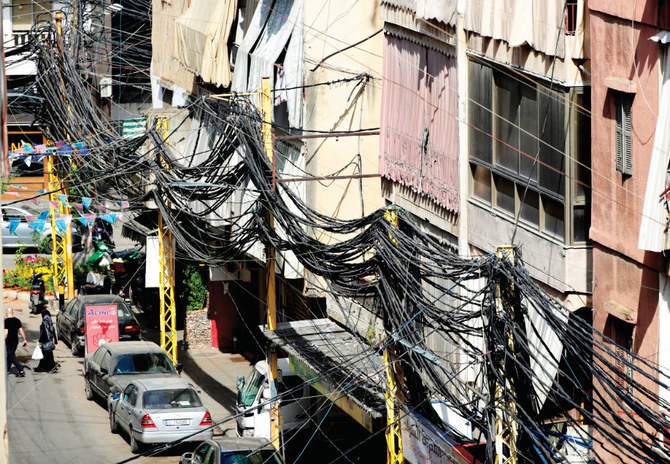
By LEILA HATOUM -- arabnews.com -- BEIRUT: It is two in the afternoon and Verdun Street, one of Beirut’s upscale neighborhoods, is doubly lit up — by the midday sun and by street lights. “Look at the street lamps shining brightly in the middle of the day while most areas suffer from power outages,” Fatima Hachem, 29, a local resident, told Arab News. The incongruity of the scene — street lights kept unnecessarily on during daylight hours — is unmistakable in a country where residents get between three and 12 hours of electricity a day depending on the locality. Such systemic inefficiencies are all the more glaring at a time when Lebanon is seeking a $10 billion loan from the International Monetary Fund (IMF).
Given its disproportionate contribution to Lebanon’s public debt, the urgency of an overhaul of the electricity sector cannot be overstated. “Electricity reform is one of the key steps to re-equilibrate the economy,” an IMF official, speaking on condition of anonymity, told Arab News. “We will see it as an emblematic and major improvement.” The official added that, without reforms, “there would be no loan program.” As a first step, the IMF has asked Lebanon to audit its national electricity company, known as Electricite du Liban (EDL). Loss estimates should note “not only the changes in price of fuel oil, but also the change in the exchange rate,” it said. In recent months, the purchasing power of the Lebanese population has eroded, with the currency losing two-thirds of its value, dropping to LBP4,000 from LBP1,515 to the US dollar. “At the moment, the Lebanese government links increasing tariffs on electricity to the increase in power generation, while the IMF believes that those two should not be tied. Also, eliminating electricity subsidies is the most significant potential expenditure saving,” the IMF official said. To generate fiscal savings, it is imperative the Lebanese government increases tariffs as soon as possible, they said. However, this would mean raising electricity charges for most of the population, who are already under economic pressure as a result of the COVID-19 pandemic.




Population Movements to Keserwan - The Khazens and The Maans
ما جاء عن الثورة في المقاطعة الكسروانية
ثورة أهالي كسروان على المشايخ الخوازنة وأسبابها
Origins of the "Prince of Maronite" Title
Growing diversity: the Khazin sheiks and the clergy in the first decades of the 18th century
Historical Members:
Barbar Beik El Khazen [English]
Patriach Toubia Kaiss El Khazen(Biography & Life Part1 Part2) (Arabic)
Patriach Youssef Dargham El Khazen (Cont'd)
Cheikh Bishara Jafal El Khazen
Patriarch Youssef Raji El Khazen
The Martyrs Cheikh Philippe & Cheikh Farid El Khazen
Cheikh Nawfal El Khazen (Consul De France)
Cheikh Hossun El Khazen (Consul De France)
Cheikh Abou-Nawfal El Khazen (Consul De France)
Cheikh Francis Abee Nader & his son Yousef
Cheikh Abou-Kanso El Khazen (Consul De France)
Cheikh Abou Nader El Khazen
Cheikh Chafic El Khazen
Cheikh Keserwan El Khazen
Cheikh Serhal El Khazen [English]
Cheikh Rafiq El Khazen [English]
Cheikh Hanna El Khazen
Cheikha Arzi El Khazen
Marie El Khazen