by devdiscourse.com -- The Lebanese central bank aims to bring down the price of the U.S. dollar progressively with the agreement of licensed foreign currency dealers to help stabilise prices as much as it can, governor Riad Salameh told Reuters on Tuesday. President Michel Aoun said on Friday the central bank would supply the currency market with dollars from Monday as part of an effort to prop up the Lebanese pound, which has shed more than 60% of its value since October. Responding to a written question from Reuters, Salameh did not say if the central bank had started supplying the market with dollars. "Our aim is with the agreement of the licensed exchangers to bring the price of the dollar progressively lower, contributing as much as we can to stabilise the prices," he wrote. "This approach is necessary in a cash economy," he said. "We hope that reforms will be enacted ... to bring confidence."
Lebanon is grappling with an acute financial crisis seen as the biggest threat to its stability since the 1975-90 civil war. Its currency has fallen amid a hard currency liquidity crunch, which led the state to default on its sovereign debt in March. Dollars continue to trade on a parallel market despite official efforts to regulate dealing. Licensed foreign currency dealers agreed with the government earlier this month to work to gradually reduce the exchange rate to 3,200 pounds per dollar. On the parallel market on Wednesday, one dealer said he bought dollars at a rate of 4,700 and another at 4,800. The official rates on offer at licensed dealers were 3,860/3,910. Queues formed outside some licensed dealers, where several customers said they had bought a maximum of $200 at the 3,910 rate. Lebanon still applies an official peg of 1,507.5 pounds to the dollar for imports of fuel, medicine and wheat.
by arabnews.com -- NAJIA HOUSSARI -- BEIRUT: The UN in Lebanon has denied it has any intention of stopping its operations or evacuating its personnel from the country. It said that “the support provided by the UN through its activities and operations is continuing and increasing at a faster rate, regardless of the challenges that resulted from the pandemic of the new coronavirus.” Stories circulated on social media at the end of last week about the intention of the UN to withdraw from Lebanon — and that the international organization had told its foreign employees to prepare their passports in preparation for leaving the country. However, the UN in Lebanon described this information as “speculation” in a statement issued on Monday
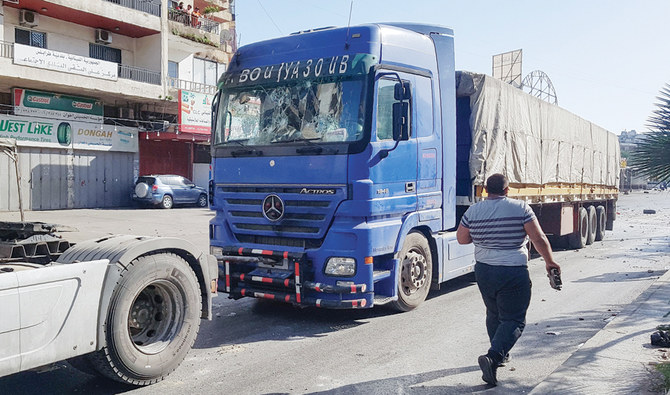
For the first time since 2011, two World Food Programme (WFP) trucks carrying supplies were seized last Tuesday while crossing the northern coastal road toward Syrian territory. The young men who intercepted the trucks justified their actions by saying that the Lebanese were hungry and that some people in the Lebanese state were “smuggling food items at the expense of the Lebanese people to the Syrian regime.” The two trucks are still parked at the Port of Tripoli after Lebanese customs teams worked to protect them and return them to the port. Malak Jaafar, the WFP spokesperson in Lebanon, told Arab News: “There is no decision yet to move the organization’s convoy from Lebanon to Syria. The convoy includes 39 trucks loaded with foodstuffs to be sent to the organization’s warehouses in Homs, Syria. There are 37 trucks at Beirut port and two trucks at Tripoli port waiting for security clearance so that we can move the convoy toward Syrian territory and there are contacts with Lebanese officials to secure this protection.”

by thenational.ae -- The Lebanese army on Monday said it arrested dozens of suspects for vandalism after days of protests against a plunging local currency and the worst economic crisis in decades. Hundreds of protesters clashed with security troops at the weekend across the nation after days of rallies against a ruling class considered to be corrupt and impotent in tackling the worsening crisis. "The total number of arrests made by military intelligence between June 11 and 15 in different Lebanese regions is 36 people for acts of vandalism", damaging public and private property and attacking troops, the army said. The army launched raids in the northern port of Tripoli, Lebanon's second city, the official National News Agency reported. For three nights, young men attacked banks and shops and threw rocks at security troops in Tripoli, who responded with rubber bullets and tear gas. Medical services reported dozens of wounded.
Protesters were angered by a steep drop in the Lebanese pound, the rocketing price of food and what they perceive to be the government's failure to rein in the country's economic collapse. Relative calm returned on Sunday evening, with protesters holding a peaceful rally in the capital Beirut, while dozens marched to a central square in Tripoli. President Michel Aoun on Monday discussed the protests with the country's top security body, including ministers and military officials. "Such acts of vandalism will not be allowed after today," Mr Aoun said after the meeting of the Higher Defence Council. He called for "a wave of arrests, including of those who planned and carried out" such acts, and ordered authorities to increase "pre-emptive" operations to prevent further violence.
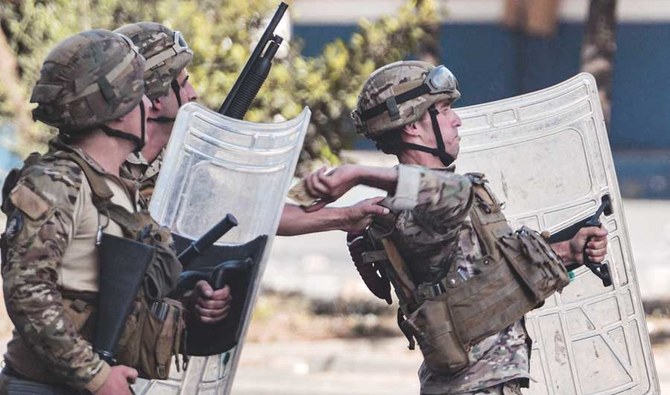
by arabnews.com -- NAJIA HOUSSARI -- BEIRUT: Prime Minister Hassan Diab responded to his government’s political opponents in a tough speech addressing the Lebanese on Saturday night. As the protests continued and clashes between demonstrators and security forces in the city of Tripoli caused injuries, Diab spoke of “a programmed campaign organized by parties known by name and method of thinking that are not deterred from using any method to shatter the image of others.” Diab said that his government “has a high percentage of citizens’ confidence, which has disturbed many of those who bet on its failure, and some have tried to invest without any national deterrent by pumping lies and rumors, to prevent the government from removing the rubble under which the secrets of corruption disappear.” “Know that we have found many keys from that black structure. There is a lot to discover soon with documents and facts, and this structure will fall on those who hide in its corners,” he said. Diab said that “the coup attempt fell and all secret and public meetings and orders of internal and joint operations to stop discovering of corruption failed too.” “They revealed that people’s lives do not concern them and that their aim is to protect themselves.” Diab said that “the state is not bankrupt, there is financial stumbling, but the country is rich in citizens and its resources.”
Addressing the people, he said: “Your rights are reserved with the banks and the Bank of Lebanon and the state is the guarantor.” “There are those who want to go back to before Oct. 17 (the date of protests against the Saad Hariri government) and turn the clock back.” Diab spoke of “political barriers that stand in the way of his government, but change is definitely coming.” He said that “the state oppresses its children and youth and deprives them of their rights.” “When the state weakens, the gangs are strengthened, and when the state retreats, small states appear, and when stability shakes, civil peace collapses, and when accountability stops, corruption prevails,” he said. “The judiciary does not need to be instructed to move. We insist that the judiciary be independent and impartial. The confrontation is difficult, and I call on the Lebanese to be more patient because the battle with corruption is very fierce, because the corrupt will not give up so easily,” the prime minister said.
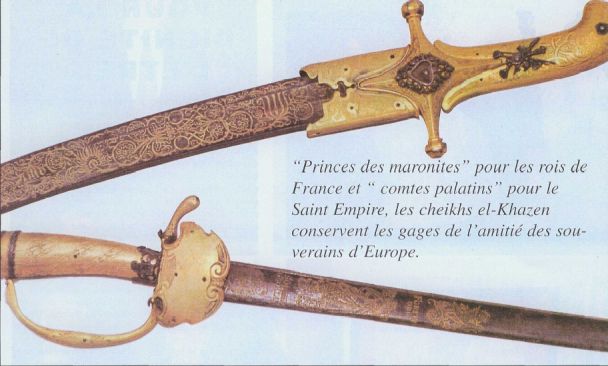
Population Movements to Keserwan - The Khazens and The Maans
ما جاء عن الثورة في المقاطعة الكسروانية
ثورة أهالي كسروان على المشايخ الخوازنة وأسبابها
Origins of the "Prince of Maronite" Title
Growing diversity: the Khazin sheiks and the clergy in the first decades of the 18th century
Historical Members:
Barbar Beik El Khazen [English]
Patriach Toubia Kaiss El Khazen(Biography & Life Part1 Part2) (Arabic)
Patriach Youssef Dargham El Khazen (Cont'd)
Cheikh Bishara Jafal El Khazen
Patriarch Youssef Raji El Khazen
The Martyrs Cheikh Philippe & Cheikh Farid El Khazen
Cheikh Nawfal El Khazen (Consul De France)
Cheikh Hossun El Khazen (Consul De France)
Cheikh Abou-Nawfal El Khazen (Consul De France)
Cheikh Francis Abee Nader & his son Yousef
Cheikh Abou-Kanso El Khazen (Consul De France)
Cheikh Abou Nader El Khazen
Cheikh Chafic El Khazen
Cheikh Keserwan El Khazen
Cheikh Serhal El Khazen [English]
Cheikh Rafiq El Khazen [English]
Cheikh Hanna El Khazen
Cheikha Arzi El Khazen
Marie El Khazen