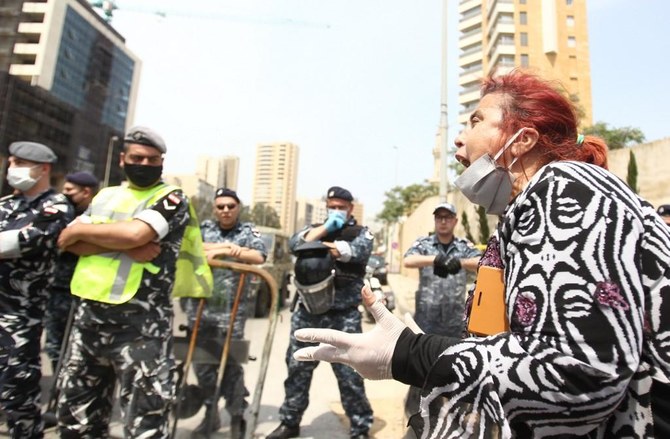
by arabnews.com -- NAJIA HOUSSARI -- BEIRUT: The Lebanese Council of Ministers has extended the period of general mobilization in the country to July 5 following a recommendation by the Lebanese Supreme Council of Defense. The decision comes two days before the demonstration planned by the civil movement on Saturday, resuming anti-government protests that erupted in the country on Oct. 17. “We do not fear the demonstrators, rather we fear for their health, and we are keen to protect the demonstration so that it would achieve its goals,” said Minister of Information Manal Abdel Samad after a Cabinet session on Thursday.
In a statement, the Lebanese Supreme Council of Defense said: “The military and security services should be firm in deterring violations of the general mobilization in order to prevent the proliferation of the coronavirus, and to cooperate with civil society and local authorities to achieve this objective.” General mobilization conditions include wearing masks, maintaining social distancing and avoiding overcrowding. During the meeting of the Supreme Council of Defense, Prime Minister Hassan Diab said: “The risk remains high, considering that cases of COVID-19 are still being recorded. “The precautionary and preventive measures are still necessary to avoid a second wave of the pandemic, which could be harder than the first wave. “The government understands the suffering of the people due to the social situation, but there is fear that some groups might take advantage of this for their political objectives in cutting roads and dismantling the country, shutting down enterprises, and obstructing people’s businesses, that could result in employees losing their jobs,” he added.

by realclearmarkets.com -- By John Tamny -- “I’d rather be an owner of something besides money that can disappear at any time in the bank.” That’s what Robert T. recently communicated to Wall Street Journal reporters Dion Nissenbaum and Nazih Osseiran. T. is a Beirut-based businessman who, according to Nissenbaum and Osseiran, recently “drained his family bank accounts to buy a ski chalet, an apartment in Dubai and two places in one of Beirut’s upscale neighborhoods.” With Beirut’s economy in serious trouble, its citizens are in the midst of a consumption binge.
Nissenbaum and Osseiran add that in a “desperate attempt to preserve their life savings amid the country’s financial crisis, many well-off Lebanese are now sinking money into Land Rovers, ski chalets, and expensive artwork.” In the real estate space alone, they report that the dollar value of property sales rose $1.8 billion in the first two months of 2020, which is apparently a 70% increase on the previous year. At which point conventional economic thinkers are scratching their heads. Economists routinely argue that consumption drives economic growth, yet growth is collapsing in Lebanon amid frenzied consumption, particularly at “the very top end of the luxury market.” What explains this riddle? The riddle is that economists to a man and woman have long been incorrect about what powers economic growth. Investment, not consumption is the source of growth. Consumption is a consequence of growth. In Lebanon, past growth made today’s frenzied consumption possible. Many Lebanese, desperate to “preserve their life savings” amassed during past periods of economic growth, are consuming hard assets with abandon to protect their wealth. Call it a “flight to the real.” It’s what people do when they no longer trust money. They exchange it for hard assets, or wealth that already exists. They consume wealth as opposed to creating new wealth through investment.

by Selina Denman -- thenational.ae -- To coincide with the launch of her latest song, Lebanese singer Majida El Roumi is appearing on the cover of Vogue Arabia’s June issue, which is out next week. Despite having a career that has spanned four decades, this is the first time that the enigmatic chanteuse has been photographed for a magazine cover. “I did not pose for any magazine cover for more than 45 years. It didn’t affect me," she states in her interview with Vogue Arabia. "An artist’s prestige lies in making their fans long to see them perform. Recurrent appearances don’t serve the artist, but rather make their presence mundane, in a way that will not impact people.” El Roumi is seen draped in the Lebanese flag in one version of the cover; in another, she champions the work of a fellow Lebanese creative by donning a red gown by Georges Hobeika.
In the interview, she speaks of the important role that artists can play as public figures. “The artist’s role is more important than a politician. An artist should call for unity, independence and freedom of his country. This is their true duty,” says Al Roumi, who is also a UN Goodwill Ambassador. “I don’t care about material matters. What I care about is to stand by my human brothers, live their pain and wipe their tears. This is my true joy,” adds the singer, who performed the closing concert at this year’s Abu Dhabi Classics.

by middleeasteye.net -- Lebanon has denied endorsing a US sanctions act that targets the government of Syrian President Bashar al-Assad. The office of Prime Minister Hassan Diab rubbished media reports on Monday which claimed Lebanon had endorsed the Caesar Act, stating it was simply seeking to "study the impact" of the legislation on Lebanon. The act, which is named after a Syrian military photographer who smuggled tens of thousands of gruesome photos out of the country that documented evidence of war crimes, was passed by the US Senate in December as part of the Trump administration's $738bn defence policy bill.
The act sanctions the Syrian government as well as individuals and entities with links to Damascus, including firms and businesses working in the country's energy, aviation, construction and engineering sectors. "Some media outlets have published a report claiming that the Caesar Act for US sanctions was distributed during the cabinet session and that the government has endorsed this law," Diab's office said in a statement. "The truth is that the government intends to study the impact of this act on Lebanon and the margins that the government could work within while avoiding negative repercussions against the country. "No commitment, discussion or endorsement of this Act took place during the Cabinet session," the statement added.



Population Movements to Keserwan - The Khazens and The Maans
ما جاء عن الثورة في المقاطعة الكسروانية
ثورة أهالي كسروان على المشايخ الخوازنة وأسبابها
Origins of the "Prince of Maronite" Title
Growing diversity: the Khazin sheiks and the clergy in the first decades of the 18th century
Historical Members:
Barbar Beik El Khazen [English]
Patriach Toubia Kaiss El Khazen(Biography & Life Part1 Part2) (Arabic)
Patriach Youssef Dargham El Khazen (Cont'd)
Cheikh Bishara Jafal El Khazen
Patriarch Youssef Raji El Khazen
The Martyrs Cheikh Philippe & Cheikh Farid El Khazen
Cheikh Nawfal El Khazen (Consul De France)
Cheikh Hossun El Khazen (Consul De France)
Cheikh Abou-Nawfal El Khazen (Consul De France)
Cheikh Francis Abee Nader & his son Yousef
Cheikh Abou-Kanso El Khazen (Consul De France)
Cheikh Abou Nader El Khazen
Cheikh Chafic El Khazen
Cheikh Keserwan El Khazen
Cheikh Serhal El Khazen [English]
Cheikh Rafiq El Khazen [English]
Cheikh Hanna El Khazen
Cheikha Arzi El Khazen
Marie El Khazen