Sad day for our cathedral in USA. Vandalism against Our Lady of Mt. Lebanon-St. Peter Cathedral, the Official Seat of the Maronite Eparchy Our Lady of Lebanon in Los Angeles, California.
By Christine Rousselle Washington, D.C. Newsroom -- (CNA).- Catholic churches and cathedrals in several cities were among the buildings damaged in the protests and riots that occurred nationwide over the past week. Church buildings in California, Minnesota, New York, Kentucky, Texas, and Colorado were attacked. Many of the defaced or damaged churches were cathedrals. The Cathedral Basilica of the Immaculate Conception in Denver sustained permanent damage. Vandals repeatedly struck the Denver cathedral on multiple nights of the protests and riots over the weekend. The church building and rectory were spray painted with the slogans “Pedofiles” [sic], “God is dead,” “There is no God,” along with other anti-police, anarchist, and anti-religion phrases and symbols.
Gates surrounding the cathedral were damaged, and tear gas that was fired to disperse the protests leaked into the rectory. The doors to the cathedral are believed to have been permanently damaged by the vandalism and will reportedly need to be replaced. Three bags of rocks were collected from the parking lot, but the cathedral’s most valuable windows were unharmed. Other windows on the cathedral’s campus were shattered. St. Patrick’s Cathedral in New York City was tagged with various graffiti, including profanities, “No justice, no peace,” “BLM” (Black Lives Matter) “NYPDK.” The name of George Floyd was also written on the stairs outside the cathedral. Floyd’s killing by a Minneapolis police officer on May 25 sparked a week of ongoing protests in cities across the country, some of which descended into violence. In New York City, surveillance video captured two women spray painting the cathedral on Saturday afternoon, during the protests in the city. Police are looking to identify both women and are offering a reward.

by arabnews.com -- NAJIA HOUSSARI -- BEIRUT: Having entered the stage of “gradual societal immunity,” according to the Minister of Health Hamad Hassan, Lebanon’s commercial complexes, hotels, cafes and museums reopened their doors to customers on Monday after closing for two-and-a-half months due to the coronavirus disease (COVID-19) pandemic. People and employees underwent complete sanitization when entering malls, and adhered to putting face masks on in the street and in their cars, buses, shops and offices. However, the movement remained slow. The streets did not witness major traffic jams, due to the new system of allocating days to drivers whose car license plates end in odd and even numbers on a rotating basis.
According to the decision of the Ministry of Interior, places still excluded from reopening are cinemas, theaters, assembly and wedding halls, gyms, nurseries, children’s entertainment spaces, and electronic game arcades and internet centers. The curfew hours also decreased; they are now from midnight to 5 a.m. Shops in many markets seemed empty and closed, while some owners replaced their usual goods with others, with fruit and vegetables most popular.

by arabnews.com -- BARIA ALAMUDDIN -- Once upon a time, an incautious word against Hezbollah — whether from lowly journalists or leading politicians — could merit a death sentence. Nowadays, ridiculing the “Axis of Resistance” has become a Lebanese national pastime. In recent days, a flood of videos and articles have boldly questioned how Lebanon benefits from Hassan Nasrallah’s promises of breakfasting in Jerusalem, while penniless citizens struggle to obtain breakfast in Beirut. “The image of the Israelis packing their stuff and getting on planes and ships is in front of my eyes,” Nasrallah blustered in his latest fusillade of lies and obfuscations. Nasrallah nowadays has no stomach for confronting the “Zionist enemy.” He believes that being the most rabidly outspoken anti-Israel voice excuses him from acting on his pronouncements. His nonsensical rhetoric is Hezbollah’s pretext for pointing its weapons at the heads of Lebanese and Syrian citizens. Hezbollah doesn’t stand for “muqawamah” (resistance) against Israel — its real war is against Lebanon’s dignity, identity, prosperity, culture and national pride.
Just as Antoine Lahd and his South Lebanon Army were regarded as traitors for aligning with Israel, social media activists are incessantly denouncing Nasrallah as a traitor for selling out his nation to Iran. Hezbollah’s very existence guarantees that Lebanon will never receive sufficient international financial support, which represents its only possible exit from the current catastrophic impasse. Intellectuals, economists and academics are sounding the alarm bell that the cancerous tumor of Hezbollah is steadily killing the Lebanese state. Can nobody propose a procedure for excizing it before it’s too late?
By Viktor Katona -- oilprice.com -- The Eastern Mediterranean has been a household name in European energy circles for quite some time, with the undisclosed demise of erstwhile plans to link Turkmenistan to Europe elevating it to priority level for Brussels as there was no other realistic non-Russian pipeline project around. The Levantine Basin did indeed produce some remarkable discoveries, especially in the early days of exploration of early 2010s – the Israeli Leviathan (2010) and Egyptian Zohr (2015) have substantially boosted both countries’ upstream standing. Hence, when Lebanon awarded three Blocks in its offshore zone to a European consortium comprising of the French Total, Italian ENI and Russian NOVATEK, hopes were running high that the EastMed craze might have a new standard-bearer.
Hopes for a 2020 breakthrough for the Eastern Mediterranean were first curbed by ExxonMobil announcing that it would postpone two exploration wells next to its 2019 Glaucus discovery, later accentuated by the ENI-Total tandem adjourning appraisal works on their 2018 Calypso discovery, effectively bringing Cyprus drilling activity to an almost halt this year. But the real enthusiasm-killer came several weeks later when the Total-ENI-NOVATEK consortium stated that the first-ever exploration well in Lebanese waters, the Byblos-1 well in Block 04, turned out to be dry. Things might still turn for the better if the consortium’s second well planned for 2020, in Block 09, is not postponed (there are some rumours about it being moved to H1 2021) and discovers commercial hydrocarbon deposits.
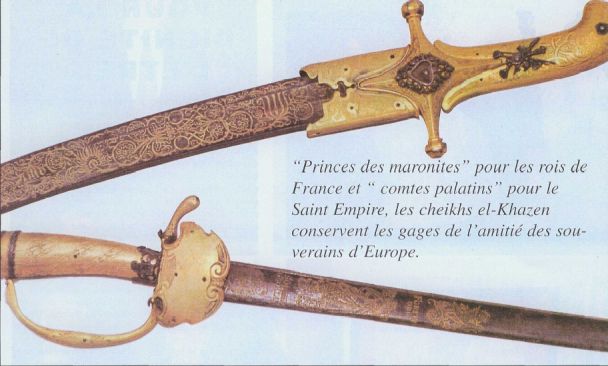
Population Movements to Keserwan - The Khazens and The Maans
ما جاء عن الثورة في المقاطعة الكسروانية
ثورة أهالي كسروان على المشايخ الخوازنة وأسبابها
Origins of the "Prince of Maronite" Title
Growing diversity: the Khazin sheiks and the clergy in the first decades of the 18th century
Historical Members:
Barbar Beik El Khazen [English]
Patriach Toubia Kaiss El Khazen(Biography & Life Part1 Part2) (Arabic)
Patriach Youssef Dargham El Khazen (Cont'd)
Cheikh Bishara Jafal El Khazen
Patriarch Youssef Raji El Khazen
The Martyrs Cheikh Philippe & Cheikh Farid El Khazen
Cheikh Nawfal El Khazen (Consul De France)
Cheikh Hossun El Khazen (Consul De France)
Cheikh Abou-Nawfal El Khazen (Consul De France)
Cheikh Francis Abee Nader & his son Yousef
Cheikh Abou-Kanso El Khazen (Consul De France)
Cheikh Abou Nader El Khazen
Cheikh Chafic El Khazen
Cheikh Keserwan El Khazen
Cheikh Serhal El Khazen [English]
Cheikh Rafiq El Khazen [English]
Cheikh Hanna El Khazen
Cheikha Arzi El Khazen
Marie El Khazen