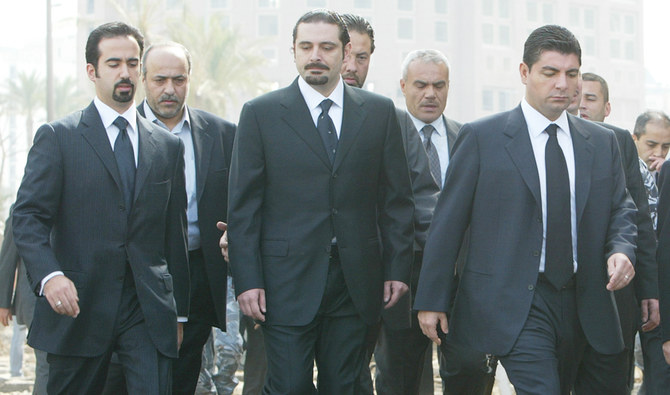
by arabnews.com -- BEIRUT: Allies of former Lebanese Prime Minister Saad Hariri reacted with scorn on Sunday after an apparent attempt by his elder brother Bahaa Hariri to return to the political arena. Mustafa Alloush, a member of the political bureau of Saad’s Future Movement, told Arab News he was surprised by Bahaa’s sudden “zeal for Lebanon, from which he has been away since the assassination of his father.” The two men’s father, former Prime Minister Rafik Hariri, died when his convoy in central Beirut was targeted by a van bomb widely attributed to Hezbollah in February 2005. Alloush was responding to a statement by Bahaa Hariri in which he offered his support to forces calling for political change in Lebanon. Bahaa said that after the end of the coronavirus pandemic, Lebanon would return to a corrupt and greedy system that used hollow sectarian rhetoric to “steal our country’s capabilities.” He called for the restoration of “the dignity of the Lebanese people, which has been lost” because of a corrupt political system. “There is no strong, responsible, honest or economically robust state to shoulder the burden of inspiring activity across the country,” he said. Bahaa expressed support for “the rightful demands” of “the people’s revolution against the system of corruption and illegal weapons.” He criticized the tendency of most politicians and political parties after his father’s assassination in 2005 to accumulate power and money at the expense of the country and citizens’ interests by forming multiparty alliances.
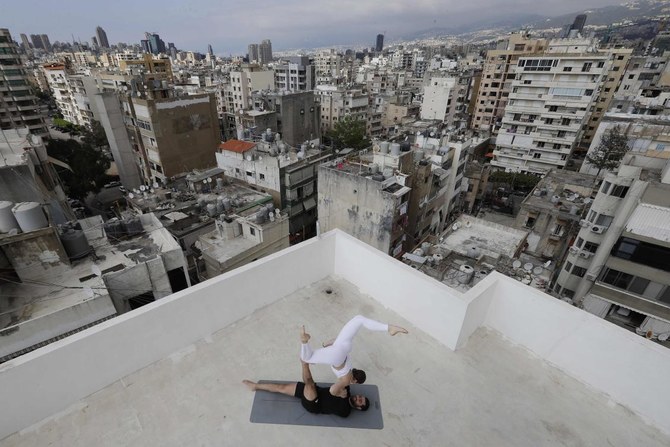
by AFP --- BEIRUT: Usually the kingdom of water tanks and satellite dishes, Lebanon’s rooftops have recently been graced by unlikely scenes of locked-down residents fleeing their flats. Deprived of rehearsal rooms or workshops by restrictions imposed to stem the spread of the novel coronavirus, or just needing some extra breathing space, many people have found solace without leaving their buildings. Several have ventured onto their roofs to escape the lockdown after taking to the streets in recent months as part of nationwide protests against rulers deemed corrupt and inept. AFP photographer Joseph Eid spent weeks scaling staircases to see how people have taken over underused rooftops, whose only visitors used to be caretakers, plumbers and electricians. “When confinement started, I soon couldn’t take it anymore, and that’s when I thought of checking out the roof,” said Sherazade Mami, a Tunisian dancer who has been living in Beirut since 2016.
Every day, she walks up to the ninth floor of her building with her water, her mat and her music to stretch and practice. Like others discovering their rooftops during the lockdown, Mami said her outlook on the city had changed. “Once you’re up there, you realize — I have an amazing view on the whole of Beirut. It’s beautiful, the city is so quiet,” she said of the sprawling metropolis usually known for its noise and chaotic traffic. “You can hear the birds singing, you’re under the sun, it’s heaven ... It’s better than rehearsing in the theater in some ways,” she added.

by un.org -- With the novel coronavirus exacerbating already dire socio-economic conditions in Lebanon, journalists there find themselves facing double the work. Even as Lebanon’s government grapples with a deteriorating economy and financial crisis on one hand, and the COVID-19 pandemic on the other, popular demonstrations have resumed. Many of those protesting are ignoring measures aimed at guarding against the spread of the coronavirus. Reporters are caught in the middle. “Now that popular protests and movements are back amid the coronavirus outbreak, the biggest challenge I’m facing while at work is trying to cover developments from the field,” said Joyce Akiki, a prominent reporter with Lebanon-based MTV channel in a velfie (or a video selfie) she posted on her social media platforms. “I’m compelled to interview people and penetrate protests where hundreds of people are gathering without maintaining physical distance or wearing protective masks, forcing me to risk contracting the virus.”
Akiki’s velfie is part of #JournalistsSafetyIsYourSafety, a social media challenge launched by the UN Educational, Scientific and Cultural Organization (UNESCO) regional office in Lebanon and the UN Information Centre (UNIC) in Beirut on the occasion of World Press Freedom Day. Raneem Abou Khzam, a prominent young reporter for LBCI TV, echoed the same fear in the velfie she posted on Twitter and Instagram. The two-day challenge, taken by 15 renowned reporters, involved recounting one challenge they are facing in their work amid the pandemic, posting it as a short video or velfie, and challenging their colleagues to do the same. The posts were promoted on the social media platforms of all UN agencies in Lebanon, an effort coordinated with the UN Communications Group in Lebanon.

by english.aawsat.com -- With the crash of Lebanon's national currency that sent food prices soaring, the Lebanese government placed a plan to fight inflation. “We were facing an enormous and dangerous challenge, as inflation, mainly food prices, have become unreasonable,” Prime Minister Hassan Diab said at a cabinet session held Thursday to follow-up on the living conditions in the country. “We cannot stay idle … It is totally unacceptable for us not to act quickly, because things will further get out of control. Pricing has become random and ill-conceived, and prices have nothing to do with the dollar exchange rate,” Diab said.
During the cabinet session, Industry Minister Imad Hoballah said measures would be taken to fight soaring food prices, while Justice Minister Marie Claude Najem said that her ministry was following-up on complaints made by the Economy Ministry on price hikes. Economy Minister Raoul Nehme informed the government of a decision to set a maximum profit margin for basic commodities. Nehme had launched a training course for volunteers to support consumer protection by monitoring the markets. "We are ready to train personnel from all municipalities to help us protect consumers," he said. Protests erupted across the country late last month against the soaring unemployment and poverty. Last week, the government formally requested the assistance of the International Monetary Fund (IMF) to save Lebanon from the deep financial crisis. The move came one day after the announcement of the long-awaited economic plan.




Population Movements to Keserwan - The Khazens and The Maans
ما جاء عن الثورة في المقاطعة الكسروانية
ثورة أهالي كسروان على المشايخ الخوازنة وأسبابها
Origins of the "Prince of Maronite" Title
Growing diversity: the Khazin sheiks and the clergy in the first decades of the 18th century
Historical Members:
Barbar Beik El Khazen [English]
Patriach Toubia Kaiss El Khazen(Biography & Life Part1 Part2) (Arabic)
Patriach Youssef Dargham El Khazen (Cont'd)
Cheikh Bishara Jafal El Khazen
Patriarch Youssef Raji El Khazen
The Martyrs Cheikh Philippe & Cheikh Farid El Khazen
Cheikh Nawfal El Khazen (Consul De France)
Cheikh Hossun El Khazen (Consul De France)
Cheikh Abou-Nawfal El Khazen (Consul De France)
Cheikh Francis Abee Nader & his son Yousef
Cheikh Abou-Kanso El Khazen (Consul De France)
Cheikh Abou Nader El Khazen
Cheikh Chafic El Khazen
Cheikh Keserwan El Khazen
Cheikh Serhal El Khazen [English]
Cheikh Rafiq El Khazen [English]
Cheikh Hanna El Khazen
Cheikha Arzi El Khazen
Marie El Khazen