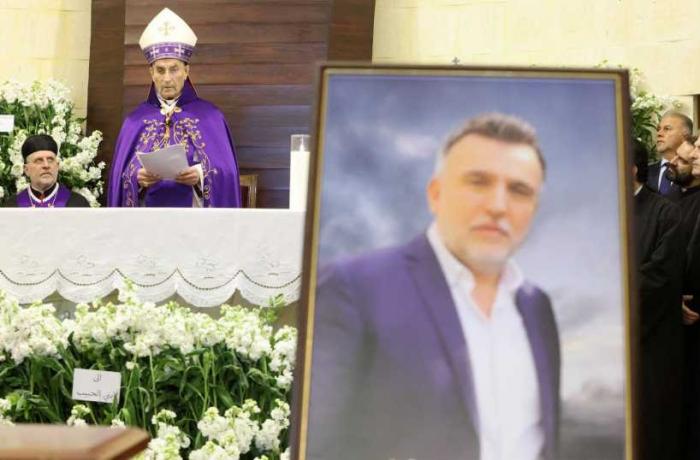
The plan involves various social or socio-political associations and organisations. Lebanon’s Maronite Church is already helping 33,456 people at a cost of 71.585 billion Lebanese pounds (about US.2 million at the official exchange rate).
Beirut (AsiaNews) –Patriarch Bechara al-Rahi yesterday announced that the Maronite Church, alarmed by rising poverty in the Lebanese population, will undertake an ambitious country-wide plan to provide food and social assistance to families without income as a result of the current economic crisis. The plan will be based on a survey conducted by parishes, bishoprics and monasteries as well as Caritas-Liban, the Church’s official charity, coordinated by the Maronite Center for Documentation and Research under Patriarchal Vicar Samir Mazloum. A meeting was held yesterday to vet the assistance plan. Various social or socio-political associations and organisations will be part of the effort: the Maronite League, the Maronite Foundation in the World, the Maronite Foundation for Integral Development, the Pontifical Mission, the Lebanese Red Cross, the Saint Vincent de Paul Association, the Maronite Central Council, the Maronites Rally for Lebanon, the Kallassi group, Labora, Offer-Joie and the National Council for the Cedar Revolution , as well as the Patriarchal Rescue Committee.
They will be joined by donors acting without intermediaries or making donations to charities, parish fraternities, apostolic communities, and various associations, municipalities and collective initiatives. The Patriarch noted that Lebanon’s Maronite Church is helping about 33,456 people at a cost of 71. 585 billion Lebanese pounds (about US.2 million at the official exchange rate). In addition, its educational, hospital and social institutions are providing employment opportunities to 18,870 families, with an overall annual payroll of 430.73 billion Lebanese pounds (US$ 283.8 million) with an average monthly salary of US,253. For the Maronite Patriarch, “The Church’s diakonia of love today finds itself faced with the heavy duty of helping the poor and the needy, whose number is rising as a result of the economic and financial crises, a stifled life, the unpredictable rise in prices and the depreciation of the Lebanese pound.” Finally, Patriarch al-Rahi noted that the meeting in Bkerké coincided with the meeting at the presidential palace centred on the government economic rescue plan. “We hope both state and church will succeed for the greater good of all and the well-being of everyone, each in their respective domain of activity and by their own means," said the prelate.

by thearabweekly.com - Ali Al-Amin -- “Look for Iran.” These words encapsulate the financial, political and moral collapse of Lebanon. These words describe Lebanon’s transformation into a vassal state, lacking in sovereignty and with permeable borders — and run by the axis of evil led by Iran. Through its Hezbollah presence in Lebanon, Iran has worn down the Lebanese, reducing them to a state of hunger and poverty. Meanwhile, the Lebanese have seen their earnings and savings siphoned off as a result of authoritarian and financial tyranny and mangled institutions, riddled with corruption, partisan quotas and cronyism. Even the popular uprising in Lebanon has been neutralised by the malicious authority, which knows only how to evade accountability by inventing scapegoats for its multiple failures, while conveniently hiding the systematic looting of the state’s resources.
Tragic as it is in Lebanon, the COVID-19 pandemic is no longer the main concern of the Lebanese. There is a greater threat to their lives and souls. It was the severe economic crisis — one that is intrinsically linked to the political crisis triggered by the October 17 uprising — that revealed the extent of the popular anger at the political authority and of the dissatisfaction with the current power-sharing equation in the country. These crises resulted in a different Lebanon, a stolen country with a stolen sovereignty run by an authority that builds its influence and power on a system of interests that is contrary to the interests of the people and the constitutional institutions — a system that uses border crossings for smuggling activities that feed a mafia regime under the umbrella of a so-called axis of resistance, run by the Islamic Revolutionary Guard Corps (IRGC) within the framework of the so-called “Shia Crescent.” For Tehran, Lebanon is the model country in the Iranian axis. This is obvious from the regional role assigned by the IRGC to the jewel in Iran’s crown in the region, Hezbollah. Whether in Iraq or in Syria, Lebanese Hezbollah has a finger in every pie. In Iraq, it is given the task of settling the disputes between the Iraqi factions, especially in the Popular Mobilisation Forces (PMF), which explains the recent American decision to offer a $10 million reward for information about the whereabouts and activities of Hezbollah’s representative in Iraq, Muhammad Kawtharani. In Syria, Hezbollah is one of the most prominent pillars of Iranian influence, ready to spring into action whenever talk about imminent international and regional settlements in Syria makes Iran itchy. This role partly explains the reasons for the only visit taken by Iranian Foreign Minister Mohammad Javad Zarif outside the country for months: A trip to Damascus to meet Bashar Assad in the wake of Russia’s message of reprimand to the latter.

by nytimes.com -- By Lina Mounzer -- BEIRUT, Lebanon — Two weeks ago, it seemed every conversation in Lebanon was about keeping safe from the virus. The bustling streets of Beirut were quiet; everyone wore masks and gloves and glared at anyone who coughed in public. The smell of hand sanitizers filled elevators. Back from my grocery runs, I disinfected everything I bought and put my plastic bags on the balcony for a week before reusing them. Last week I came back from the store and nearly forgot to wash my hands as I pulled out the grocery bill and pointed out the exorbitant prices to my husband. We crossed out things we could no longer regularly afford, like cheese. We are the lucky ones. In September, about one-third of Lebanon’s population lived below the poverty line. Today, it is closer to half the population. Lebanon has been on a lockdown to stem the coronavirus outbreak since mid-March, when the government closed borders and “nonessential” businesses. The Lebanese government has been praised for its swift response to the pandemic, but the crisis was also a gift for the politicians.
The Lebanese had been protesting against their political elites since October and refusing to leave the protest sites. Set off by a proposed tax on WhatsApp phone calls announced on Oct. 17 — one of the many proposed austerity measures meant to offset Lebanon’s staggering $86 billion debt — the protests targeted the government for decades of corruption, sectarian power-sharing and the broken banking system. Lebanon’s banks lent depositors’ money to the government and no longer have the dollar liquidity to match the numbers in people’s bank accounts. By November, the banks placed strict limits on withdrawals, some allowing a mere $100 a month. These withdrawal limits functioned as unofficial capital controls.
by Daily Star BEIRUT: The American University of Beirut announced Tuesday that its staff would endure significant pay cuts and potential layoffs …

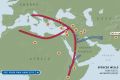
Population Movements to Keserwan - The Khazens and The Maans
ما جاء عن الثورة في المقاطعة الكسروانية
ثورة أهالي كسروان على المشايخ الخوازنة وأسبابها
Origins of the "Prince of Maronite" Title
Growing diversity: the Khazin sheiks and the clergy in the first decades of the 18th century
Historical Members:
Barbar Beik El Khazen [English]
Patriach Toubia Kaiss El Khazen(Biography & Life Part1 Part2) (Arabic)
Patriach Youssef Dargham El Khazen (Cont'd)
Cheikh Bishara Jafal El Khazen
Patriarch Youssef Raji El Khazen
The Martyrs Cheikh Philippe & Cheikh Farid El Khazen
Cheikh Nawfal El Khazen (Consul De France)
Cheikh Hossun El Khazen (Consul De France)
Cheikh Abou-Nawfal El Khazen (Consul De France)
Cheikh Francis Abee Nader & his son Yousef
Cheikh Abou-Kanso El Khazen (Consul De France)
Cheikh Abou Nader El Khazen
Cheikh Chafic El Khazen
Cheikh Keserwan El Khazen
Cheikh Serhal El Khazen [English]
Cheikh Rafiq El Khazen [English]
Cheikh Hanna El Khazen
Cheikha Arzi El Khazen
Marie El Khazen