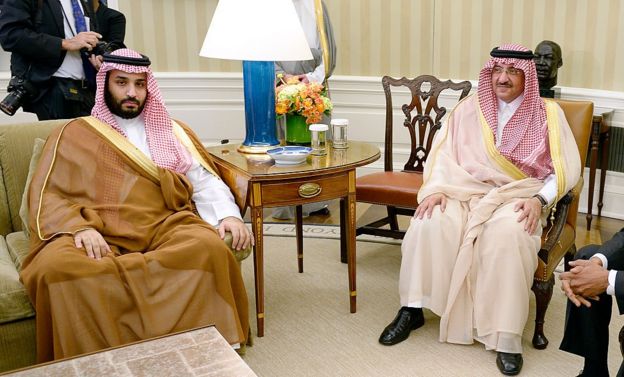
by bbc.com --Three senior members of Saudi Arabia's royal family, including the king's brother, have been arrested for unexplained reasons, US media report. Two of the men were among the kingdom's most influential figures. The detentions have been linked to Crown Prince Mohammed bin Salman. In 2017 dozens of Saudi royal figures, ministers and businessmen were confined to the Ritz-Carlton hotel in Riyadh after the crown prince ordered their arrests. Mohammed bin Salman is considered the de facto ruler of the kingdom, after he was named crown prince by his father in 2016. The detentions took place early on Friday morning, report the New York Times and Wall Street Journal. The three men arrested are the king's younger brother Prince Ahmed bin Abdulaziz, former crown prince Mohammed bin Nayef, and a royal cousin, Prince Nawaf bin Nayef. Mohammed bin Nayef was interior minister until he was removed from his role and placed under house arrest by Mohammed Bin Salman in 2017.

By Tom Perry - Reuters -- BEIRUT (1) - The Lebanese central bank instructed overseas trade dealers on Friday they need to not purchase foreign currency at costs more than 30% past the charges set by the central bank, searching for to carry down the worth being paid for arduous foreign money. The Lebanese pound, pegged in opposition to the greenback on the rate of 1,507.5 kilos for more than 20 years, has slumped because the nation descended right into a monetary disaster final October. Primarily based on the present peg, the central bank’s instruction means foreign money dealers ought to not pay more than round 2,000 kilos for a greenback, in contrast with the two,630 kilos one seller mentioned he was providing for a greenback on Friday. The central bank mentioned overseas foreign money dealers ought to chorus from any commerce that did not stick to this share it had set. The choice applies for six months. It marked the second try since January to management the worth being paid for arduous foreign money by overseas trade dealers. Lebanon’s union of trade dealers mentioned in January it had determined to set the rate at a most of two,000 Lebanese kilos to the greenback in settlement with the central bank governor - a value that did not maintain.

BEIRUT (Reuters) by Samia Nakhoul, Tom Perry -- The Lebanese government must swallow its misgivings and reach a rescue deal with the International Monetary Fund (IMF) or risk economic implosion and further turmoil, economists, diplomats and politicians said. Privately, some government officials acknowledge that an IMF bailout is the most logical solution to Lebanon’s economic crisis, according to a source familiar with ongoing discussions. But to get such a rescue program in place, the new government would have to overcome the objections of Hezbollah, the powerful Iranian-backed power broker in Prime Minister Hassan Diab’s cabinet and its Christian and Shi’ite allies, who are concerned about the austerity measures an IMF rescue would involve.
As Lebanon’s financial crisis drags on and government revenues dwindle, the bill to rescue the country is rising. Former economy minister and ex-vice central bank governor Nasser Saidi estimates the economy will need $30 billion, and an additional $25 billion to recapitalise a banking system in hock to the state. “Lebanon needs external liquidity both for the balance of payments but also for the government,” Saidi said. “That’s why the external package and the IMF reform program which comes with all the associated reforms which we need is so necessary”. A $1.2 billion payment on a Eurobond is falling due on March 9 and even though Lebanon is widely expected to restructure its foreign-currency-denominated debt that is unlikely to be enough to deal with the total debt burden, economists and analysts say.
![Popular anger continues to grow in Lebanon as people are forced to queue for hours simply to retrieve just a few hundred dollars in a country where the local currency and the greenback were formerly used interchangeably [File: Hasan Shaaban/Bloomberg]](https://www.aljazeera.com/mritems/imagecache/mbdxxlarge/mritems/Images/2020/3/5/e19b87e826b8415ca2f9b00b82df3b63_18.jpg)
Al Jazeera by Timour Azhari -- Beirut, Lebanon - A judge in Lebanon has suspended a decision by a financial prosecutor to freeze the assets of 20 banks and their chairmen and boards of directors The judge, Ghassan Oueidat, said late on Thursday he has issued a stay of the prosecutor's order so he could study its effects on the country’s monetary situation, bank transactions, depositors’ money, and economic security. The prosecutor, Judge Ali Ibrahim, earlier on Thursday ordered the assets of the banks, their executives and boards of directors to be frozen as part of an investigation into billions of dollars transferred out of the cash-strapped nation.
Ibrahim's order came amid a worsening economic and financial spiral that has Lebanon staring down the barrel of defaulting on a Eurobond repayment due next week. An acute foreign currency shortage has seen the Lebanese pound devalue on parallel markets to lows unprecedented since it was pegged to the US dollar in 1993. Lebanon's economy is dependent on inflows of foreign currency from its large diaspora, but they have dried up as the country descends deeper into a crisis rooted in corruption, government mismanagement, a dilapidated power sector that bleeds billions and the civil war next door in Syria. The dollar shortage has made the scenario of a default on the country's enormous $87bn public debt - the third highest in the world compared with its gross domestic product (GDP) - increasingly likely.
The cabinet will meet on Saturday to decide whether to make good on a much-anticipated $1.2bn Eurobond repayment due on March 9. "Given the negotiations on the Eurobonds with the banks, [Ibrahim's] decision can be seen as a pressure tool on them to accept government conditions," Jad Chaaban, an associate professor of economics at the American University of Beirut, told Al Jazeera. A senior banking source told Al Jazeera that they view the decision as a further attempt by politicians to shift blame for the country's dire situation onto banks and away from a political class that has ruled Lebanon since its 1975-90 civil war. "There is political pressure on the judge to do this. It's as if we are the ones who stole money and hired thousands of people, and wrecked the electricity sector and wasted money on deals. It's a scapegoat," the source said.
Population Movements to Keserwan - The Khazens and The Maans
ما جاء عن الثورة في المقاطعة الكسروانية
ثورة أهالي كسروان على المشايخ الخوازنة وأسبابها
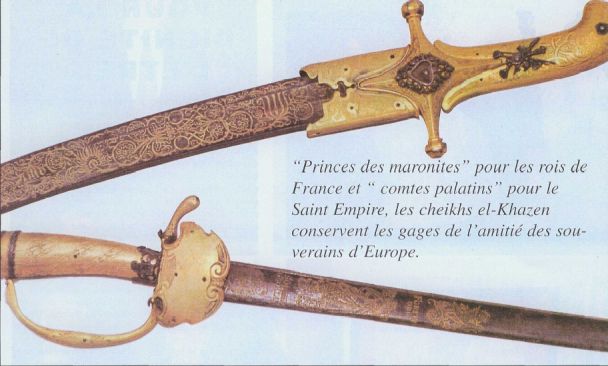
Origins of the "Prince of Maronite" Title
Growing diversity: the Khazin sheiks and the clergy in the first decades of the 18th century
Historical Members:
Barbar Beik El Khazen [English]
Patriach Toubia Kaiss El Khazen(Biography & Life Part1 Part2) (Arabic)
Patriach Youssef Dargham El Khazen (Cont'd)
Cheikh Bishara Jafal El Khazen
Patriarch Youssef Raji El Khazen
The Martyrs Cheikh Philippe & Cheikh Farid El Khazen
Cheikh Nawfal El Khazen (Consul De France)
Cheikh Hossun El Khazen (Consul De France)
Cheikh Abou-Nawfal El Khazen (Consul De France)
Cheikh Francis Abee Nader & his son Yousef
Cheikh Abou-Kanso El Khazen (Consul De France)
Cheikh Abou Nader El Khazen
Cheikh Chafic El Khazen
Cheikh Keserwan El Khazen
Cheikh Serhal El Khazen [English]
Cheikh Rafiq El Khazen [English]
Cheikh Hanna El Khazen
Cheikha Arzi El Khazen
Marie El Khazen