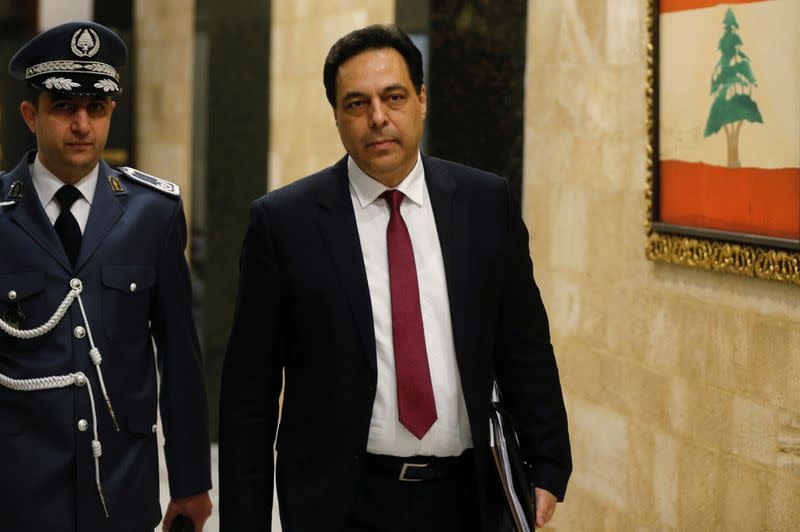
by reuters --- BEIRUT: Lebanon’s Prime Minister Hassan Diab, who is getting the cold shoulder from Gulf Arab states, yesterday met Iran’s parliament speaker, the first senior foreign official to visit since Diab’s government took office. The heavily armed Hezbollah, an ally of Iran, is a main backer of Diab’s cabinet, which took office last month after efforts failed to strike a deal with Saad Al-Hariri, a traditional Western ally. Gulf Arab states had long channeled funds into Lebanon. But now, alarmed by the rising influence of Hezbollah, Lebanon’s rich neighbors appear loathe to help it out of an unprecedented economic and financial crisis. The crisis came to a head last year as slowing capital inflows led to a liquidity crunch and protests erupted against the ruling elite. Banks are curbing access to cash, the Lebanese pound has slumped, inflation has spiked and firms are shedding jobs. Foreign donors say they will only help once Lebanon enacts long-delayed reforms. Analysts say Hezbollah’s role in forming Lebanon’s new cabinet could make it harder to get aid from Western and Gulf states that are worried about Tehran’s clout in the region. Diab has said his first trip abroad would be to the Arab region, particularly the Gulf monarchies. But none of them have officially commented on the government nor extended public invitations to Diab. An Arab diplomat in the Gulf said only Qatar had invited Diab to visit so far. “No other government in the Gulf will invite him,” the diplomat said. Qatar did not immediately respond to a request for comment on whether it had sent an invitation.

by dailystar.com.lb -- BEIRUT: An Israeli online newspaper reported Monday that a Lebanese man, who worked for the Israeli Mossad, fears deportation to Lebanon, claiming that Israel refuses to help him. The Times of Israel says that Benjamin Philip-not his real name- worked for the Mossad since 2011, during which time he helped gather information on Lebanon’s Hezbollah. While the paper does not give his current whereabouts, it says Philip is seeking asylum in Europe.“However, if this [asylum] fails [...] it appears he will be sent back to Lebanon,” the report said. He said that if deported, he will face years of imprisonment, “a scenario that he, a gay man, cannot accept, knowing that such a sentence in a Lebanese prison would mean rape and torture,” the paper said. Philip added that his decision to go public with his story came “out of a sense of desperation, hoping — as a last-ditch effort — that by making his case public, he could pressure Israel and the Mossad to help him, as he says they promised to do.”

by middleeasteye.net -- Lebanon's state-owned carrier Middle East Airlines (MEA) revoked a decision to accept payment only in US dollars after a backlash on Sunday, Lebanese media said. The country is in the throes of an economic meltdown and a biting liquidity crunch that has seen the local currency depreciate and banks impose stringent controls on withdrawals and transfers abroad, AFP said. News of the decision, which was first reported late Saturday, drew dozens of people to MEA's ticket office at Beirut airport where they tried to buy tickets in Lebanese pounds before the decision was due to take effect on Monday, Reuters reported. Former foreign minister Gebran Bassil declared the decision illegal. Writing on Twitter, parliamentarian Fouad Makhzoumi said the move put the Lebanese under effective "house arrest" and must be cancelled. President Michel Aoun said airfares should be priced in Lebanese pounds in line with the law.

by thehill.com -- John Craig is former U.S. Ambassador --Lebanon today can be likened to a bus without brakes, its driver hurtling toward a brick wall. One can see the impending collapse of the country’s economy and national currency, a perfect storm that’s been in the making for at least ten years. However, the passengers on this bus — the Lebanese people — are not sitting idly by. They have risen up against those who drove Lebanon toward its collapse, and many have abandoned it midway, taking from the country all they could carry. The Transatlantic Leadership Network held a conference earlier this month at the U.S. House of Representatives in Washington D.C. dedicated to Lebanon’s turmoil. All-star experts gathered in an effort to discuss best ways forward. One was one of the most reputable members of Lebanon’s parliament: Neemat Frem.
Frem left the comfort zone of a successful 25 years in the private business sector to run for parliament. After winning the seat, he began his public service with a simple question that ended up demonstrating the gravity of problems in Lebanon: How many paid employees were there in Lebanon’s public sector? Frem could not obtain the answer from anyone. Frem instructed the Central Audit Bureau to his parliamentary committee, officially requesting a bottom-up audit of all 150 governmental departments and directorates. The report displayed stunning results: Lebanon’s public sector workforce stands at 256,000 employees and 100,000 retirees — out of a total Lebanese workforce of 1.2 million. Almost a third of the country’s workforce was on the public sector payroll.


Population Movements to Keserwan - The Khazens and The Maans
ما جاء عن الثورة في المقاطعة الكسروانية
ثورة أهالي كسروان على المشايخ الخوازنة وأسبابها
Origins of the "Prince of Maronite" Title
Growing diversity: the Khazin sheiks and the clergy in the first decades of the 18th century
Historical Members:
Barbar Beik El Khazen [English]
Patriach Toubia Kaiss El Khazen(Biography & Life Part1 Part2) (Arabic)
Patriach Youssef Dargham El Khazen (Cont'd)
Cheikh Bishara Jafal El Khazen
Patriarch Youssef Raji El Khazen
The Martyrs Cheikh Philippe & Cheikh Farid El Khazen
Cheikh Nawfal El Khazen (Consul De France)
Cheikh Hossun El Khazen (Consul De France)
Cheikh Abou-Nawfal El Khazen (Consul De France)
Cheikh Francis Abee Nader & his son Yousef
Cheikh Abou-Kanso El Khazen (Consul De France)
Cheikh Abou Nader El Khazen
Cheikh Chafic El Khazen
Cheikh Keserwan El Khazen
Cheikh Serhal El Khazen [English]
Cheikh Rafiq El Khazen [English]
Cheikh Hanna El Khazen
Cheikha Arzi El Khazen
Marie El Khazen