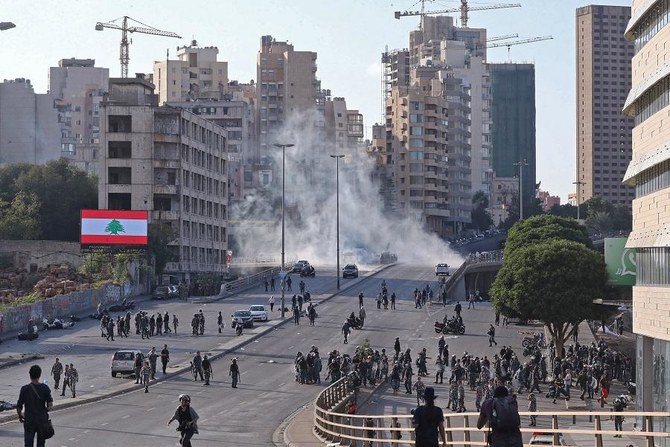
By NAJIA HOUSSARI -- arabnews.com -- BEIRUT: The streets of Beirut erupted in fury once more on Tuesday as protesters tried to block members of parliament from holding a vote to approve the government of new Prime Minister Hassan Diab. Riot police fired tear gas and water cannon, and demonstrators lobbed rocks at security forces and hurled eggs and paint at MPs and ministers as they arrived at parliament. Protesters tore down walls to use stones as missiles, and set fire to a branch of one of Lebanon’s biggest banks, BLOM. Flames engulfed the building as demonstrators smashed the facade and furniture. At least 370 people were injured in the clashes, and 45 were treated in hospital. One MP, Salim Saadeh of the Syrian Social National Party, suffered head injuries when protesters smashed up his car. He was treated at the American University Hospital, before returning to parliament to vote with a swelling on his forehead and around his left eye. Protesters also pelted the cars of ministers Damianos Kattar and Ghazi Wazni with stones and eggs. The Minister of Public Works and Transport, Michel Najjar, traveled to parliament on the pillion seat of a motorcycle.
In the end, the protest failed — the vote of trust in the new government went ahead, with 63 voting in favour, 20 voting against, and one abstention. Nevertheless, the protesters, many of whom had slept overnight in freezing temperatures in Riad El-Solh and Martyrs Squares, had made their point. “People are suffering and the government is not listening,” said demonstrator Lama Tabbara, 34. “It takes a long time to uproot an old rotten tree, and that’s what the government represents.” Another protester, Christopher, 26, said: “We are here to reject Diab’s government and to say that the Lebanese people have no confidence in it — even if MPs vote to support it.” He said the new ministers may appear to be qualified but they still depended on “the parties that destroyed the country.”
by naharnet — Maronite Archbishop of Beirut Boulos Abdul Sater on Sunday noted that “a true leader is one who resists the …

by themedialine.org -- DIMA ABUMARIA -- One critic says that with so much poverty, few today talk about ‘resistance’ against Israel, the Iran-backed Shi’ite group’s primary raison d’etre Anti-government protestors continued to take to the streets of Beirut over the weekend, declaring their lack of confidence in the country’s new prime minister, Hassan Diab, and his cabinet. As the new government’s biggest backer, the Iran-backed Hizbullah movement is seeing its popularity wane and possibly losing its legitimacy as a resistance movement. “The government failed before it even started,” Ali Amin, a Lebanese analyst and journalist who writes for the London-based Al-Arab newspaper, told The Media Line, explaining that people were revolting against an entire political system but were given a new government with the same platform and same political powers. “Hizbullah is a key party in forming this new government and is perhaps its primary backer, as [the government] could never have been formed without Hizbullah’s support for its leader and members,” he said. “The ongoing battle here is between the new government and the street, which rejects it and is expressing this through protests.”
The protests have been taking place since mid-October, when people rose up against a new tax on the use of internet-based communications programs like Whatsapp. The protests widened to express a deep dissatisfaction with economic mismanagement, corruption and sectarianism. Under relentless pressure, Prime Minister Saad al-Hariri resigned on October 29. But since the beginning, demonstrators have vowed not to leave the streets until there is a government of experts rather than politicians who merely represent the country’s many ethnic and religious groups. Amin adds that Lebanon is expected to witness a wave of new demonstrations on Tuesday as the parliament gathers for a vote of confidence in the new government, noting that the majority of lawmakers are in the sway of Hizbullah and its allies.

Bloomberg/Beirut -- Some foreign holders of Lebanon’s Eurobonds are expressing support for a government debt restructuring as the clamour grows among local politicians to skip a payment due in weeks. At a private meeting days ago with government representatives, a number of foreign funds that own Lebanese sovereign bonds, including a $1.2bn note due March 9, argued that the crisis-ridden country would be better off restructuring rather than paying its debt, said a person familiar with the matter, declining to identify the investors. In a suggestion that the fallout can be contained, they said Lebanon’s bonds were already discounted on their balance sheets, according to the person, who asked not to be named because the information isn’t public. Most of Lebanon’s bonds maturing beyond this year trade at between 35 and 40 cents on the dollar. The March notes fell around 2 cents to 87 on Thursday, still above their low of 76 on January 29.
Central bank governor Riad Salameh has told officials including the new Prime Minister, Hassan Diab, that he is willing to pay the debt if instructed by the government, people familiar with the talks said. He’s already helped repay nearly $5bn of bonds in the past year. While Diab is in favour of meeting Lebanon’s debt obligations this year, according to a local media report, he hasn’t yet made a final decision. The decision will come down to a choice of who should bear the cost of easing one of the world’s biggest debt burdens, estimated at over 150% of gross domestic product last year, as hardships mount after months of protests. Lebanon is enduring its worst financial crisis in decades, with the central bank rationing dollars and nationwide unrest over what many fear could be an imminent collapse. Despite a spotless record of servicing international debt, consensus is fraying in Lebanon as almost $3.5bn in Eurobond principal and interest payments come due by June. Bankers say local lenders, which hold most of the country’s Eurobonds, favour a repayment to avoid blowing a hole in their balance sheets. The most recent payment of $1.5bn, made by the central bank in November, was criticised by some local politicians who said Lebanon should instead use what’s left of its reserves on buying much-needed imports. A group of lawmakers aligned with a majority in parliament is lobbying the government to seek technical assistance from international institutions before making a final decision. They’re trying to convince the premier and others that Lebanon risks a crisis and violence similar to Venezuela, which defaulted on its debts in 2017.


Population Movements to Keserwan - The Khazens and The Maans
ما جاء عن الثورة في المقاطعة الكسروانية
ثورة أهالي كسروان على المشايخ الخوازنة وأسبابها
Origins of the "Prince of Maronite" Title
Growing diversity: the Khazin sheiks and the clergy in the first decades of the 18th century
Historical Members:
Barbar Beik El Khazen [English]
Patriach Toubia Kaiss El Khazen(Biography & Life Part1 Part2) (Arabic)
Patriach Youssef Dargham El Khazen (Cont'd)
Cheikh Bishara Jafal El Khazen
Patriarch Youssef Raji El Khazen
The Martyrs Cheikh Philippe & Cheikh Farid El Khazen
Cheikh Nawfal El Khazen (Consul De France)
Cheikh Hossun El Khazen (Consul De France)
Cheikh Abou-Nawfal El Khazen (Consul De France)
Cheikh Francis Abee Nader & his son Yousef
Cheikh Abou-Kanso El Khazen (Consul De France)
Cheikh Abou Nader El Khazen
Cheikh Chafic El Khazen
Cheikh Keserwan El Khazen
Cheikh Serhal El Khazen [English]
Cheikh Rafiq El Khazen [English]
Cheikh Hanna El Khazen
Cheikha Arzi El Khazen
Marie El Khazen