by lorientlejour.com -- Le bâtonnier de Beyrouth, Melhem Khalaf, a pris lundi avec grandiloquence la défense d'un avocat très âgé, sorti d'une salle d'audience par un juge parce qu'il parlait trop fort, selon des éléments obtenus par L'Orient-Le Jour qui a interrogé l'un des acteurs de l'affaire, en l'occurence le président du Tribunal pénal chargé des affaires criminelles, Sami Sodqi, ainsi qu'un membre du conseil de l'Ordre des avocats. "Le juge Sodqi présidait une audience et a entendu quelqu'un parler fort. On l'a informé qu'il s'agissait de l'avocat Malek Oueidate. Le juge a alors demandé qu il sorte de la salle d'audience", raconte à L'OLJ Nader Gaspard, membre du Conseil de l'ordre des avocats et commissaire du Palais de justice de Beyrouth près du gouvernement.
Selon des sources concordantes, l'avocat, qui aurait des problèmes d'audition, discutait avec son épouse au téléphone d'une histoire de médicaments. Informé de l'incident, M. Gaspard s'est rendu, en compagnie du bâtonnier, auprès de l'avocat. "Melhem Khalaf, le secrétaire général de l'Ordre, Saadeddine Khatib et moi, ainsi que plusieurs avocats, avons trouvé l'avocat en dehors de la salle d'audience assis sur un banc", poursuit M. Gaspard. La vidéo du bâtonnier rhabillant Malek Oueidate de sa robe d'avocat a fait le tour des réseaux sociaux.
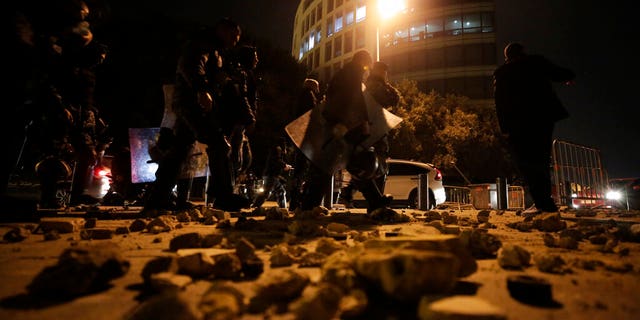
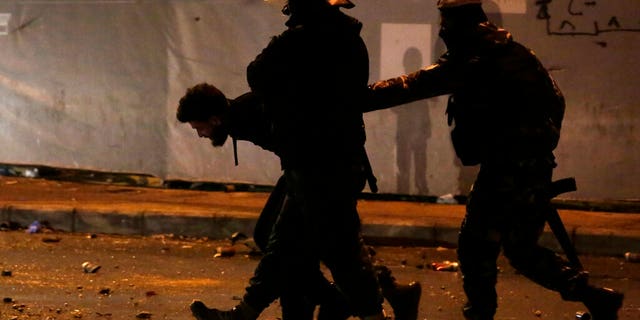
by AP -- Lebanese security forces prepared for more violence on Sunday after a night of protests over the country’s worsening financial situation gripped Lebanon’s capital. Demonstrators used rocks and other projectiles early Sunday while security forces responded by firing tear gas canisters and water cannons, before turning to rubber bullets. A few protesters tried to breach metal barriers that separated them from the riot police, while hundreds more gathered down the blocked street leading to the Parliament building.
At least 70 people were injured in the first 90 minutes of the clashes, including 30 transported to hospitals for treatment, according to the Red Cross. Reporters on the scene said most of the injured were from rubber bullets. Earlier Sunday, security forces reinforced the metal barriers surrounding the Parliament building in central Beirut, after the worst night of violence since protests erupted several months ago. Saturday's clashes left nearly 400 people injured, according to the Red Cross and the Lebanese Civil Defense. Lebanon's Internal Security Forces said 142 of its members were injured, some with serious concussions. Lebanon's military made a show of force on Sunday, heavily deploying in downtown Beirut and patrolling ahead of the rallies. Riot police were in the front line guarding Parliament.
Sunday’s unrest comes a day after President Michel Aoun called on the military to intervene as fierce clashes broke out between protesters and police. "We're not scared. This is all for our future and our children," shoemaker Bassam Taleb told Reuters at the protest. "The country is frozen. The state is not doing a thing, they're a bunch of thieves. And if you have money in the bank, you can't even get a hundred dollars out." Earlier in Beirut on Sunday, shopkeepers, banks and other businesses swept up broken glass and boarded-up windows. Workers at one bank took down the large sign with its name to remove any identifier and avoid soliciting anger from protesters, who smashed the windows and the facade of Lebanon's Banking Association headquarters with metal bars on Saturday. The demonstrators widely blame Lebanese financial institutions, alongside government corruption, for the crippling economic crisis. The Associated Press contributed to this report.
An AFP photographer at the scene said security forces fired rubber bullets at stone-throwing protesters as thick clouds of tear gas covered central Beirut. On Sunday, local television aired the testimonies of relatives of two young men they said were hit in the eyes by rubber bullets. Human Rights Watch condemned what it called "the brutal use of force unleashed by Lebanon's riot police against largely peaceful demonstrators". "Riot police showed a blatant disregard for their human rights obligations, instead launching tear gas canisters at protesters' heads, firing rubber bullets in their eyes and attacking people at hospitals and a mosque," said its deputy Middle East director Michael Page. The authorities must act quickly "to end this culture of impunity for police abuse", he said. Saturday's clashes began after dozens of protesters threw stones and plant pots at security forces, and tried to charge police lines near parliament with traffic signs. The security forces responded with water cannon and thick tear gas. Protesters had called for a week of "anger" over the political leadership's failure to form a new government even as the country sinks deeper into a financial crisis.
'STOP WASTING TIME'
The NNA said around 30 people were briefly detained after the violence on Saturday. Security forces said they had opened an probe after a video shared online showed police beating up people believed to be protesters as they were brought to a Beirut police station. "Another day without a government, another night of violence and clashes," UN envoy to Lebanon Jan Kubis said on Twitter. Outgoing prime minister Saad Hariri, who stepped down on October 29, urged political parties to "stop wasting time". "Form a government and pave the way towards political and economic solutions," he said.

This is an opinion article and does not necessarily represent khazen.org opinion
Syria’s invisible hand in Lebanon confronts Iran’s allies
by Dr Basem Shabb -- Since October 17, a nationwide uprising took Lebanese by storm, forcing then prime minister Saad Hariri and his Cabinet to step down. In December, Iran-backed Hezbollah and its ally, the Christian Free Patriotic Movement, or FPM, were duped into naming Dr Hassan Diab, a Sunni academic, as prime minister designate. It is the prime minister designate's duty by law to form the Cabinet but acting foreign minister and head of the FPM, Gebran Bassil mistakenly thought he could impose his preferred nominees on a relatively unknown prime minister and divide the spoils with Hezbollah. Much to the dismay of Mr Bassil, Mr Diab appears bent on forming a government of unaffiliated experts, in compliance with the demands of protesters. Mr Diab has challenged Mr Bassil as well as his father-in-law Lebanese President Michel Aoun, with active support from pro-Syrian politicians, most notably member of parliament Jamil Al Sayyed. Other pro-Syrian factions voiced their demands to be represented in the new government, effectively competing with the FPM for the next Cabinet's 18 ministries.
It seems that Mr Diab, far from being weak and isolated, has considerable support from Pro-Syrian factions opposed to Mr Hariri. Grand Mufti Abdul Latif Darian and other Sunni dignitaries have refrained from criticising Mr Diab, avoiding the thorny issue of his legitimacy within the community. More importantly, the Saudi leadership has yet to take a position on Mr Diab, which may indicate that they are ready to give him a chance. Syrian President Bashar Al Assad has yet to comment on the situation but Druze politician Wiam Wahhab, one of Syria's closest allies in Lebanon, has indicated he was the one to suggest Mr Diab for the position of prime minister. The Russians first endorsed Mr Hariri but after Mr Diab was officially nominated, they have assumed a neutral stance. Western powers are closely watching as Lebanese politicians bicker while the economy is in free fall.


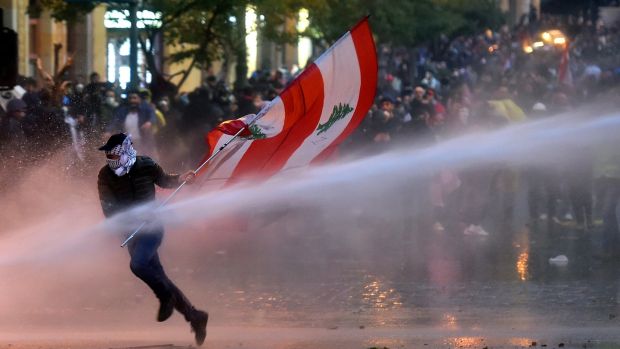
by france 24 --- Clashes between police and protesters in Lebanon angered by delays in forming a government wounded more than 160 people on both sides Saturday as anti-establishment demonstrations enter a fourth month. The sound of ambulance sirens rang out across Beirut as the Red Cross reported 65 wounded had been taken to hospital and 100 more were treated on site. On Saturday evening, fire tore through protest tents in an iconic square in central Beirut. It was not immediately clear what caused the blaze. According to the spokesman, there were injuries on both sides. The protest movement rocking Lebanon since October 17 revived this week as a deepening economic crisis increases pressure to form a new government. No progress appears to have been made towards finalising the cabinet, which protesters demand be comprised of independent experts and exclude all established political parties. ‘We won’t pay the price’
Earlier, marches converged on the city centre from across Beirut, with demonstrators chanting "We won't pay the price". But near parliament, dozens of protesters threw rocks and large plant pots at police guarding the institution. Others charged police blockades with traffic signs and metal barriers. Security forces behind the barricades responded with water cannon and tear gas to disperse the crowds. Lebanon's Interior Minister Raya el-Hassan said it was unacceptable for protesters to attack security forces. "I always asserted the right to protest, but for the protests to turn into a blatant assault on the security forces, on public and private property, is condemned and not acceptable at all," she said in a tweet. The Internal Security Forces also took to the social media: "A direct and violent confrontation is taking place with anti-riot police at one of the entrances to parliament", they tweeted. "We ask peaceful protesters to keep away from the site of the rioting for their safety." They published photos of several wounded policemen and a video showing pillars stripped of their tiles, reportedly to be thrown at security forces.

by AFP -- BEIRUT: Protesters blocked several main roads across Lebanon on Friday as unprecedented demonstrations against a political elite accused of corruption and incompetence entered their fourth month. The protest movement rocking Lebanon since October 17 has resurged this week, over delays in forming a new cabinet to address the country's growing economic crisis. No progress seemed to have been made on a final lineup, which protesters demand be made up solely of independent experts and exclude traditional political parties. In central Beirut, dozens of protesters Friday stood between parked cars blocking a key thoroughfare linking the city's east and west. “We blocked the road with cars because it's something they can't move," Marwan Karam said.
The protester condemned what he regarded as efforts to form yet another government in which power is divided among the traditional parties. “We don't want a government of masked political figures," the 30-year-old told AFP. “Any such government will fall. We won't give it any chance in the street." Forming a new cabinet is often a drawn-out process in Lebanon, where a complex system seeks to maintain balance between the various political parties and a multitude of religious confessions. Nearby, Carlos Yammine, 32, said he did not want yet another “cake-sharing government". “What we have asked for from the start of the movement is a reduced, transitional, emergency government of independents," he said, leaning against his car. Demonstrators also blocked roads in second city Tripoli Friday morning, although they were cleared later in the day, local media reported. Protests also took place in the southern port city of Tyre later in the day.
‘Unacceptable' violence
Population Movements to Keserwan - The Khazens and The Maans
ما جاء عن الثورة في المقاطعة الكسروانية
ثورة أهالي كسروان على المشايخ الخوازنة وأسبابها
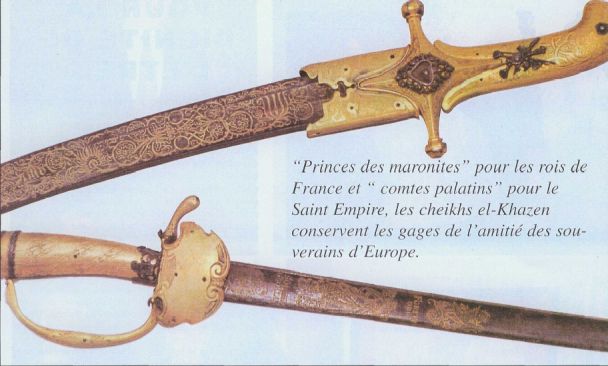
Origins of the "Prince of Maronite" Title
Growing diversity: the Khazin sheiks and the clergy in the first decades of the 18th century
Historical Members:
Barbar Beik El Khazen [English]
Patriach Toubia Kaiss El Khazen(Biography & Life Part1 Part2) (Arabic)
Patriach Youssef Dargham El Khazen (Cont'd)
Cheikh Bishara Jafal El Khazen
Patriarch Youssef Raji El Khazen
The Martyrs Cheikh Philippe & Cheikh Farid El Khazen
Cheikh Nawfal El Khazen (Consul De France)
Cheikh Hossun El Khazen (Consul De France)
Cheikh Abou-Nawfal El Khazen (Consul De France)
Cheikh Francis Abee Nader & his son Yousef
Cheikh Abou-Kanso El Khazen (Consul De France)
Cheikh Abou Nader El Khazen
Cheikh Chafic El Khazen
Cheikh Keserwan El Khazen
Cheikh Serhal El Khazen [English]
Cheikh Rafiq El Khazen [English]
Cheikh Hanna El Khazen
Cheikha Arzi El Khazen
Marie El Khazen