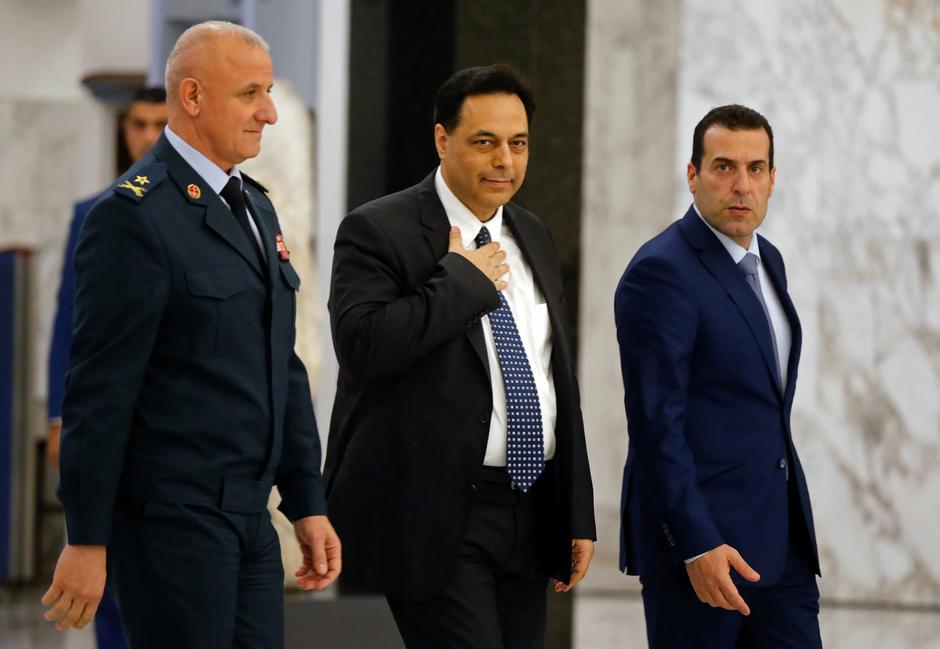
by arabnews.com --RANDA TAKIEDDINE -- A few days after the killing of Qassem Soleimani in Iraq, Hezbollah exhibited, all along the road to Beirut’s Rafik Hariri International Airport, posters bearing the portrait of the leading member of Iran’s Quds Force, who was responsible for killings, massacres and troubles in Syria, Iraq and Lebanon. This was a shocking scene to a Lebanese patriot. Hassan Nasrallah, the leader of Hezbollah, said Iran’s missile attacks on Iraqi military bases that host US troops was just “a slap” and promised they were only the beginning of the actions that would be taken in response to the US‘ killing of Soleimani. Nasrallah, Iran’s man in Lebanon, made an aggressive speech, in which he presented the goals of his party and his Iranian sponsor: Attacks on American targets in the Middle East with the aim of removing US military forces from the region.
At the same time, Hezbollah MPs and ministers in the caretaker Lebanese government made it publicly known that the party wanted the quick formation of a new government at any cost. However, despite their support of the designated prime minister, Hassan Diab, they failed to obtain a quick understanding between their allies, namely the caretaker Foreign Minister Gebran Bassil, who wanted seven ministerial positions for his followers, and Nabih Berri, the Shiite Speaker of Parliament, who disagreed with Bassil. Meanwhile, the demonstrations have resumed in Lebanon, with protesters objecting to Diab and all the political class, who they describe as “corrupt and responsible for the disastrous economic and financial situation that is wrecking the lives of the people, young and old, in the country.” Violence erupted near the Central Bank on Tuesday. Some accused Hezbollah and its ally the Amal Movement of having infiltrated the peaceful demonstrators, breaking windows and causing injuries. Hezbollah and Amal deny this.
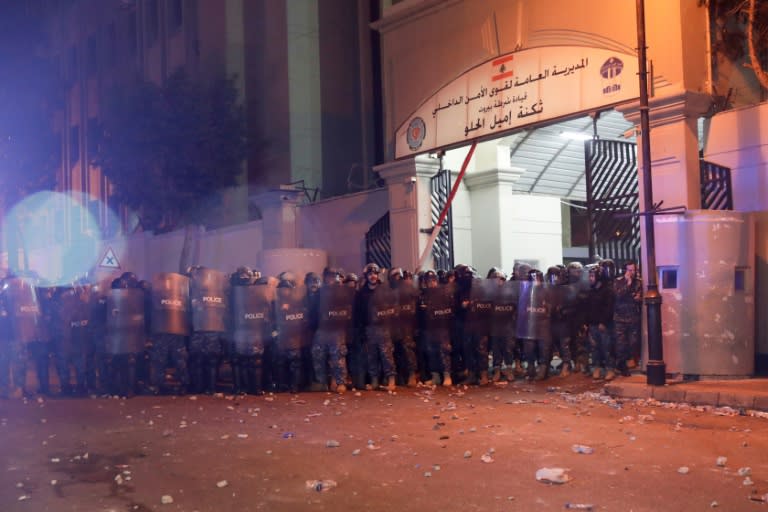
Beirut (AFP) - Lebanon's security forces on Thursday released most of the 100-plus anti-government protesters detained in the past 48 hours, lawyers told AFP, after two nights of violent demonstrations in Beirut. Protesters gathered in Beirut again on Thursday evening in front of the Central Bank and interior ministry, where several hundred demonstrators denounced police use of force and outgoing minister Raya al-Hassan. A protest movement that has rocked Lebanon since October surged again from Tuesday, with a committee of lawyers defending demonstrators saying 101 people had been detained, including 56 on Wednesday, with five minors among them. The lawyers' committee announced on Facebook on Thursday that "all those arrested have been released with the exception of seven foreigners".
The detained foreigners -- six Syrians and an Egyptian -- will be brought before authorities, the committee added. Lebanese security forces announced 59 people were arrested on suspicion of vandalism and assault on Tuesday, when protesters angered by stringent informal capital controls attacked banks in central Beirut. "Under popular pressure, the detained have been released two days after a hysterical crackdown," Nizar Saghieh, who heads the Legal Agenda non-governmental organisation, wrote on Twitter. Amnesty International denounced what it said were "arbitrary arrests". "What we have witnessed in the past couple of days is an alarming attack on freedom of assembly and expression," said the watchdog's Middle East research director Lynn Maalouf. "Acts by a minority of protesters who vandalised banks or threw stones is never a justification for such excessive use of force and sweeping arrests by law enforcement."
- Fresh protests -
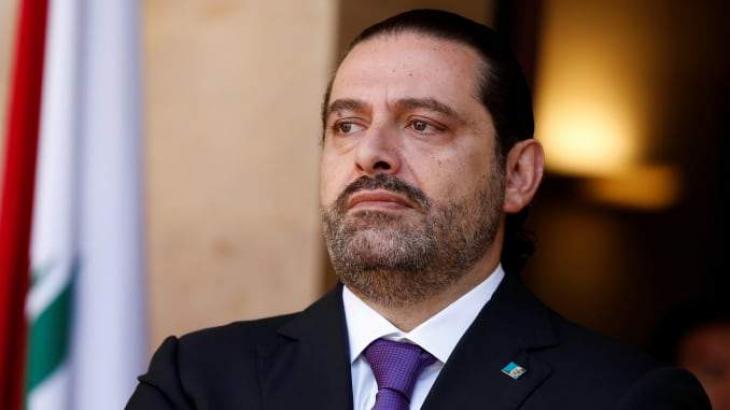
BEIRUT ( Sputnik) Riots that took place on one of the central Beirut streets were beyond inexcusable and such actions can destroy the whole country, acting Lebanese Prime Minister Saad Hariri said on Wednesday. Earlier in the day, eyewitnesses told Sputnik that protesters continued clashing with police and throwing stones and other objects, who in response fired tear gas to disperse the protesters. Reports said that around 47 officers were injured and 59 people were detained. "The attack on the Hamra street is unacceptable under no circumstances. It is an attack that I do not want to hold anyone responsible for, the people's revolution or their dissatisfaction with banks ... From my political, governmental and parliamentary viewpoint, I will not accept being a witness of suspicious actions that can ruin the whole country," Hariri said in a statement. He called to prosecute those accountable for the riots in the Lebanese capital in accordance to the law and also demanded the army to fulfill its obligations on ensuring security.
In October, protests flared across Lebanon amid a crippling economic crisis. They have been demanding urgent reforms to end the deepening liquidity crisis, while President Michel Aoun has blamed it on sanctions. The economic and financial situation has continued to deteriorate, with private entrepreneurs refusing to accept any payment by bank transfer. Hariri's government resigned on October 29, but the demonstrations have not stopped. In mid-December, President Michel Aoun designated former Education Minister Diab as the next prime minister. However, a new government that satisfies all political parties has not yet been formed. According to the media reports, anti-government protesters gave Diab 48 hours to form a new cabinet.
Hariri Says 'No One Can Sack' Salameh, Asks 'Where was Army' Tuesday
by naharnet -- Caretaker Prime Minister Saad Hariri on Wednesday defended Central Bank Governor Riad Salameh following a meeting with him at the Center House. “The central bank governor has immunity and no one can sack him,” Hariri told reporters after the talks. “All people want to blame the central bank for what’s happening in the country, but there are $47 billion in debt in the electricity file and had we addressed the file, the issue would have been solved,” Hariri added. “The funds went to private generator providers and everyone knows who they are,” the caretaker PM went on to say. “They are saying that I’m the one obstructing the electricity file, but have I ever been in charge of the energy ministry?” Hariri said.

by thenational.ae -- As turmoil sweeps the Middle East, the eyes of the world have lost sight of the ongoing uprisings in Iraq, but also in Lebanon. After weeks of relative calm, the Lebanese people have vowed to relaunch nationwide protests in what they have dubbed a “week of wrath”. The Lebanese have a lot to be angry about. Their country is going through a crippling economic crisis and, for the past thirty years, it has been led by an elite that has largely failed to meet the population's basic needs. Lebanon has been without a government for more than two months after a popular uprising led Prime Minister Saad Hariri and his Cabinet to resign. Mr Hariri stated at the time that he wanted to heed the calls of those calling for a better future for Lebanon. The country has been suffering from electricity shortages for the past three decades, however, in the last week, it has endured even longer cuts, with some Beirut residents reporting less than 30 minutes of electricity per day. An internet shutdown is also on the horizon. Telecommunication companies have expressed fears that the government will be unable to pay them for their services by March.
Adding to people’s woes, a financial crisis of unprecedented proportions has hit the country since November. Lebanon has been downgraded by Moody’s and other credit rating agencies twice in a year, and the Lebanese pound has lost half of its value to the American dollar on the black market. A shortage of dollars, to which the pound is pegged and that is used interchangeably with the local currency, has pushed banks to impose informal capital controls. The draconian measures include a cap on foreign currency withdrawals of $200 per week, a ban on transferring money abroad, as well as refusing people access to their frozen accounts. As a result, most companies have downsized or halved their employees’ salaries and many businesses have gone bankrupt. Frustration is in the air, as Lebanese are forced to queue for hours at their local bank, only to withdraw a couple hundred dollars. Many fear their life savings are as good as gone. The situation has fuelled anger at the banking system, with protesters staging demonstrations in front of Lebanon’s Central bank. Some have even resorted to violence, setting the very banks where they keep their savings on fire, or smashing their windows in desperation.




Population Movements to Keserwan - The Khazens and The Maans
ما جاء عن الثورة في المقاطعة الكسروانية
ثورة أهالي كسروان على المشايخ الخوازنة وأسبابها
Origins of the "Prince of Maronite" Title
Growing diversity: the Khazin sheiks and the clergy in the first decades of the 18th century
Historical Members:
Barbar Beik El Khazen [English]
Patriach Toubia Kaiss El Khazen(Biography & Life Part1 Part2) (Arabic)
Patriach Youssef Dargham El Khazen (Cont'd)
Cheikh Bishara Jafal El Khazen
Patriarch Youssef Raji El Khazen
The Martyrs Cheikh Philippe & Cheikh Farid El Khazen
Cheikh Nawfal El Khazen (Consul De France)
Cheikh Hossun El Khazen (Consul De France)
Cheikh Abou-Nawfal El Khazen (Consul De France)
Cheikh Francis Abee Nader & his son Yousef
Cheikh Abou-Kanso El Khazen (Consul De France)
Cheikh Abou Nader El Khazen
Cheikh Chafic El Khazen
Cheikh Keserwan El Khazen
Cheikh Serhal El Khazen [English]
Cheikh Rafiq El Khazen [English]
Cheikh Hanna El Khazen
Cheikha Arzi El Khazen
Marie El Khazen