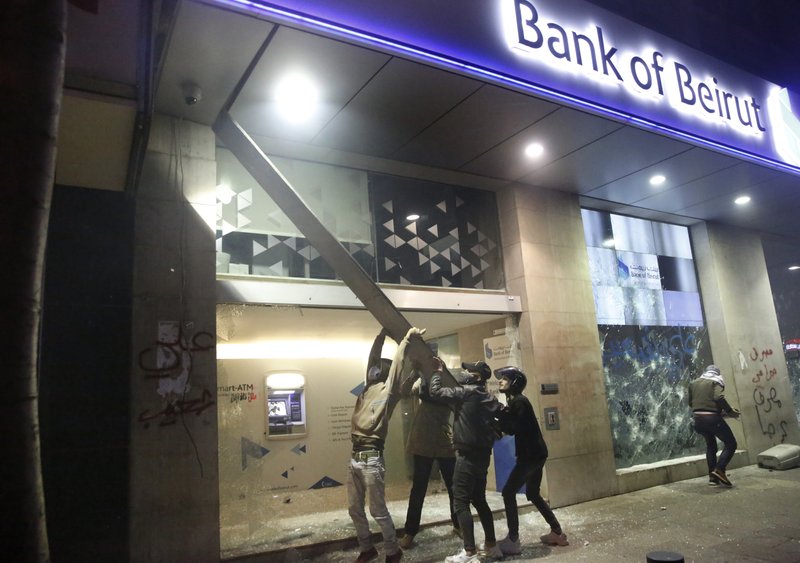
BEIRUT (AP) SARAH EL DEEB— Lebanese security forces fired volleys of tear gas at protesters who responded with rocks outside the country’s central bank in pitched street battles that lasted for hours late Tuesday. The clashes ended a day of rallies that followed a lull in the three-months-long protests. The street clashes stretched down one of Beirut’s busiest commercial areas and come after a day when protesters resorted to blocking roads to express their impatience at a ruling elite they say has failed to address a fast crumbling economy. The protesters have also turned their anger at the country’s banks, which have imposed capital controls on foreign currency accounts in the highly dollarized economy. Protesters using metal bars and sticks smashed windows of commercial banks and foreign exchange bureaus nearby.
Beirut’s most bustling commercial boulevards, Hamra Street, also packed with theaters and restaurants, was deserted late Tuesday save for protesters and security forces. Local TV stations carried the pitched street battles live, including late night arrests of at least half a dozen protesters. Calm had prevailed since the designation of Hassan Diab as prime minister in mid-December. But Diab, nominated by the President and a simple majority of parliament members, has so far failed to form an emergency government amid political divisions and jockeying for power. The lull was also partly due to the holidays followed by soaring regional tensions between the U.S. and Iran that eclipsed the protesters in Lebanon and Iraq demanding sweeping political change. Clashes at the bank began late Tuesday after security forces arrested a few of the protesters. It was not immediately clear why they were arrested. Local media said the protesters had removed metal barriers erected around the central bank. Lebanon’s Internal Security forces later said “vandals” attacked the central bank and injured a number of the personnel guarding it. The demonstrators accuse the central bank’s governor of financial policies that have worsened Lebanon’s liquidity crunch. The country is facing its worst economic crisis in decades. The local currency has lost over 60% of its value in just the past few weeks, while sources of foreign currency have dried up. Meanwhile, banks have imposed informal capital controls limiting withdrawal of dollars and foreign transfers in the country, which relies heavily on imports of basic goods.
by AP -- American troops were informed of an impending missile barrage hours before their air base in Iraq was struck by Iran, U.S. military officials said Monday, days after the attack that marked a major escalation between the longtime foes. At 11 p.m. on Jan. 7, U.S. Lt. Col. Antoinette Chase gave the order for American troops at Ain al-Asad air base in western Iraq, to go on lockdown. Military movements froze as her team, responsible for emergency response at the base, sent out alerts about the threat. At 11:30 p.m., she gave the order to take cover in bunkers. The first strike landed sometime after 1:35 a.m. on Jan. 8 and the barrage continued for nearly two hours. Half way through the attack, Chase learned the missiles were being launched from Iran.
No American soldiers were killed or wounded, the U.S. has said, although several troops were treated for concussions from the blast and are being assessed, said Col. Myles Caggins, a spokesman at the base for the U.S. coalition fighting the Islamic State group. “The reason why we pushed it at 2330 is because at that point in time all indications pointed to something coming,” she told reporters touring the base. “Worst case scenario — we were told was it’s probably going to be a missile attack. So we were informed of that.” The Iranian attack was in retaliation for the U.S. drone strike near Baghdad airport that killed top Iranian Gen. Qassem Soleimani on Jan. 3. An Associated Press crew touring the Ain al-Asad base saw large craters and damaged military trailers. Forklifts lifted rubble and loaded it onto trucks from an area the size of a football stadium. U.S. soldiers inspected portable housing units destroyed in the attack. The sprawling complex in western Anbar province is about 180 kilometers (110 miles) west of Baghdad and is shared with the Iraqi military. It houses about 1,500 members of the U.S. military and the U.S.-led coalition fighting the Islamic State militant group.

BEIRUT (AP) — LEBANESE protesters used sandbags and bricks Monday to block a main street outside the country's central bank, protesting financial policies they say deepened a liquidity crunch. Lebanon is facing its worst economic crisis in decades, with the local currency losing over 60% of its value to the dollar over the last weeks while sources of foreign currency have dried up. Meanwhile, banks imposed informal capital controls limiting withdrawal of dollars and foreign transfers in the country that relies heavily on imports of basic goods. Panic has set in among residents who fear their deposits are in danger. Nationwide protests for three months have failed to pressure politicians to form a new government to institute drastic reforms.
The incumbent prime minister Saad Hariri resigned in late October. The president after consulting parliamentary blocs designated a new prime minister in December, who has yet to form a new Cabinet amid deep political divisions. After weeks of calm, protesters threatened to launch a week of protests, culminating in civil disobedience, demanding the immediate formation of a government to deal with the severe financial crisis.

thearabweekly.com -- Lebanon’s economy is on the verge of collapse and everyone — Lebanese locals, expatriates, bankers, economists, politicians and even donors who have yet to come through with their pledges because they are waiting on economic reforms — knows it. The banking sector’s steady decline is devastating because it was once one of the few reliable parts of Lebanon’s economy. Lebanon’s industrial and agricultural sectors, despite their high-quality products, have been unable to penetrate foreign markets but the country’s banking and services sectors often flourished, beginning in the 1950s and 1960s when Beirut was a haven for Arab oil money and foreign depositors. In times of stability, tourism in Lebanon also became a vibrant sector. The Lebanese economy has faced problems because it relies too heavily on consumer-based structures. This aggravated the current crisis in which many Lebanese are unable to access money from their bank accounts because of capital restrictions.
The capital limits, imposed by banks that fear depositors will withdraw money all at once and cause a liquidity crisis, pushed people to desperate measures to try to withdraw money from their accounts. Some have crushed ATMs and bank facades; others took sleeping mattresses into bank lobbies and there were those who have taken to occupying tellers’ desks. One depositor withdrew 6 million Lebanese pounds — more than $10,000 — in cash after he parked a bulldozer in front of the bank entrance and threatened to demolish the building if his request was not met. The chaotic scene is broadcast live on social media, further eroding confidence in the banking system. Melhem Khalaf, president of the Beirut Bar Association, slammed the capital control measures imposed by the Lebanese Banks Association as “unconstitutional and illegal.” “This is a process that should be undertaken by the legislative authority,” he said in a statement. Some depositors have turned to the Lebanese judiciary with complaints and numerous courts have ruled in favour of depositors Lebanese families dependent on expatriates working abroad and transferring money home to them are also growing concerned. It is estimated that almost 500,000 Lebanese are working in the Arab Gulf region, many regularly sending money to loved ones in Lebanon. If Lebanon’s cash and banking transfer system crashes, that source of income would be lost for many Lebanese households.




Population Movements to Keserwan - The Khazens and The Maans
ما جاء عن الثورة في المقاطعة الكسروانية
ثورة أهالي كسروان على المشايخ الخوازنة وأسبابها
Origins of the "Prince of Maronite" Title
Growing diversity: the Khazin sheiks and the clergy in the first decades of the 18th century
Historical Members:
Barbar Beik El Khazen [English]
Patriach Toubia Kaiss El Khazen(Biography & Life Part1 Part2) (Arabic)
Patriach Youssef Dargham El Khazen (Cont'd)
Cheikh Bishara Jafal El Khazen
Patriarch Youssef Raji El Khazen
The Martyrs Cheikh Philippe & Cheikh Farid El Khazen
Cheikh Nawfal El Khazen (Consul De France)
Cheikh Hossun El Khazen (Consul De France)
Cheikh Abou-Nawfal El Khazen (Consul De France)
Cheikh Francis Abee Nader & his son Yousef
Cheikh Abou-Kanso El Khazen (Consul De France)
Cheikh Abou Nader El Khazen
Cheikh Chafic El Khazen
Cheikh Keserwan El Khazen
Cheikh Serhal El Khazen [English]
Cheikh Rafiq El Khazen [English]
Cheikh Hanna El Khazen
Cheikha Arzi El Khazen
Marie El Khazen