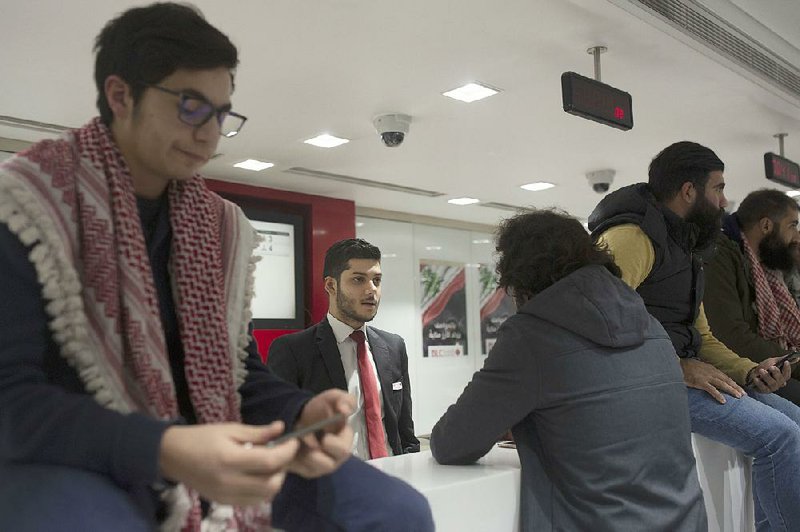
by MAYA ALLERUZZO The Associated Press -- BEIRUT -- Dozens of Lebanese protesters held a brief sit-in inside a bank in Beirut and another in the country's south on Saturday, part of their focus on banking policies they complain are inefficient and corrupt. Lebanon is facing its worst economic crisis in decades, while protests against corruption and mismanagement have gripped the country since October. The local currency has lost more than 40% of its value after more than 20 years of being tied to the dollar. Banks are imposing unprecedented capital controls to protect their deposits amid a deepening confidence crisis. Meanwhile, layoffs and salary cuts are becoming the norm, while politicians argue over forming a new government.
Dozens of protesters entered a private bank in the commercial Hamra district in Beirut, protesting capital controls and insisting that no one would leave without the money they came for. Banks have put a withdrawal ceiling of $200 a week on most accounts, while totally blocking outside transfers. "Thieves! Thieves!" two dozen protesters chanted, some sitting on counters and others on the floor. Bank staff watched and security guards did not interfere. The protesters later helped a woman with a cane get to the second floor, again shouting that she wouldn't leave until she got the money she needs. The protesters posted videos of their actions on a Twitter account linked to the protest movement.
by naharnet – The Lebanese judiciary has launched an investigation into reports claiming that nine Lebanese politicians have transferred $2 billion abroad …

By Ester Carpenter -- Five Gen-Zer squatted in early November on a small pile of rubbish in the middle of Martyrerplatz in downtown Beirut. In white gloves, they sorted bottle caps, cigarette butts, mouthpieces for hookahs, adhesive tape and plastic food packaging – all waste of the protests from the previous day. Although the five were students, they had not been in class for 26 days. Some of her teachers were upset, but the activists thought cleaning up after the protests that had hit the country since mid-October was more important than learning. They wanted to show the country how to take care of themselves, said 17-year-old Paul Hanna and took a break from sorting. “Without recycling, most of the garbage goes into the sea.” “We don’t want to see garbage on the street,” said Mira Raheb, also 17. “If we clean here, it will change (the mentality).”
Like youth activists around the world, Lebanese environmentalists reject the status quo, which means in Lebanon to protest against rampant government corruption, a sluggish economy and a long list of environmental issues that dominate everyday life. Hoping to take advantage of the current unrest, they are also working to make the country greener. Since the end of the civil war in the 1990s, Lebanon has not been able to provide its citizens with 24/7 electricity, a functioning public transport network, proper waste disposal, or drinking water. The lack of basic supplies has a particularly severe impact on poor families and working-class families, and the environment also suffers from people turning to diesel-powered generators and relying on plastic water bottles.
Last October, wildfire broke out in a forested area south of Beirut that quickly got out of control and set fire to more than 3,000 acres. Hot, windy conditions played a role, but so did the government’s incompetence (three privately donated fire helicopters were in poor condition at a nearby airport). Five days later, over a million Lebanese were on the streets demanding the government’s resignation. Prime Minister Saad Hariri had resigned until the end of October. “The forest fires were an important forerunner of the revolution.” “The forest fires were an important forerunner of the revolution,” said 36-year-old Adib Dada. As part of the protests, Dada, an environmental architect and biomimics specialist, led a guerrilla gardening project that planted 30 native trees and shrubs in downtown Beirut, a group called Regenerate Lebanon.

By Najia Houssari by eurasiareview.com -- Widespread anger at Lebanese banking restrictions boiled over on Saturday when dozens of protesters stormed a Beirut branch following its refusal to deliver employees’ salaries in US dollars. The protest group, made up mainly of Communist Party members, occupied the BLC bank’s Hamra branch and staged a sit-in over what they described as “the false practices of the banks.” Lebanon’s banks have imposed weekly limits on withdrawals of US dollars amid a shortage in liquidity as the country grapples with its worst economic and financial crisis in more than three decades. The restrictions have added to mounting anger over job layoffs, salary cuts and rapidly rising prices. The Communist Party later issued a statement saying that the sit-in resulted in “all customers receiving their money and deposits, which confirms the false practices of the banks, as the administration claimed that the dollar was not available inside the branch, which turned out to be untrue.”
On Thursday, protesters staged a sit-in outside the central bank and the Lebanese Banks’ Association building in protest against the banks’ policies amid unprecedented capital controls. Banks’ strict controls on releasing hard currency have added to the liquidity crisis on top of an economic downturn. Meanwhile, attempts to form a national salvation government stalled after a number of Sunni political figures refused to accept ministerial positions in the leadership. The Future Movement, the largest Sunni parliamentary bloc, is boycotting attempts to establish a new government. Nasser Yassin, acting director of the Issam Fares Institute for Public Policy and International Affairs at the American University of Beirut, told Arab News that he had rejected a request to take up a ministerial position. Yassin described the portfolio as a “suicide mission.” “I am not enthusiastic in the current circumstances,” he said.

Population Movements to Keserwan - The Khazens and The Maans
ما جاء عن الثورة في المقاطعة الكسروانية
ثورة أهالي كسروان على المشايخ الخوازنة وأسبابها
Origins of the "Prince of Maronite" Title
Growing diversity: the Khazin sheiks and the clergy in the first decades of the 18th century
Historical Members:
Barbar Beik El Khazen [English]
Patriach Toubia Kaiss El Khazen(Biography & Life Part1 Part2) (Arabic)
Patriach Youssef Dargham El Khazen (Cont'd)
Cheikh Bishara Jafal El Khazen
Patriarch Youssef Raji El Khazen
The Martyrs Cheikh Philippe & Cheikh Farid El Khazen
Cheikh Nawfal El Khazen (Consul De France)
Cheikh Hossun El Khazen (Consul De France)
Cheikh Abou-Nawfal El Khazen (Consul De France)
Cheikh Francis Abee Nader & his son Yousef
Cheikh Abou-Kanso El Khazen (Consul De France)
Cheikh Abou Nader El Khazen
Cheikh Chafic El Khazen
Cheikh Keserwan El Khazen
Cheikh Serhal El Khazen [English]
Cheikh Rafiq El Khazen [English]
Cheikh Hanna El Khazen
Cheikha Arzi El Khazen
Marie El Khazen