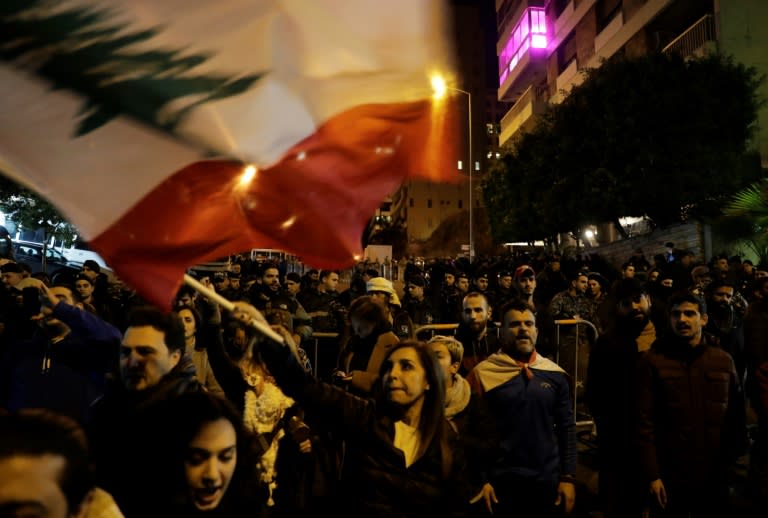
by middleeasteye.net -- Protesters gathered outside the Beirut home of Lebanon's new prime minister on Saturday, calling for Hassan Diab's resignation less than 10 days after he was appointed. Lebanon is without a cabinet and in the grips of a deepening economic crisis after a two-month-old protest movement forced Saad Hariri to stand down as prime minister on 29 October. Anti-government protests continued after Hariri's resignation, while political parties negotiated for weeks before nominating Diab, a professor and former education minister, to replace him on 19 December, AFP said.
Echoing protester demands, Diab promised to form a government of independent experts within six weeks - in a country where appointing a cabinet can take months. But protesters on Saturday were unconvinced by his promise. "We're here to bring down Hassan Diab. He doesn't represent us. He's one of them," said one young demonstrator, referring to the country's ruling elite, who protesters despise collectively. Lina, another protester agreed, saying: "It's the revolution that must name the prime minister, not them." The 60-year-old Diab, who has a low public profile and styles himself as a technocrat, last week called protester demands legitimate but asked them to give him a chance to form "an exceptional government". "We are willing to give him a chance, but let us at least give him a roadmap," Lina told AFP. The protests and political deadlock have brought Lebanon to its worst economic crisis since the 1975-1990 civil war. The international community has urged a new cabinet be formed swiftly to implement economic reforms and unlock international aid. Lebanon urgently needs a new government to pull it out of the long-brewing crisis. Foreign donors say they will only help after there is a cabinet that can enact reforms, Reuters reported. Lebanon is grappling with its worst economic crisis in decades and battered confidence in its banking system. The risk of devaluation has risen in a country with one of the world's biggest foreign debt burdens.
Foreign debt burden

by albawaba.com -- A probe has started into the billions of dollars sent overseas from Lebanon amid a political crisis that has gripped the country for months, with the country’s central bank chief warning that “nothing can disappear.” Lebanon is experiencing a severe liquidity crunch in light of an economic downturn, political gridlock and massive protests, factors that have triggered a crisis of confidence inside and outside the country. Banque du Liban governor, Riad Salamé, said: “People may do as they please with their money, but if suspicious funds were transferred in 2019, we will investigate them, and investigations start in Lebanon. We will do whatever we are legally permitted to do to verify all the transfers that took place. Nothing can disappear. The central bank is addressing the gradual crisis, and we hope the decisions we have taken to increase the banks’ capital will help the country recover so that the economy can improve.” He did not blame civil society for the deterioration of the Lebanese lira’s exchange rate against the dollar. After Oct. 17, the date on which the protests erupted, he said that the banks closed for two weeks and it was this shuttering that created turmoil in the financial market.
The dollar’s exchange rate at shops has reached 2,100 liras, but Salamé said there was no change in the official rate which is set at 1507.50. A parliamentary finance and budget committee said overseas remittances worth billions of dollars were made from Lebanese banks. “Approximately $11 billion of bank money has ended up overseas,” said MP Hassan Fadlallah, while committee head Ibrahim Kanaan said Lebanese people’s concerns over the domestic situation had led to the withdrawal of $6 billion from banks. People braved bitter conditions to protest outside a banking association’s headquarters and Banque du Liban branches. There is a campaign to confront banks withholding the money of small depositors. Protesters urged people to stop making loan repayments, condemning banking policies and corruption. Security measures around banks have failed to deter anger, with people demanding money and salaries from staff.
BEIRUT, Dec. 27 (Xinhua) — An official of the World Food Program (WFP) urged on Friday the return of Syrian refugees in …
by reuters — Lebanon’s central bank governor said on Thursday “nobody knows” how much more the cost of dollars could rise on …


Population Movements to Keserwan - The Khazens and The Maans
ما جاء عن الثورة في المقاطعة الكسروانية
ثورة أهالي كسروان على المشايخ الخوازنة وأسبابها
Origins of the "Prince of Maronite" Title
Growing diversity: the Khazin sheiks and the clergy in the first decades of the 18th century
Historical Members:
Barbar Beik El Khazen [English]
Patriach Toubia Kaiss El Khazen(Biography & Life Part1 Part2) (Arabic)
Patriach Youssef Dargham El Khazen (Cont'd)
Cheikh Bishara Jafal El Khazen
Patriarch Youssef Raji El Khazen
The Martyrs Cheikh Philippe & Cheikh Farid El Khazen
Cheikh Nawfal El Khazen (Consul De France)
Cheikh Hossun El Khazen (Consul De France)
Cheikh Abou-Nawfal El Khazen (Consul De France)
Cheikh Francis Abee Nader & his son Yousef
Cheikh Abou-Kanso El Khazen (Consul De France)
Cheikh Abou Nader El Khazen
Cheikh Chafic El Khazen
Cheikh Keserwan El Khazen
Cheikh Serhal El Khazen [English]
Cheikh Rafiq El Khazen [English]
Cheikh Hanna El Khazen
Cheikha Arzi El Khazen
Marie El Khazen