by AP — BEIRUT – Dozens of protesters staged a sit-in outside the central bank and the Lebanese Banks’ Association building Thursday …
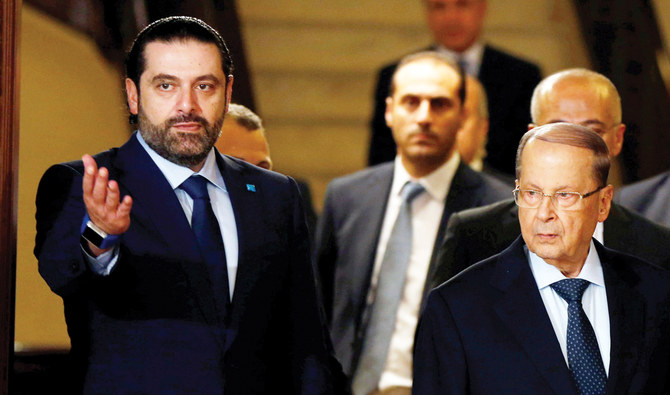
by arabnews.com -- BEIRUT: Tensions between Lebanon’s president and former prime minister have flared after they accused each other of being to blame for the turmoil engulfing the country. A recession, massive street protests and a political crisis have created financial and security chaos. Lebanon has had a caretaker government since Oct. 29, when Saad Hariri resigned as prime minister after nearly two weeks of protests. He has clashed with President Michel Aoun about the leadership and composition of a new administration. “The problem with the president is that he is acting as if nothing has happened in the country, and he is trying to act smart by endorsing the demands of the revolution, and my stance is clear, I will not be represented in this government and I will not nominate anyone, nor will I give it a confidence vote,” said Hariri. “Now they are targeting the political legacy of the Hariri family, and they will try to hold it responsible for all the calamities that have befallen the country, but whoever tries to bury Hariri’s legacy will be as if he would be burying himself. Let us see who really stole from the country. I will not cover anyone, and they should do the same thing.”
Aoun responded to Hariri by saying: “Does he envy me for my resilience and calmness in trying to control the situation, or does he want me to act foolishly and badly? We waited for 100 days for him (Hariri) and nothing came out. We waited for someone who kept hesitating. I want, and I do not want, as if someone was playing with a daisy. A government cannot be formed in this manner.”

The Daily Star BEIRUT: Caretaker Prime Minister Saad Hariri launched Tuesday his harshest criticism yet of Gebran Bassil, saying he would not work again with the Free Patriotic Movement leader unless he abandons his "sectarian and racist" speech. "How can you work with someone who is always insulting you? How can you work with such people whose speech is sectarian and racist?" Hariri told a group of reporters at his Downtown Beirut home. "I will not work again with Gebran Bassil, unless he moderates [his policies]." Hariri said that the Future Movement would not be represented in any new government formed by PM-designate Hassan Diab and, for the first time, indicated that the party would not give such a government a vote of confidence in parliament. "I will not be represented, take part in or cover the new government. If required, I will not give it a vote of confidence." Asked how he would describe Diab's cabinet – should he succeed in forming one with the backing of the FPM, Hezbollah and the Amal Movement – Hariri said: "The government of Gebran Bassil." The outgoing premier said he did not regret his decision to resign in response to nationwide protests that erupted on Oct. 17, nor his refusal to be reappointed unless it was on his terms. "I don't regret my decision," Hariri said. "My conscience is clear. All my work is to preserve the country."

Beirut- Asharq Al-Awsat -- Lebanon's caretaker finance minister accused the country's banks on Tuesday of "trapping" civil servants' salaries with withdrawal limits that have fuelled public anger in the crisis-stricken country. "What is happening in some Lebanese banks is unacceptable," Ali Hassan Khalil wrote on Twitter. "They are trapping the salaries of (state) employees that are transferred by the finance ministry every month." Rocked by two months of anti-government protests and a political deadlock, Lebanon is also facing its worst economic crisis since the 1975-1990 civil war. A liquidity crunch has pushed Lebanese banks to impose capital controls on dollar accounts, capping withdrawals at around $1,000 a month. Some have imposed even tighter restrictions. Some have also capped weekly withdrawals of the Lebanese pound at one million -- the equivalent of $660 at official rates -- even as the currency has plunged by nearly a third against the dollar on the black market in recent weeks. The tightening controls have prompted public uproar, with many accusing banks of robbing them of their savings. On Tuesday, Khalil said it was a "sacred right" of civil servants to be paid in full and on time. "It is not permissible for this right to be violated," he said, vowing legal action to ensure public servants can access their salaries in full. At banks in the northern city of Tripoli, tensions soared Tuesday as clients struggled to withdraw their salaries, said an AFP correspondent there. A fight broke out in a branch near the city's main protest camp after the bank refused to let a customer withdraw dollars. An anti-government street movement has rocked the small Mediterranean country since October 17.


Population Movements to Keserwan - The Khazens and The Maans
ما جاء عن الثورة في المقاطعة الكسروانية
ثورة أهالي كسروان على المشايخ الخوازنة وأسبابها
Origins of the "Prince of Maronite" Title
Growing diversity: the Khazin sheiks and the clergy in the first decades of the 18th century
Historical Members:
Barbar Beik El Khazen [English]
Patriach Toubia Kaiss El Khazen(Biography & Life Part1 Part2) (Arabic)
Patriach Youssef Dargham El Khazen (Cont'd)
Cheikh Bishara Jafal El Khazen
Patriarch Youssef Raji El Khazen
The Martyrs Cheikh Philippe & Cheikh Farid El Khazen
Cheikh Nawfal El Khazen (Consul De France)
Cheikh Hossun El Khazen (Consul De France)
Cheikh Abou-Nawfal El Khazen (Consul De France)
Cheikh Francis Abee Nader & his son Yousef
Cheikh Abou-Kanso El Khazen (Consul De France)
Cheikh Abou Nader El Khazen
Cheikh Chafic El Khazen
Cheikh Keserwan El Khazen
Cheikh Serhal El Khazen [English]
Cheikh Rafiq El Khazen [English]
Cheikh Hanna El Khazen
Cheikha Arzi El Khazen
Marie El Khazen