by naharnet.com — Maronite Patriarch Beshara al-Rahi said in his Christmas message on Tuesday that officials have brought Lebanon to economic and …
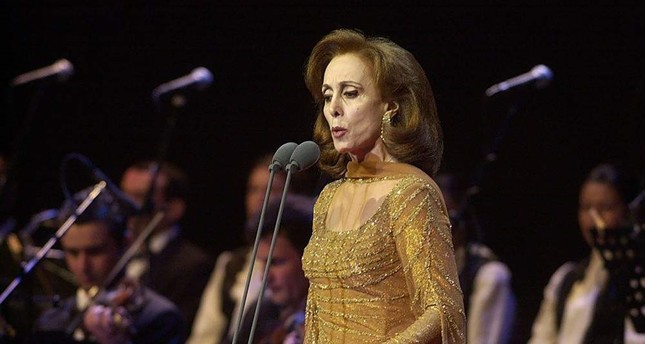
by MEHMET FAHRI DANIŞ dailysabah.com -- Music often becomes a uniting element for nations whose citizens have very little in common: Editf Piaf in France, Elvis Presley in the U.S. and Lys Assia in Sweden. In the case of Lebanon, Fairuz – or Nouhad Haddad by her birth name – holds a very special place as she is equally embraced by the country's multicultural society. The existence of the phenomenon of the nation is closely related to the presence of symbolic motifs that claim to represent it. What makes a community a nation is mostly these symbolic productions that its members unwittingly confirm and participate in producing every day. National anthems and flags, heroes, "sacred" landscapes, national architecture, national cuisines and tourist brochures all contain the archaic emphasis of nationalist movements' attempts to construct links with the past.
'The national symbol'
National symbols allow members of communities to feel like part of the national consciousness. Efforts to maintain ties to this consciousness through popular culture are also made – for example, a company identified with a country and is universally known, national athletes competing in the Olympic games or artists representing their country in musical contests. Today, these can serve as more effective tools for emphasizing national consciousness than an antiquated anthem or national flag. When it comes to Lebanon, the cedar tree motif, a symbol of national character, is an excellent example of a nationalist symbol. Used on the first Lebanese flag designed during the mandate rule established in 1920 and in the flag of independent Lebanon in 1943, this figure serves a symbolic function that links the Lebanese with the Phoenicians on the basis of territorial identity. Another symbol for the country as important as the cedar tree is Fairuz, who began her artistic career during the 1950s.
Fairuz's career
by al-monitor.com -- Sarah Abdallah -- BEIRUT — An economic and financial crisis looms over Lebanon, the third-highest indebted country in the world in terms of debt-to-gross domestic product ratio, which stood at 151% in 2018. “Given the large public debt … [Lebanon's] interest payments now exceed 9% of GDP,” the International Monetary Fund (IMF) said in a July report. The IMF also said, “Deposit growth in 2018 was the lowest since 2005 and the BdL [Bank of Lebanon] reserves have now decreased by around $6 billion since early 2018.” The crisis comes with strict banking procedures. Lebanese banks imposed restrictions on deposits and capped withdrawals. They also suspended housing loans and froze transfers abroad. This led to a US dollar scarcity in the Lebanese market and increased its exchange price against the Lebanese pound. The dollar reached 2,400 Lebanese pounds at the money changers in late November, before settling between 1,980 Lebanese pounds and 2,000 Lebanese pounds in sales and purchases during the second week of December. The official rate, however, remained Dec. 20 at 1,507.5 Lebanese pounds on the Beirut Stock Exchange. Remarkably, the exchange rate in Syria also gyrated, hitting 1,000 Syrian pounds against the US dollar, while its value set by the Syrian Central Bank remained at 434 Syrian pounds.
This has led many to wonder about the connection between the two monetary crises. Some Lebanese fear that large amounts of dollars are being smuggled from Lebanon to Syria. But the dollar scarcity in Lebanon has led to the same condition in Syria. Many Syrians hold bank accounts in Lebanon, which at one time was a much more stable market. Now, though, these accounts are being frozen or restricted. US sanctions prohibit American financial institutions from doing business with Syrian banks. Meanwhile, more than 1 million Syrian refugees are registered with the UN High Commissioner for Refugees in Lebanon. The Lebanese government estimates the actual number at 1.5 million Syrians. Add to this the Syrian merchants who deposit their money in Lebanese banks. A Norwegian Refugee Council report quoting World Bank data showed 17% of remittances to Syria come from Lebanon, second only to Saudi Arabia, with 29% of total financial remittances.
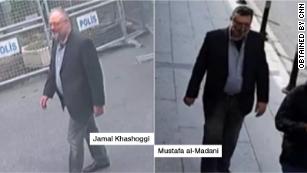
By Sarah El Sirgany and Lauren Said-Moorhouse -- (CNN) -- Saudi Arabia has sentenced five people to death for the murder of journalist Jamal Khashoggi but cleared a former top adviser to Crown Prince Mohammed bin Salman, a public prosecutor said Monday. There was no evidence against Saud al-Qahtani, Saudi Deputy Public Prosecutor Shaalan al-Shaalan announced in a televised press conference Monday. A court also dismissed charges against Ahmed al-Assiri, a former deputy intelligence chief, and Mohammed al-Otaibi, Saudi's consul general in Istanbul when the murder took place, he said. Al-Qahtani and al-Otaibi were sanctioned a year ago by the US Treasury for their alleged involvement in the murder. Both al-Qahtani and al-Assiri were part of Crown Prince Mohammed bin Salman's inner circle and were relieved of their duties in the immediate aftermath of Khashoggi's killing in October 2018. "Saud al-Qahtani was questioned by the public prosecution and was not charged because there was no evidence against him," al-Shaalan said.
Reading preliminary rulings for 11 people who have been investigated by Saudi Arabia, al-Shaalan said five others who took part in the murder had been sentenced to death. Another three people face a total of 24 years in prison for covering up the murder and violating regulations. He did not reveal any of their names. Khashoggi -- a Washington Post columnist and royal insider-turned-critic -- was last seen entering the Saudi consulate in Istanbul on October 2, 2018. He had expected to collect documents for his upcoming wedding but was instead killed and allegedly dismembered in the building. His remains are yet to be found.
Verdict slammed as 'a mockery'
The murder drew international condemnation and the CIA concluded that bin Salman personally ordered the killing. Riyadh's version of events on October 2 have repeatedly shifted as new details have emerged but it has always maintained that neither bin Salman nor his father King Salman knew of the operation to target Khashoggi. US officials, however, have said such a mission -- including 15 men sent from the Kingdom -- could not have been carried out without the authorization of bin Salman. Khashoggi's son Salah described the ruling as "fair" on Twitter Monday. "A fair judiciary is based on 2 principles: justice and quick proceedings. Today's judiciary was fair to us, the sons of Jamal Khashoggi," wrote Salah, Khashoggi's eldest son who handles the family's relations with the government. "We affirm our confidence in Saudi judiciary on all its levels as it ruled in our favor and achieved justice." Earlier this year, Salah took to Twitter to deny that a settlement had been reached between his family and the Saudi government after a source told CNN that Khashoggi's family have received millions of US dollars in cash and assets as compensation for the killing. But Hatice Cengiz, Khashoggi's fiancée, said the Saudi announcement was "not acceptable." In a post on Twitter on Monday, Cengiz wrote that she would never forget Khashoggi, nor his "murderers" or "those who are trying to cover up" his murder.




Population Movements to Keserwan - The Khazens and The Maans
ما جاء عن الثورة في المقاطعة الكسروانية
ثورة أهالي كسروان على المشايخ الخوازنة وأسبابها
Origins of the "Prince of Maronite" Title
Growing diversity: the Khazin sheiks and the clergy in the first decades of the 18th century
Historical Members:
Barbar Beik El Khazen [English]
Patriach Toubia Kaiss El Khazen(Biography & Life Part1 Part2) (Arabic)
Patriach Youssef Dargham El Khazen (Cont'd)
Cheikh Bishara Jafal El Khazen
Patriarch Youssef Raji El Khazen
The Martyrs Cheikh Philippe & Cheikh Farid El Khazen
Cheikh Nawfal El Khazen (Consul De France)
Cheikh Hossun El Khazen (Consul De France)
Cheikh Abou-Nawfal El Khazen (Consul De France)
Cheikh Francis Abee Nader & his son Yousef
Cheikh Abou-Kanso El Khazen (Consul De France)
Cheikh Abou Nader El Khazen
Cheikh Chafic El Khazen
Cheikh Keserwan El Khazen
Cheikh Serhal El Khazen [English]
Cheikh Rafiq El Khazen [English]
Cheikh Hanna El Khazen
Cheikha Arzi El Khazen
Marie El Khazen