By BEIRUT, Lebanon — After a nearly two-hour wait at his bank, in early November, Fadi Aziz, a freelance web designer in Beirut, asked the teller to withdraw $1,000 from his account. The teller was courteous but firm: “You can’t withdraw more than $300 per week.” Mr. Aziz, who was traveling out of the country, protested that he needed the money. He insisted that the $300 limitation was illegal, that there had been no official circulars to decree it. He was ushered in to see the branch manager. This branch manager is notorious for the way she deals with customers — through the cold, inhuman logic of capital. Once, years ago, I called from abroad because I was having a problem with my debit card. She snidely inquired whether it was even worth fixing the problem considering how little money I seemed to be earning. She was no different with Mr. Aziz. “On accounts like yours, sir,” she said, with her usual sneer, “we’ve capped the withdrawal limit at $300.” More important customers would, of course, be able to withdraw more cash. Agree to disagree, or disagree better? We'll help you understand the sharpest arguments on the most pressing issues of the week, from new and familiar voices.
The branch manager’s attitude not only reflects the Lebanese banking system’s brazen disregard for customers, it also represents the manner in which the system has been dealing with our money. Lebanese banks have been promising — and paying out — exorbitant interest rates to big depositors from the interest earned on the money they have lent out to the state. The economy is effectively a giant Ponzi scheme. The setup, whereby individual enrichment is achieved through increased public debt, is unsustainable. In Lebanon’s service-based economy, which is heavily reliant on imports and where capital is not invested in improving economic productivity but only in providing a stable dollar peg for the Lebanese lira, it almost guarantees economic collapse. The massive countrywide protests that have entered a second month — and show no sign of letting up — have only somewhat hastened that economic collapse. Set off by a proposed tax on WhatsApp phone calls announced on Oct. 17, the protests are fundamentally about decades of corruption and economic mismanagement. From the outset, protesters have been calling not only for the resignation of the government led by Prime Minister Saad Hariri (which did indeed resign on Oct. 29) but also for an end to the sectarian political system that has served as the perfect environment for corruption.

by arabnews.com -- RANDA TAKIEDDINE -- A gathering of Lebanese anti-government protesters getting haircuts in front of the central bank building in Beirut last week attracted many jokes and much amusement. The protesters were expressing their rejection of a potential move by banks to take a proportion of their depositors’ money — known as a “haircut” — as a result of the country’s ongoing financial crisis. The demonstrators were having fun and enjoying this original way of protesting despite their fears over the uncertainty of the outcome of their popular uprising against corruption and the failures of the political classes. Salim Sfeir, the head of the Association of Banks in Lebanon, said in an interview with Reuters that a haircut would not solve the problem and, on the contrary, would scare off customers. The Lebanese diaspora has plenty of money overseas and this money would never come back if there was a haircut, Sfeir said. The Lebanese economy is experiencing its worst crisis since the civil war began in 1975. Government debt amounts to $88.4 billion — 150 percent of Lebanon’s gross domestic product. However, despite the liquidity crisis that is endangering the country, Lebanon last week settled a maturing $1.5 billion Eurobond, signaling to the market that, despite the political and economic crisis, it has not defaulted.
But the political stalemate — with the political class denying the people’s demands for a new government of honest, independent people — is aggravating the financial situation. The banks were shut at the beginning of the protest for two weeks. They reopened last week but limited weekly withdrawals to $1,000 and restricted transfers abroad. Added to that, depositors can only withdraw money in Lebanese pounds, which they can change for US dollars with an exchange agent. As a result of this unofficial market, the dollar rate reached as high as 2,000 Lebanese pounds, even though the currency is officially pegged to the dollar at 1,500. These measures have created panic among the people. A growing fear surfaced about the possibility of banks failing to give money to their depositors. The confidence of nonresident depositors has been lost. Banks have been targeted by many protesters, some shouting at central bank governor Riad Salame to “give us back the stolen money.” Rumors have spread in the cities, with crowds rushing to the banks to withdraw money. The central bank said last week that it was allowing banks to borrow dollars without limits at 20 percent interest to secure depositors’ needs, but stressed that the funds should not be sent abroad. The Institute of International Finance said that deposits had dropped by more than $10 billion dollars since the end of August. An important part of this money was sent abroad, while more than $4 billion of it is being kept in people’s homes.
Hezbollah and its allies are dragging their feet with no concern for the demands of the people. Randa Takieddine
by bangkokpost.com — PARIS – A French-Lebanese engineer has been chosen as secretary general of the Renault-Nissan-Mitsubishi auto alliance, part of a …

by courant.com -- By BY BASSEM MROUE -- Overnight confrontations between supporters and opponents of Lebanon's president — mostly fistfights and stone throwing — erupted in cities and towns across the country, injuring dozens of people, and 16 people were detained for their involvement, the Lebanese Red Cross and the army said Wednesday. The nationwide uprising against the country's ruling elite has remained overwhelmingly peaceful since it began Oct. 17, but as the political deadlock for forming a new government drags on, tempers have risen. President Michel Aoun has yet to hold consultations with parliamentary blocs on choosing a new prime minister after the government resigned a month ago. Outgoing Prime Minister Saad Hariri , who was Aoun's and the militant Hezbollah's favorite to lead a new Cabinet, withdrew his candidacy for the premiership, saying he hoped to clear the way for a solution to the political impasse after over 40 days of protests. Protesters have resorted to road closures and other tactics to pressure politicians into responding to their demands for a new government.
The prolonged deadlock is awakening sectarian and political rivalries, with scuffles breaking out in areas that were deadly front lines during the country's 1975-90 civil war. The most recent violence first began Sunday night after supporters of the two main Shiite groups, Hezbollah and the Amal Movement of Parliament Speaker Nabih Berri, attacked protesters on Beirut's Ring Road. That thoroughfare had in the past connected predominantly Muslim neighborhoods in the city's west with Christian areas in the east. Intense clashes took place Tuesday night between people in the Shiite suburb of Chiyah and the adjacent Christian area of Ein Rummaneh, where stones were hurled between supporters of Hezbollah and rival groups supporting the right-wing Christian Lebanese Forces. A shooting in Ein Rummaneh in April 1975 triggered the 15-year civil war that killed nearly 150,000 people. Also on Tuesday night, supporters and opponents of Aoun engaged in fistfights and stone throwing in the northern city of Tripoli, Lebanon's second largest, injuring 24 people; seven were hospitalized.
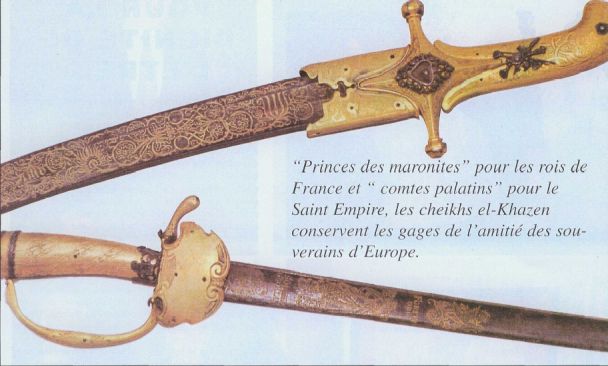
Population Movements to Keserwan - The Khazens and The Maans
ما جاء عن الثورة في المقاطعة الكسروانية
ثورة أهالي كسروان على المشايخ الخوازنة وأسبابها
Origins of the "Prince of Maronite" Title
Growing diversity: the Khazin sheiks and the clergy in the first decades of the 18th century
Historical Members:
Barbar Beik El Khazen [English]
Patriach Toubia Kaiss El Khazen(Biography & Life Part1 Part2) (Arabic)
Patriach Youssef Dargham El Khazen (Cont'd)
Cheikh Bishara Jafal El Khazen
Patriarch Youssef Raji El Khazen
The Martyrs Cheikh Philippe & Cheikh Farid El Khazen
Cheikh Nawfal El Khazen (Consul De France)
Cheikh Hossun El Khazen (Consul De France)
Cheikh Abou-Nawfal El Khazen (Consul De France)
Cheikh Francis Abee Nader & his son Yousef
Cheikh Abou-Kanso El Khazen (Consul De France)
Cheikh Abou Nader El Khazen
Cheikh Chafic El Khazen
Cheikh Keserwan El Khazen
Cheikh Serhal El Khazen [English]
Cheikh Rafiq El Khazen [English]
Cheikh Hanna El Khazen
Cheikha Arzi El Khazen
Marie El Khazen