By Zerina Kapetanovic, Ranveer Chandra, Tusher Chakraborty, and Andrew Nelson -sinews.siam.org ---
The global demand for food is expected to increase by 70% by the year 2050 compared to 2010 levels. Achieving this increase in food production has become even more challenging as the resources we rely on are starting to diminish. For instance, water levels are receding, the amount of arable land is decreasing, and climate change has become more imminent. Data driven agriculture techniques can help alleviate the world’s food problem by reducing waste in resources, increasing yield, and ensuring sustainable farming practices. In particular, studies have shown that precision irrigation techniques can increase yield by 45% all the while reducing water intake by 37% [1]. Such results extend to other precision agriculture techniques as well. While the efficacy of data driven agriculture has been demonstrated, these techniques are sparsely adopted in today’s farming practices. This is primarily due to the expensive cost of data collection and the challenging environment of typical farming locations.
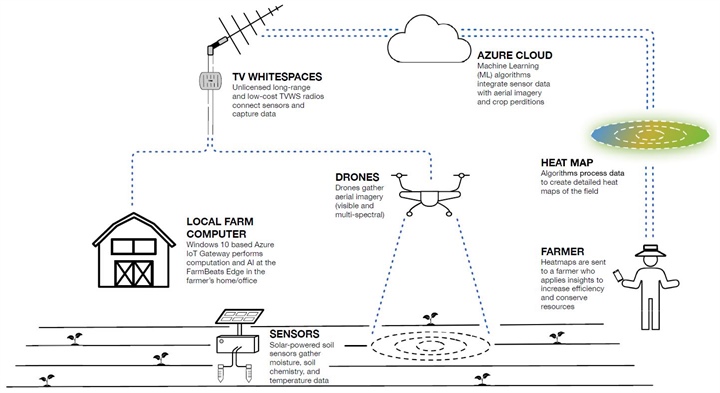
To enable data driven agriculture, a seamless data collection system is needed. In other words, this would be an end-to-end IoT system where sensors collect data, such as soil moisture or temperature, and stream to the cloud to perform data analytics. In turn, providing insights for farmers to enable precision agriculture techniques. For example, soil moisture data can be used to determine where water should be applied and where it is not needed. However, enabling an IoT system for agriculture faces several significant challenges, those being power, connectivity, and overall system cost.
![Millions of Lebanese have been affected by unofficial capital controls imposed on their withdrawals from banks, as the government fears capital flight [File: Jamal Saidi/Reuters]](https://www.aljazeera.com/mritems/imagecache/mbdxxlarge/mritems/Images/2019/11/27/8a776153eaa448f4bd25c86c43f23729_18.jpg)
by aljazeera.com -- Leila Molana-Allen -- Lebanon has close to $1.5bn in public debt that it may decide to repay on Thursday. The country's escalating financial crisis and weeks-long anti-government protests are adding more pressure to an already difficult situation. At $86bn, Lebanon's sovereign debt is the world's third-highest relative to gross domestic product (GDP). The country's beleaguered economy is expected to contract by 0.2 percent this year. In an effort to calm protesters and to reduce the deficit from the current 11 percent to 0.6 percent by 2020, the government recently proposed a reform package. However, because talk of a tax on the internet partly fuelled the initial protests, ministers avoided tax increases on individuals and instead proposed using a bank contribution of $3.4bn to alleviate the deficit, alongside other proposals. For protesters however, many of whom want the wholesale removal of the prevailing political class, the move was too little, too late.
While anti-government protests have lowered confidence in the economy still further, the crisis was in motion well before the demonstrations began. The situation was compounded after Prime Minister Saad Hariri resigned on October 29, leaving in place a caretaker government without the bureaucratic powers to introduce the necessary economic reforms. On Tuesday protesters gathered around the central bank, wearing masks of Central Bank governor Riad Salameh's face and chanting "Thief, thief, Salameh is a thief!" The following day they were back, this time with a Beirut hairdresser offering free haircuts in front of the building "to show them how to give a haircut", according to a poster advertising the event. The scene references proposals by some economists that the central bank should confiscate a certain percentage from the highest depositors' accounts, a financial haircut on those who benefitted the most from high interest rates, in order to relieve the debt burden. "We have to find a solution, and the solution must not be [borne by] the poor people,' said protester Enas Sherry. "They benefitted from the interest, which was very high over the years, so they have to pay what they took from us."
'A regulated Ponzi scheme'

by coindesk.com -- Leigh Cuen -- News of Lebanese banks shuttering to prevent a bank run was met with predictable enthusiasm from the global bitcoin commentariat. People in Lebanon can no longer send foreign currencies, mainly dollars and euros, abroad. Further, due to heavily restricted banking access and limited liquidity provided by established grassroots networks, most Lebanese civilians also struggle to acquire bitcoin. Long-time bitcoiner Ali Askar, currently on the ground in Lebanon, told CoinDesk a few Telegram and WhatsApp groups for local traders have nearly doubled in size over the past year, with one such private group reaching roughly 300 members this past weekend. Following news of the banking limitations, the Beirut-based car dealership Rkein Motors promptly started accepting bitcoin payments this week. Clearly, awareness is spreading.
However, a stark disconnect between daily bitcoin users and the rest of the populace continues in a region plagued by economic and political conflict. “Bitcoin will not help the people. It will help the politicians because they are the filthy rich ones who have access to money,” one anonymous bitcoin trader with family in Lebanon told CoinDesk. He uses a European bank account to buy bitcoin, then sends it to people on the ground in Lebanon. “It [bitcoin] could help them, perhaps, if they were sitting at home with 24 hours worth of electricity and internet, and they could work online to get paid for their online work. That’s a utopian scenario,” he added. “In Lebanon, the internet is very expensive. Electricity doesn’t come often. We sometimes have electricity for just six hours a day.”
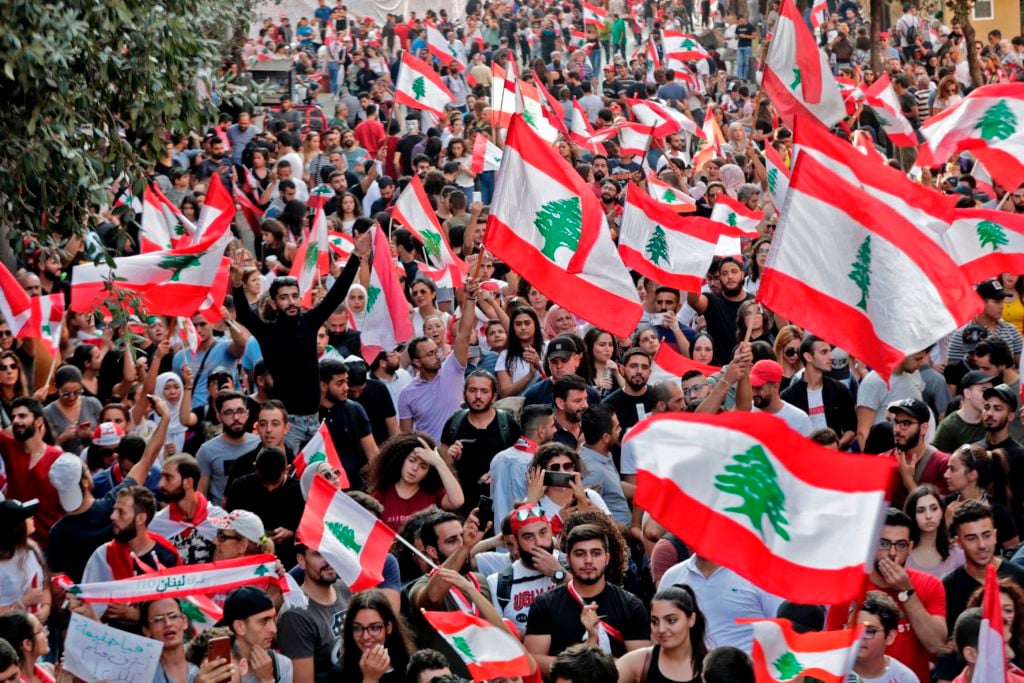
By Rebecca Collard --- foreignpolicy.com -- BEIRUT—It was the sort of chant that, only a month or so ago, would have been all but unthinkable in Lebanon. “Terrorists, terrorists, Hezbollah are terrorists,” yelled some of the hundreds of anti-government protesters who stood on a main road in Beirut early Monday morning, in a tense standoff with supporters of Hezbollah and another Shiite party, the Amal Movement. Other protesters told the chanters to stop, but as widespread economic discontent and anger engulf Lebanon—and with Hezbollah leader Hassan Nasrallah defending the government—the sanctity around Hezbollah’s reputation is clearly broken.
“Hezbollah is being seen as part and parcel [of] the main hurdle to change in Lebanon,” said Mohanad Hage Ali, a fellow at the Carnegie Middle East Center. The demonstrations have been mostly peaceful and unilaterally against the whole ruling class—all sects, all political parties. And until recently Nasrallah, who doesn’t have an official government position, was seen as above the endemic corruption that has helped push the country toward a collapse, particularly among Hezbollah’s Shiite support base. Hezbollah’s expulsion of Israeli troops from Lebanese territory in 2000 earned the group the moniker “the resistance” among Lebanese of all sects and political affiliations. Even after the 2006 war, which left swaths of Lebanon in ruins, the group enjoyed popular support for what many here saw as a victory against Israeli aggression by defenders of the country. In May 2008, Hezbollah fighters took over central Beirut after the government threatened to shut down the group’s telecommunications network and remove an ally in charge of airport security, pointing their weapons inside rather than toward the border for the first time.
And as Hezbollah sent thousands of fighters across the border to fight in Syria in support of President Bashar al-Assad in 2013, more people questioned exactly whom Hezbollah was defending. The group’s reputation has been fading further since the first days of protests in mid-October, which saw large crowds take to the streets in primarily Shiite areas such as Tyre and Nabatieh. Suddenly, with demonstrators there shouting similar anti-government slogans as protesters in Beirut—who want all the current sectarian political leaders gone and new elections under a new system— Hezbollah found itself part of the targeted establishment. The protests are seen as a direct challenge to the gains made by Hezbollah in the 2018 elections and a threat to the organization’s foreign-policy agenda, said Hage Ali.



Population Movements to Keserwan - The Khazens and The Maans
ما جاء عن الثورة في المقاطعة الكسروانية
ثورة أهالي كسروان على المشايخ الخوازنة وأسبابها
Origins of the "Prince of Maronite" Title
Growing diversity: the Khazin sheiks and the clergy in the first decades of the 18th century
Historical Members:
Barbar Beik El Khazen [English]
Patriach Toubia Kaiss El Khazen(Biography & Life Part1 Part2) (Arabic)
Patriach Youssef Dargham El Khazen (Cont'd)
Cheikh Bishara Jafal El Khazen
Patriarch Youssef Raji El Khazen
The Martyrs Cheikh Philippe & Cheikh Farid El Khazen
Cheikh Nawfal El Khazen (Consul De France)
Cheikh Hossun El Khazen (Consul De France)
Cheikh Abou-Nawfal El Khazen (Consul De France)
Cheikh Francis Abee Nader & his son Yousef
Cheikh Abou-Kanso El Khazen (Consul De France)
Cheikh Abou Nader El Khazen
Cheikh Chafic El Khazen
Cheikh Keserwan El Khazen
Cheikh Serhal El Khazen [English]
Cheikh Rafiq El Khazen [English]
Cheikh Hanna El Khazen
Cheikha Arzi El Khazen
Marie El Khazen