middle-east-online.com -- BEIRUT - Lebanese student Fatima Jaber's family is struggling to pay off multiple loans with double-digit interest rates. Even before the start of protests that have forced out Lebanon's prime minister, her confidence was fading in a financial system long regarded as a pillar of stability. But now, like many Lebanese, she thinks the system is broken.
The loss of trust is eroding liquidity in the banking sector, increasing concerns that banks may not be able to help the government fund high budget and current account deficits. One of the world's most indebted countries, Lebanon has a public debt equal to about 150% of its gross domestic product. "We need a change to the system because everyone has at least one loan from the bank and the rates are very high and we can't pay them," said Jaber, 22, as she and a small crowd protested outside the central bank in the capital, Beirut. Dollar loans have to be repaid in the same currency, which is especially difficult because there is a hard currency squeeze in Lebanon. With big banks' websites showing the annual interest on some loans is about 27%, any people are in dire straits.
Central bank governor Riad Salameh sought to ease concerns on Monday, saying the bank had a usable foreign cash reserve of $30 billion and total assets of $38 billion. The central bank has taken steps to protest depositors by ensuring no bank would fail and will seek to lower interest rates through liquidity management, he said. But the imposition by banks of controls on dollar withdrawals and transfers overseas has failed to rebuild confidence.

by middleeasteye.net -- Violence flared-up in Lebanon on Wednesday following the killing of a protester and a televised speech by President Michel Aoun overnight which triggered fresh rage against the country's sectarian leadership. Clashes broke out Wednesday afternoon at the Jal el-Dib bridge and highway, a major route from Lebanon's north to the capital, between protesters blocking the thoroughfare and local residents armed with knives and sticks. A video circulated on social media showed one man shooting into the air and pointing the machine gun towards protesters. A separate video showed protesters disarm the man and smashed the car in which he had arrived. At least four people were injured, local media reported. The Lebanese army intervened later in the afternoon to reopen the road. Hundreds also gathered along a highway leading to the presidential palace in Baabda as Lebanese army officers and riot police placed metal barriers and barbed wire on the road.
Security forces have been criticised for failing to adopt similar measures earlier this month when supporters of Aoun's Free Patriotic Movement (FPM) gathered near the palace to support the president and his son-in-law, FPM leader Gebran Bassil. Aoun had invited protesters to send a delegation to meet with him, but the offer yielded no results. Previous invitations were also turned down as protesters argued it was not possible to appoint representatives to speak on behalf of the leaderless movement. Two main intersections - the Ring Bridge above Beirut’s central district and the Chevrolet intersection in the capital’s southern outskirts - were also blocked by protesters on Wednesday. Scuffles broke out between protesters and army officers at the Chevrolet intersection in the morning as the officers attempted to reopen the roads. No serious injuries were reported. Protesters also occupied the Cola intersection in east Beirut late on Wednesday.
Fight at a roadblock

by reuters.com -- Ellen Francis, Laila Bassam --BEIRUT (Reuters) - President Michel Aoun said on Tuesday Lebanon faced a catastrophe if protesters did not go home, igniting a new wave of demonstrations during which a protester was shot and killed after an altercation with Lebanese soldiers near Beirut. The shooting in Khaldeh south of Beirut was the first of its kind in nearly four weeks of nationwide protests against Lebanon’s ruling elite, escalating tensions in a country mired in deep political and economic crisis. The man who was killed was a member of the political party led by Druze leader Walid Jumblatt, a civil war adversary of Aoun. Jumblatt urged his supporters to remain calm during a visit to the hospital where the man had been taken. In a statement, the army said a soldier had opened fire to disperse protesters who were blocking a road in Khaldeh, wounding one person. The soldier was detained and the incident was under investigation.
Addressing protesters in his interview, he said, “If you continue in this way, you will strike Lebanon and your interests.” “We are working day and night to get the situation in order. If they keep going, there is a catastrophe. If they stop, there is still room for (us) to fix things,” he said. As Aoun’s interview was ending, protesters blocked several main roads across Lebanon, some with burning tyres. Linda Boulos Mikari, protesting on a road north of Beirut, said Aoun’s interview had brought her back onto the street. “We are tired of the authorities always (acting) as if we are doing nothing. The president goes live and talks to us as if we are children, ‘go home’. Respect us a little,” she said.
AOUN FOUND HARIRI “HESITANT” ON BEING PM
by gulfnews.com — Bassam Za za, Special to Gulf News— Beirut: A video of a Lebanese protestor kissing Sky News Arabia’s anchor surprisingly while …
Population Movements to Keserwan - The Khazens and The Maans
ما جاء عن الثورة في المقاطعة الكسروانية
ثورة أهالي كسروان على المشايخ الخوازنة وأسبابها
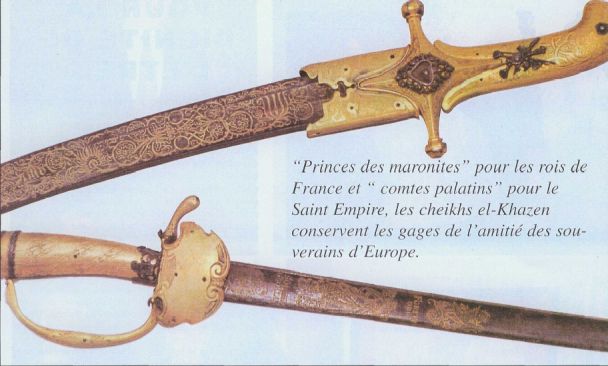
Origins of the "Prince of Maronite" Title
Growing diversity: the Khazin sheiks and the clergy in the first decades of the 18th century
Historical Members:
Barbar Beik El Khazen [English]
Patriach Toubia Kaiss El Khazen(Biography & Life Part1 Part2) (Arabic)
Patriach Youssef Dargham El Khazen (Cont'd)
Cheikh Bishara Jafal El Khazen
Patriarch Youssef Raji El Khazen
The Martyrs Cheikh Philippe & Cheikh Farid El Khazen
Cheikh Nawfal El Khazen (Consul De France)
Cheikh Hossun El Khazen (Consul De France)
Cheikh Abou-Nawfal El Khazen (Consul De France)
Cheikh Francis Abee Nader & his son Yousef
Cheikh Abou-Kanso El Khazen (Consul De France)
Cheikh Abou Nader El Khazen
Cheikh Chafic El Khazen
Cheikh Keserwan El Khazen
Cheikh Serhal El Khazen [English]
Cheikh Rafiq El Khazen [English]
Cheikh Hanna El Khazen
Cheikha Arzi El Khazen
Marie El Khazen