![Demonstrators block access to the state-owned electricity company during anti-government protests in Beirut, Lebanon [Andres Martinez Casares/Reuters]](https://www.aljazeera.com/mritems/imagecache/mbdxxlarge/mritems/Images/2019/11/8/02087cf9ae4f4eedbfdfafa2eab6acce_18.jpg)
Reuters - Lebanese bank staff are facing abuse from customers angered by restrictions on their access to their cash, the employees' union said on Friday, reflecting intensifying pressures in an economy gripped by its deepest crisis since the 1975-90 civil war. With Lebanon paralysed by political and economic turmoil, its politicians have yet to make progress towards agreeing on a new government to replace one that was toppled by an unprecedented wave of protests against the sectarian ruling elite. Saad Hariri, who quit as prime minister last week, is determined that the next government be devoid of political parties. A sectarian cabinet would not be able to secure Western assistance, a source familiar with his view told the Reuters News Agency. He is still seeking to convince the powerful, Iran-backed Shia group Hezbollah and its ally the Amal Movement of the need for such a technocratic government, the source said. Hariri's office could not immediately be reached for comment.
Leading Christian politician Samir Geagea warned of great unrest if supplies of basic goods run short and said Lebanon's financial situation was "very, very delicate". One of the world's most heavily indebted states, Lebanon was already in deep economic trouble before protests erupted on October 17, ignited by a government plan to tax WhatsApp calls and taking aim at rampant state corruption.
'Clients with guns'
by catholicherald.co.uk -- A long-awaited decision to restore a celebrated church in Iraq desecrated by ISIS has been hailed as a turning point in the struggle to keep Christianity alive in one of its most ancient heartlands. Syriac Catholic Archbishop Petros Mouche of Mosul thanked Aid to the Church in Need (ACN) for committing itself to repair the Great Al-Tahira Church (Church of the Immaculate Conception), Qaraqosh (Baghdeda), the largest Christian town in the Nineveh Plains. The plan to restore the church’s fire-damaged interior is one of a series of building projects across Nineveh announced by ACN. Speaking to ACN, Archbishop Mouche said: “For us, [the Great Al-Tahira] Church is a symbol. This church was built in 1932, and it was the villagers of Baghdeda who constructed it. “For this reason, we want this symbol to remain as a Christian symbol to encourage the people, especially the locals of Baghdeda, to stay here. “This is our country, and this is a witness that we can give for Christ.”
ACN has approved 13 other projects to rebuild church properties across the region – all of them damaged and desecrated by ISIS. The charity approved plans to reconstruct the Najem Al-Mashrik Hall and Theatre in Bashiqa, a town occupied by both Christians and Yazidis – a project which will enable the venue to once again play host to wedding ceremonies and other celebrations. Local priest Fr Daniel Behnam said: “This project will help ensure the survival of Christian families and provide them with important services. “In particular, it will help young people, providing a space for pastoral, cultural and youth activities.”

by reuters.com -- By Tom Perry and Tom Arnold -- BEIRUT - Lebanon’s outgoing Prime Minister Saad al-Hariri met President Michel Aoun on Thursday without announcing progress towards forming a new government, and banking sources said most financial transfers out of the country remained blocked. Already facing the worst economic crisis since the 1975-90 civil war, Lebanon has been pitched deeper into turmoil since Oct. 17 by a wave of protests against the ruling elite that led Hariri to resign as prime minister on Oct 29. Banks reopened on Friday after a two-week closure but customers have encountered restrictions on transfers abroad and withdrawals of hard currency.
A banking source said that generally all international transfers were still being blocked bar some exceptions such as foreign mortgage payments and tuition fees. A second banking source said restrictions had gotten tighter. Hariri has been holding closed-door meetings with other factions in the outgoing coalition cabinet over how the next government should be formed, but there have been no signs of movement towards an agreement. Parliament Speaker Nabih Berri said he wanted Hariri to be nominated as prime minister again. Under Lebanon’s sectarian power-sharing system, the prime minister is a Sunni Muslim, the president a Maronite Christian and the speaker a Shi’ite.
Aoun has yet to formally start consultations with lawmakers over nominating the new prime minister. The presidency said Aoun and Hariri discussed contacts aimed at solving “the current government situation”. The protesters have called for a new government that would exclude leaders of Lebanon’s traditional sectarian political blocs. But politicians are still wrangling over its shape. Hariri has held two meetings this week with Gebran Bassil, a son-in-law of Aoun. Both Aoun and Berri are allies of the powerful Iran-backed Shi’ite group Hezbollah.
“A HUGE” COLLAPSE AHEAD

BY foreignpolicy -- BILAL Y. SAAB -- The author of this controversial decision is U.S. President Donald Trump’s National Security Council (NSC), which broke with the enduring U.S. bipartisan consensus on Lebanon policy. But as bold as the White House’s action is, it should come as no surprise. NSC staffers with responsibility for the Middle East have been aggressively trying to repurpose and downsize Lebanon’s military assistance program for more than a year. The effort was spearheaded by former National Security Advisor John Bolton, but it continued apace even after his ousting by Trump on Sept. 10. Even though the Office of Management and Budget did not give a reason for the funding suspension, the NSC’s case should be familiar by now: It argues that Hezbollah controls the Lebanese government and poses a security threat to Israel, and until the LAF shows a greater commitment to challenging the militant party, U.S. military aid will decrease. There’s another argument for the aid freeze that may have little to do with Lebanon. Since assuming office, Trump has strongly favored cutting foreign aid in general because he believes that the United States is not getting enough back from its friends. The NSC has fulfilled his wish by instituting a new foreign assistance policy that is more frugal and more aligned with his “America First” vision. As a recipient of U.S. aid, Lebanon, like several other countries, was a target of cuts—and now a freeze.
None of the NSC’s concerns about Lebanon and Hezbollah are inaccurate or unreasonable. These concerns are shared by senior leadership in the Defense and State departments and U.S. Central Command. Hezbollah, which has more guns and combat experience than the Lebanese military, does wield tremendous influence over politics in Beirut. It alone decides when the country goes to war or makes peace, and it has a predominant say in who gets to be president and prime minister. But the disagreement in the U.S. government is not over the challenge Hezbollah represents to both Lebanon and U.S. policy. That is all crystal clear. Rather, it is over how to most effectively address this challenge. The White House views Lebanon through the narrow prism of its maximum pressure campaign against Iran. And it seems to believe that halting aid to the Lebanese military will somehow compel its leadership to confront Iran’s main ally, Hezbollah. Not only is this based on faulty logic, but it is incredibly ill-advised. The Lebanese military does not have the means, inclination, or authority to forcefully counter Hezbollah. All it can do is continue to present itself to Lebanese society as a credible alternative to the Shiite group, which is a long-term process. Its leadership understands that any attempt at confronting Hezbollah, which even the mighty Israeli army couldn’t do successfully, will result in the splintering of the military along sectarian lines and the possible return to civil war.
Population Movements to Keserwan - The Khazens and The Maans
ما جاء عن الثورة في المقاطعة الكسروانية
ثورة أهالي كسروان على المشايخ الخوازنة وأسبابها
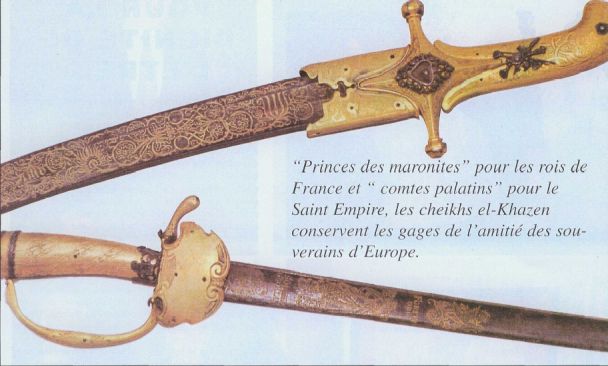
Origins of the "Prince of Maronite" Title
Growing diversity: the Khazin sheiks and the clergy in the first decades of the 18th century
Historical Members:
Barbar Beik El Khazen [English]
Patriach Toubia Kaiss El Khazen(Biography & Life Part1 Part2) (Arabic)
Patriach Youssef Dargham El Khazen (Cont'd)
Cheikh Bishara Jafal El Khazen
Patriarch Youssef Raji El Khazen
The Martyrs Cheikh Philippe & Cheikh Farid El Khazen
Cheikh Nawfal El Khazen (Consul De France)
Cheikh Hossun El Khazen (Consul De France)
Cheikh Abou-Nawfal El Khazen (Consul De France)
Cheikh Francis Abee Nader & his son Yousef
Cheikh Abou-Kanso El Khazen (Consul De France)
Cheikh Abou Nader El Khazen
Cheikh Chafic El Khazen
Cheikh Keserwan El Khazen
Cheikh Serhal El Khazen [English]
Cheikh Rafiq El Khazen [English]
Cheikh Hanna El Khazen
Cheikha Arzi El Khazen
Marie El Khazen