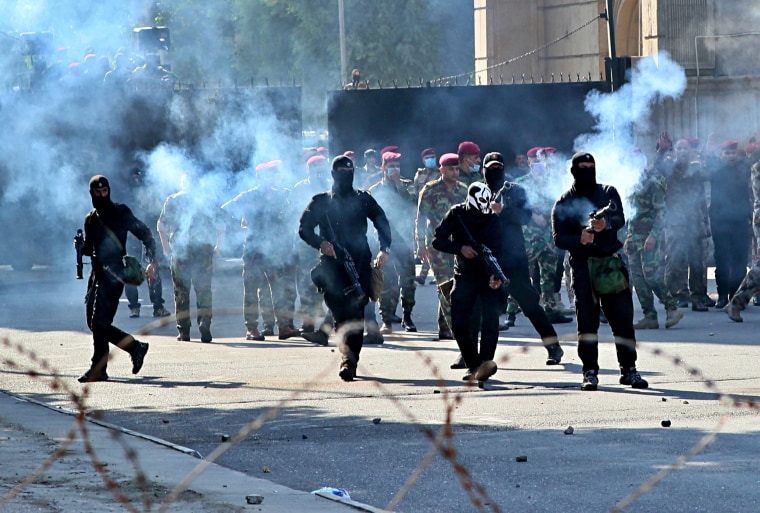
by nbcnews.com -- Saphora Smith -- They came dressed in black and wielding sticks. Images emerged on social media of men widely believed to be supporters of powerful Lebanese militant group Hezbollah tearing through a camp of anti-government protesters in Beirut on Oct. 29, smashing chairs and setting fire to tents. Meanwhile, the anti-corruption protesters regularly can be heard chanting slogans against Sayyed Hassan Nasrallah, the Iran-backed militia and political party’s leader.
The tensions between Hezbollah and the largely leaderless anti-corruption protests sweeping Lebanon are a sign of the great unease that Iran and its proxies across the region are feeling at the upsurge of anti-government demonstrations. After all, Tehran has worked for years to deepen its influence in these countries — and it’s precisely this domestic order that the demonstrators are looking to shake up, according to Neil Quilliam, an associate fellow at Chatham House, an international affairs think tank in London. “The protests pose a threat to Iranian interests in Lebanon and Iraq because they are national in character and therefore challenge the current political order, which is shored up by groups supported and underpinned by Iran,” he said.
Iran has a lot to lose if its allies such as the politically powerful Hezbollah in Lebanon, as well as Iraqi Prime Minister Adil Abdul-Mahdi's government and Iraq’s Shiite militias are shunted from power or see their influence diminish. In Iraq, after U.S. forces overthrew Saddam Hussein in 2003, Shiite allies replaced the Baathist regime. And these are the people in power today and are currently the object of the protesters’ ire. Iran also supports Shiite armed groups in the oil-rich country, who are accused by protesters of building economic empires while many Iraqis struggle in poverty.

nytimes.com -- By Edward Wong, Vivian Yee and Michael Crowley -- The indefinite hold halts a $105 million package that the State Department and Congress had approved. Analysts say the winners could be Iran, Russia, the Islamic State and Al Qaeda. WASHINGTON — The Trump administration has frozen all military aid to the Lebanese army, including a package worth $105 million that both the State Department and Congress approved in September, congressional officials said Friday. The halt to American funding of the Lebanese Armed Forces, an important multisectarian group, comes at a critical time for Lebanon, as officials are grappling with the country’s largest street protests since its independence in 1943 and a change in leadership forced by the demonstrations. A freeze on the assistance could give Iran and Russia an opening to exert greater influence over the Lebanese military, analysts say, and perhaps even allow the Islamic State and Al Qaeda to gain greater footholds in the country.
The delivery of military aid, especially in cases that involve White House intervention, has become a delicate and divisive issue in Washington. Congressional committees are overseeing an impeachment inquiry into whether President Trump held up $391 million in military aid to Ukraine in an effort to coerce Ukrainian leaders to do political favors for him. Though the president has denied it, senior administration officials have testified that there was indeed a quid pro quo, and the top American diplomat in Ukraine said he sent a cable telling Secretary of State Mike Pompeo that it was “folly” to withhold the aid. The Pentagon and State Department pressed for the aid for the Lebanese Armed Forces, congressional aides said, and officials in both departments say the military organization is an important bulwark against extremist elements and armed factions of Hezbollah, the Iran-backed Shiite group that has political and military wings.
But officials on the national security staff at the White House recently asked the Office of Management and Budget to freeze all aid to the Lebanese military, two congressional officials said Friday. Officials at the State Department and Pentagon only learned of the halt in recent days. It is unclear if anyone has told the Lebanese government of the freeze. The State Department referred questions about the freeze to the budget office, which did not have immediate comment, and the Defense Department referred questions to the White House, where officials declined to comment.
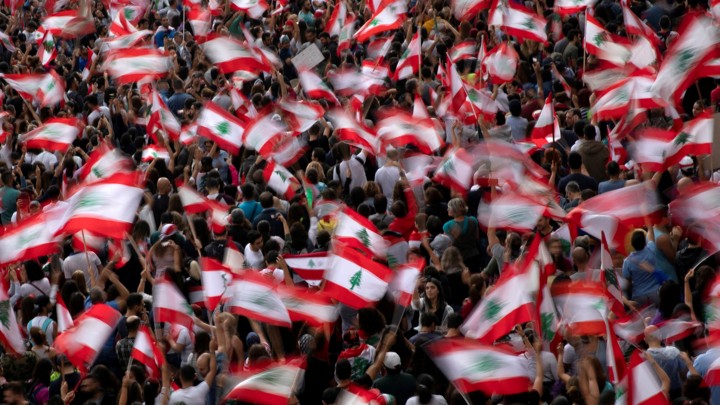
theatlantic.com - Fadlo R. Khuri -- Ten or even 20 years ago, the protests unfolding in Lebanon would have led news bulletins around the world—what is more compelling than large portions of the population of this small, schismatic, but strategic state united in optimism, standing together peacefully to overthrow decades of a dead-handed, morally bankrupt, sectarian kleptocracy? In a matter of days, the exasperated Lebanese protesters, waving the cedar flag that once symbolized our divisions, have declared an end to the Taif Agreement that enshrined confessional rule in 1989. The Lebanese Civil War finally ended on October 17, 2019. The sectarian mind-set did not disappear in the plumes of black smoke from burning tires. But if the populace has turned away from a national accord that reinforced sectarian divisions, its instigators and beneficiaries—the nation’s cynical, venal, and in some cases irredeemable political leaders—continue to assert their own personal interests, with varying degrees of skill and guile. There are few, if any, heroes or citizen leaders among these gray men. After all, they all know in their hearts that the destiny of the hero is martyrdom.
And there are certainly no willing martyrs among Lebanon’s political and military leaders. No George Washingtons, Abraham Lincolns, Charles De Gaulles, George Marshalls, Nelson Mandelas, or Mahatma Gandhis. Nor is there even a Fuad Chehab, a Rachid Karami, or a Kamal Jumblatt, to name three of Lebanon’s more far-sighted leaders of the past 70 years, two of them martyrs in a real sense. No, this is the era for gray, ambitious, vindictive men who have long paraded their faults on the Lebanese political stage, in the same manner as other populist leaders around the world, including those now occupying some of the globe’s most powerful political positions. As the president of the American University of Beirut, I have watched these protests unfold with a mixture of hope and trepidation. The protesters in Beirut, in Tripoli, in Tyre, in Sidon, in Nabatiya—who include a large proportion of our own students, faculty, and staff—must stay united to overcome the poisonous example set by Lebanon’s political leaders. Now in the second week of the protests, ambition and ego are starting to surface in an unfortunate but not unexpected way. Lebanon’s political and security leaders would like to have their battles fought for them by others. They all want someone else to eliminate their competition, allowing them to claim neutrality and good intentions. That is why we need to help steer our students, faculty, and staff away from such traps.
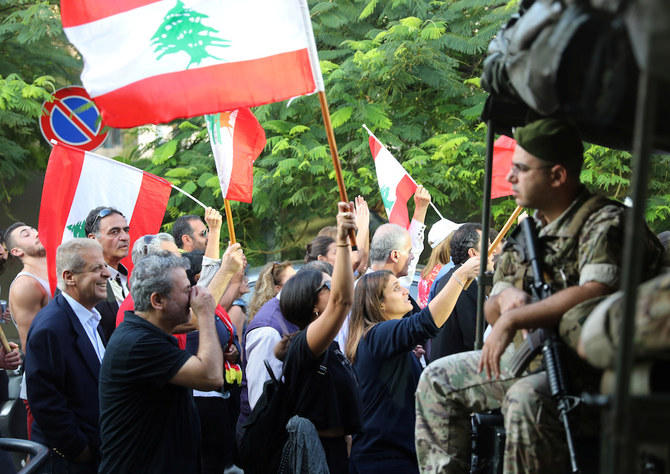
by arabnews.com --BEIRUT: Lebanon’s president Thursday said the country’s next cabinet should include ministers picked on skills, not political affiliation, seemingly endorsing a demand by a two-week-old protest movement for a technocratic government. Michel Aoun’s speech came as Lebanese protesters tried to block reopened roads and prevent their unprecedented non-sectarian push for radical reform from petering out. It followed the resignation of Prime Minister Saad Hariri’s government on Tuesday which had been met with cheers from crowds seeking the removal of a political class seen as corrupt, incompetent and sectarian. “Ministers should be selected based on their qualifications and experience, not their political loyalties,” Aoun said in a televised speech on the third anniversary of his presidency, pledging also to combat corruption and enact serious reforms. But his speech was met with disdain by demonstrators in central Beirut who, in response to his words, chanted the popular refrain of the 2011 Arab uprisings: ‘The people demand the fall of the regime.’ Nihmat Badreddine, an activist, said the president’s promises were “good in theory.”
“But there is no mechanism for implementation... and there is no deadline” she said, expressing fears of a stalled process. Sparked on Oct.17 by a proposed tax on free calls made through messaging apps such as WhatsApp, the protests have morphed into a cross-sectarian street mobilization against an entire political class that has remained largely unchanged since the end of the country’s 1975-1990 civil war. Some schools have reopened this week and banks were due to reopen on Friday, as the protests piled more economic pressure on a country that has been sliding toward debt default in recent months. Key members of the outgoing government, including the Shiite Hezbollah movement and the Christian president’s Free Patriotic Movement have warned repeatedly against the chaos a government resignation could cause. “Lebanon is at a dangerous cross roads, especially with regards to the economy,” Aoun said on Thursday. “So there is a dire need for a harmonious government that can be efficient without getting tangled in political disputes.”




Population Movements to Keserwan - The Khazens and The Maans
ما جاء عن الثورة في المقاطعة الكسروانية
ثورة أهالي كسروان على المشايخ الخوازنة وأسبابها
Origins of the "Prince of Maronite" Title
Growing diversity: the Khazin sheiks and the clergy in the first decades of the 18th century
Historical Members:
Barbar Beik El Khazen [English]
Patriach Toubia Kaiss El Khazen(Biography & Life Part1 Part2) (Arabic)
Patriach Youssef Dargham El Khazen (Cont'd)
Cheikh Bishara Jafal El Khazen
Patriarch Youssef Raji El Khazen
The Martyrs Cheikh Philippe & Cheikh Farid El Khazen
Cheikh Nawfal El Khazen (Consul De France)
Cheikh Hossun El Khazen (Consul De France)
Cheikh Abou-Nawfal El Khazen (Consul De France)
Cheikh Francis Abee Nader & his son Yousef
Cheikh Abou-Kanso El Khazen (Consul De France)
Cheikh Abou Nader El Khazen
Cheikh Chafic El Khazen
Cheikh Keserwan El Khazen
Cheikh Serhal El Khazen [English]
Cheikh Rafiq El Khazen [English]
Cheikh Hanna El Khazen
Cheikha Arzi El Khazen
Marie El Khazen