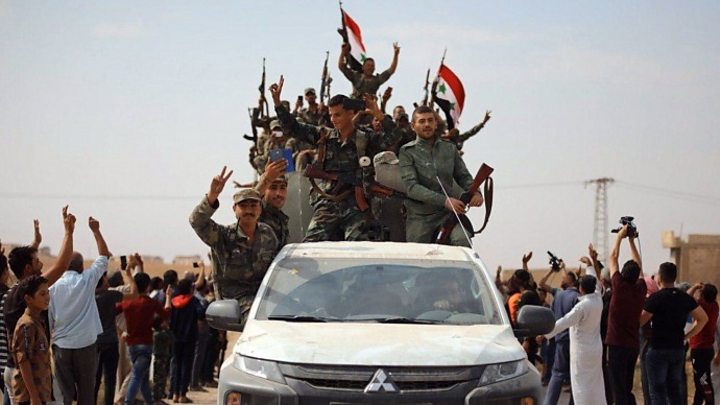
by bbc.com -- The US has sanctioned two Turkish ministries and three senior government officials in response to the country's military offensive in northern Syria. President Donald Trump also phoned his Turkish counterpart Recep Tayyip Erdogan to demand an immediate truce, Vice-President Mike Pence said. Mr Pence said he would travel to the region "as quickly as possible". Syria's army earlier entered areas in the north-east. This could result in a confrontation with Turkish-led forces. The Syrian army deployment followed a deal with Kurdish-led forces, who until last week were US allies. Turkey says its offensive aims to push Kurdish forces from the border region and establish what the government in Ankara describes as a "safe zone". With a "safe zone" reaching about 30km (20 miles) into Syria, Turkey wants to resettle up to two million Syrian refugees currently on its territory. Many of them are not Kurds and critics warn this could lead to ethnic cleansing of the local Kurdish population.
What about the US sanctions?
Speaking to reporters in Washington DC on Monday evening, US Treasury Secretary Steven Mnuchin described the sanctions as "very strong" which would have a severe impact on the Turkish economy. The US Treasury published a statement, which said that action was taken "against two [Turkish] ministries and three senior Turkish government officials in response to Turkey's military operations in Syria". "The Turkish government's actions are endangering innocent civilians, and destabilizing the region, including undermining the campaign to defeat ISIS [Islamic State]," the statement added. Appearing alongside Mr Mnuchin, Vice-President Pence warned that the sanctions "will continue and will worsen unless and until Turkey embraces an immediate ceasefire, stops the violence and agrees to negotiate a long-term settlement of the issues along the border between Turkey and Syria".
by linkedin.com — American brands may be falling out of fashion with China. For years, companies in the U.S. saw China as …

ahvalnews.com --The Arab League following an emergency meeting on Saturday condemned Turkey’s military offensive in northeast Syria, calling the incursion an “invasion of an Arab state’s land and an aggression on its sovereignty.” The Arab League is considering taking diplomatic, economic, investment and tourism measures against Turkey, Al-Arabiya quoted the Arab League Secretary General Ahmed Aboul Gheit Aboul Gheit as saying during the meeting in Cairo. Tens of thousands have fled northeast Syria as Turkish forces advance in the region on day four of an offensive targeting Kurdish forces. Turkey plans to establish a safe zone stretching along its border inside Syria to remove the majority-Kurdish Syrian Democratic Forces (SDF), which Turkey sees as a security threat due to its links to the outlawed Kurdistan Workers Party (PKK), an armed group that has been at war in Turkey for over three decades.
Lebanese Foreign Minister Gebran Bassil said it was time for Syria to rejoin the Arab League, Al-Arabiya reported, with Aboul Gheit stating that Syria's return to the league is subject to required measures that the authorities in Damascus will be required to take. Iraq’s Foreign Minister Mohamad Ali al-Hakim said that Baghdad is set to submit a formal request for Syria's return to the Arab League. Saudi Arabia's Minister of State for Foreign Affairs Adel al-Jubeir on Saturday echoed a previous condemnation by the kingdom, stating that Riyadh condemns the Turkish offensive in northeast Syria. Saudi Arabia demands an immediate halt to the military operations, al-Jubeir said, adding that the incursion is causing the Syrian people further suffering. The UAE's Minister of State for Foreign Affairs Anwar Gargash also condemned the Turkish incursion, calling on the international community to shoulder its responsibilities to stop the Turkish attacks on Syria. “We call for the exit of Turkey and its forces, as well as all foreign forces that have violated this Arab country - and to push for a successful political solution,” the minister said. Bahrain rejects any aggression by any party against Arab countries, the country’s Foreign Minister Khalid bin Ahmed Al Khalifa said on Saturday, further calling on the countries’ to maintain and confront any threats to Arab national security.

by independent.co.uk -- Robert Fisk @indyvoices -- I sniffed something was wrong in Lebanon when the central bank governor Riad Salame announced to us all that there were plenty of dollars in the system. No shortages. No tightening of the purse strings. I still have the papers with his announcement on page one. Both before, during and after the 1975-1990 civil war, you’ve been able to pay for anything here in Lebanon in US dollars: dinner bills, rent, militias, guns (during the war), cars, airline tickets, groceries. The Lebanese pound fell amid the conflict but settled afterwards – courtesy of the country’s billionaire prime minister Rafiq Hariri – at 1,500 “lebs” to the dollar. And everyone was happy. You knew that the cheerful local currency, splashed with colourful cedar trees, Roman ruins and Phoenician figurines, was interchangeable with the greenback. General Grant’s face was equal to 75,000 lebs. We even combined them in our change.
Until I walked up the road to my local ATM last week, inserted my bank card, demanded $400, was given the usual warning that this would attract an extra $5 from the machine – and was then presented with a terse voice message: “Your transaction has been cancelled.” The accent was American, of course. I tried again, at $200. Same problem. I’ve always been enthralled by the linguistics of banking. A “transaction” has held a certain thrall for me. A transaction should surely be the purchase of a property, the buying of shares, the takeover of a mega company. But by the end of my miserable ATM trip, I put in for 400,000 Lebanese pounds ($266) and was treated to a wad of those beautiful Lebanese notes with their pictures of the Baalbek ruins, museum masterpieces and, indeed, illustrations of Salame’s Lebanese central bank. My “transaction” had been completed. In other words, there were not many dollars in the system. And this is where the Lebanese economic story starts to go downhill.
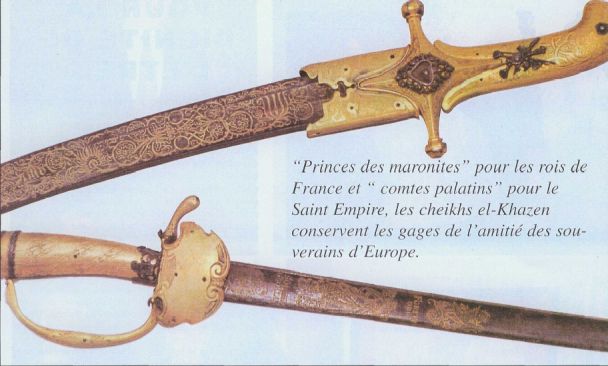
Population Movements to Keserwan - The Khazens and The Maans
ما جاء عن الثورة في المقاطعة الكسروانية
ثورة أهالي كسروان على المشايخ الخوازنة وأسبابها
Origins of the "Prince of Maronite" Title
Growing diversity: the Khazin sheiks and the clergy in the first decades of the 18th century
Historical Members:
Barbar Beik El Khazen [English]
Patriach Toubia Kaiss El Khazen(Biography & Life Part1 Part2) (Arabic)
Patriach Youssef Dargham El Khazen (Cont'd)
Cheikh Bishara Jafal El Khazen
Patriarch Youssef Raji El Khazen
The Martyrs Cheikh Philippe & Cheikh Farid El Khazen
Cheikh Nawfal El Khazen (Consul De France)
Cheikh Hossun El Khazen (Consul De France)
Cheikh Abou-Nawfal El Khazen (Consul De France)
Cheikh Francis Abee Nader & his son Yousef
Cheikh Abou-Kanso El Khazen (Consul De France)
Cheikh Abou Nader El Khazen
Cheikh Chafic El Khazen
Cheikh Keserwan El Khazen
Cheikh Serhal El Khazen [English]
Cheikh Rafiq El Khazen [English]
Cheikh Hanna El Khazen
Cheikha Arzi El Khazen
Marie El Khazen