by aawsat.com --The Lebanese government is expected to begin implementing in October a set of economic and financial measures agreed by its top leadership that will boost economic growth, President Michel Aoun said on Sunday, vowing that he would tend to this himself. He was referring to decisions taken at a top-level meeting earlier this month with the aim of reviving an economy that has been growing slowly for years and is struggling with one of the world's heaviest public debt burdens.
After the Aug. 9 meeting, Prime Minister Saad Hariri said agreed steps included finishing the 2020 budget on time, drawing up a plan to start $3.3 billion of projects approved by parliament, full implementation of a power sector reform plan, and laws to fight tax evasion and regulate public tenders. "I will personally tend to the implementation path of the decisions of the financial and economic meeting" in cooperation with Hariri, Speaker Nabih Berri and other parties in government, Aoun said. In written comments to Reuters, Aoun said this aimed "to guarantee political stability in cabinet and outside it and to secure the greatest amount of productivity", including in the implementation of the 2019 budget and its reforms.
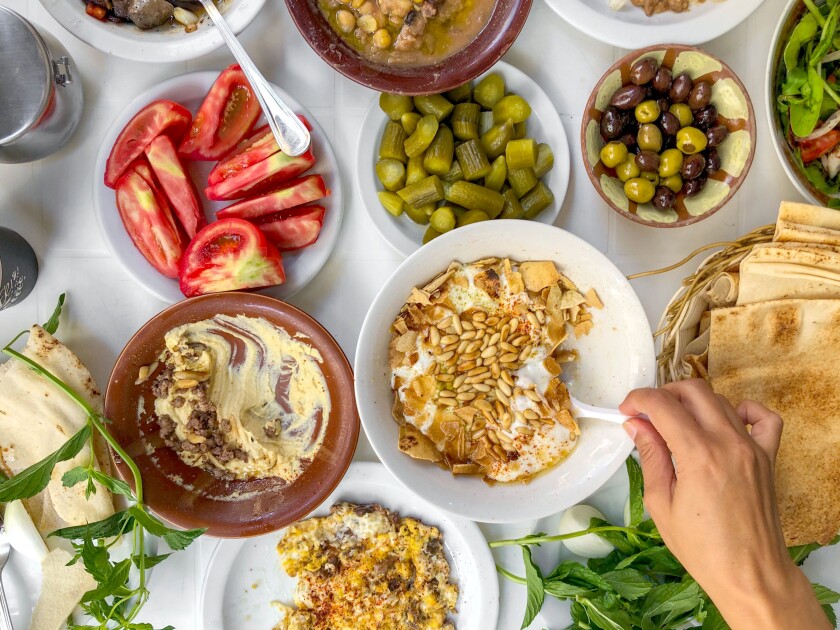
By BILL ADDISON - RESTAURANT CRITIC -latimes.com --- I’ve been thinking lately about the ways that cuisines are transformed and reinterpreted when they’re translated from home cooking to a professional kitchen. It was the subject of my newsletter last week, in conversations with food writers Andy Baraghani and Naz Deravian on the subject of Persian restaurant menus. And it was, in essence, the impetus for a recent nine-day trip I took to Lebanon. I’d known Lebanese cuisine only from restaurants I’d reviewed over the years, mostly in Atlanta: mezze of hummus, tabbouleh, labneh (yogurt drained to the thickness of fresh cheese) and fatayer (small savory pies often filled with spiced spinach and pine nuts); falafel and kebabs and shawarma.
About seven years ago I had dinner at the home of a Lebanese American friend, Caline Jarudi, whose parents, Mona and Subhi, were visiting from overseas. Mona prepared a beautiful Lebanese dish of lamb shanks braised in plenty of pomegranate molasses, which matched the meat’s gaminess with its rich, overtly sour-sweet tautness. Caline’s sister, Natalie, made exquisite hindbe — dandelion greens sautéed in olive oil and covered in caramelized onions. Their airy hummus dialed back the garlic and tahini and pushed forward the lemon. This was not how I had experienced Lebanese cooking in American restaurants. It spurred my curiosity and ardor for the cuisine in new ways. At one point Caline suggested I follow the Lebanese Syrian cookbook author Anissa Helou on Instagram. Anissa and I met in London in 2015 and became occasional traveling buddies. We immersed ourselves in the Lebanese restaurants of Dearborn, Mich., the following year; we recently ate through Iranian restaurants together in Los Angeles. As Caline and I have become closer over the years, and I grew to love her family, a trip to Beirut became inevitable. We finally planned the trip this summer as a preamble to her brother Nadim’s wedding, which took place in Estonia. (Tallinn, Estonia, is a story for another time, but: bread.)
Reuters — BEIRUT — Saudi Arabia and the United Arab Emirates are looking to invest in infrastructure projects in Lebanon after ties …
WASHINGTON (Reuters) – Lebanese Prime Minister Saad al-Hariri said on Thursday after talks in Washington that he hoped for a final decision, …


Population Movements to Keserwan - The Khazens and The Maans
ما جاء عن الثورة في المقاطعة الكسروانية
ثورة أهالي كسروان على المشايخ الخوازنة وأسبابها
Origins of the "Prince of Maronite" Title
Growing diversity: the Khazin sheiks and the clergy in the first decades of the 18th century
Historical Members:
Barbar Beik El Khazen [English]
Patriach Toubia Kaiss El Khazen(Biography & Life Part1 Part2) (Arabic)
Patriach Youssef Dargham El Khazen (Cont'd)
Cheikh Bishara Jafal El Khazen
Patriarch Youssef Raji El Khazen
The Martyrs Cheikh Philippe & Cheikh Farid El Khazen
Cheikh Nawfal El Khazen (Consul De France)
Cheikh Hossun El Khazen (Consul De France)
Cheikh Abou-Nawfal El Khazen (Consul De France)
Cheikh Francis Abee Nader & his son Yousef
Cheikh Abou-Kanso El Khazen (Consul De France)
Cheikh Abou Nader El Khazen
Cheikh Chafic El Khazen
Cheikh Keserwan El Khazen
Cheikh Serhal El Khazen [English]
Cheikh Rafiq El Khazen [English]
Cheikh Hanna El Khazen
Cheikha Arzi El Khazen
Marie El Khazen