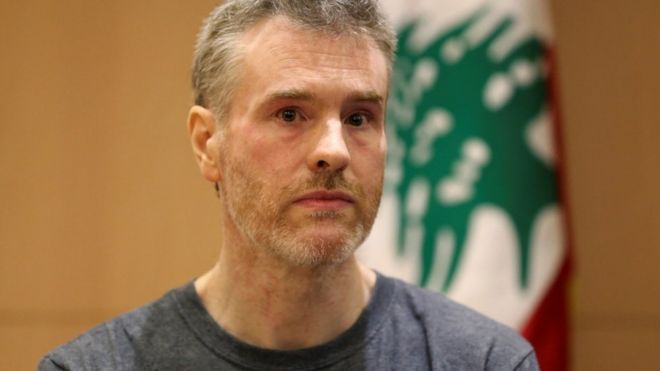
BySARAH EL DEEB, ASSOCIATED PRESS -- Details of Baxter's detention were not immediately available but Canadian media reported last December he was detained while in war-torn Syria, where he was traveling seeking an adventure. Canadian officials declined to provide further information, citing privacy provisions. Lebanon's General Security Chief Abbas Ibrahim said Baxter was detained for what Syrian authorities considered a "major violation" of local laws, adding that authorities there may have considered the incident security related. He didn't elaborate. Baxter appeared briefly on a podium, shared with Ibrahim and the Canadian ambassador to Lebanon, Emmanuelle Lamoureux. He was emotional and choked on his words as he tried to hold back tears. "I'd just like to thank the Canadian embassy for helping me," Baxter said, reaching to hold the shoulder of the Canadian ambassador. "I would like to thank the Lebanese for helping me get free. I thought I would be there forever, honestly." He added, wiping his eyes: "I didn't know if anyone knew if I was alive."
Baxter's release marked the second time Lebanon has helped free a foreigner held in Syria. Last month, Ibrahim also mediated the release of an American traveler, Sam Goodwin, held in Syria for two months. The circumstances of Goodwin's detention in northeastern Syria in May were unclear. "I think the work and effort we did shortened the period of (Baxter's) detention and as you see he is on his way to Canada," Ibrahim said Friday before Baxter spoke.

by AP -- BEIRUT — Lebanon's only English-language daily protested the country's deteriorating economic and political conditions by publishing a blank edition Thursday, calling it an "alarm bell." Each page of The Daily Star's Thursday edition bore a single phrase referring to one of the country's problems, including government deadlock, rising public debt, increasing sectarian rhetoric and unemployment. The back page had a photo of a cedar tree, a national symbol, with a caption reading: "Wake up before it's too late!" "We are sounding the alarm bell over the many challenges the country is facing," the paper's editor-in-chief Nadim Ladki told The Associated Press. "It's a call on everyone— politicians, activists, ordinary people — to pull together in the same direction to resolve the crises and challenges."
Lebanon has been in the grip of an economic crisis for months, and the government has not met since a June 30 shooting in a mountain village that escalated tensions between the Christian and Druze communities. Rival groups in the Cabinet have been divided on how to proceed with the investigation of the shooting, which left two people dead. The U.S. Embassy issued a statement Wednesday saying it supports a fair and transparent investigation into the shooting in the village of Qabr Shamoun. "Any attempt to use the tragic June 30 event in Qabr Shamoun to advance political objectives should be rejected," the embassy said in an apparent reference to the militant Hezbollah group and its allies, who are seen as pressuring Druze leader Walid Jumblatt.
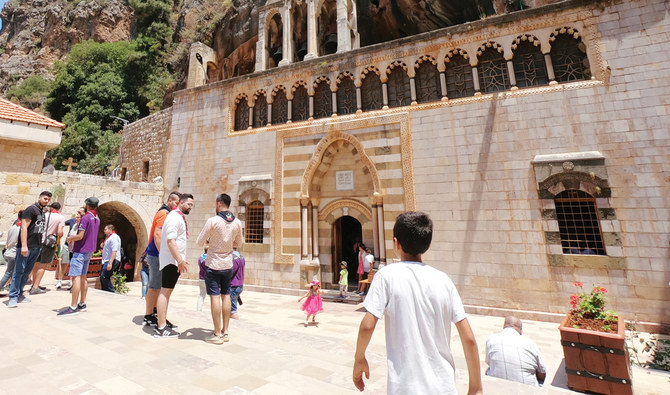
by arabnews.com -- QOZHAYA, Lebanon: The last time Samuel Botros stepped into the Lebanese monastery of Saint Anthony of Qozhaya was in 1978. He was 24, newly married, and the country was in the grip of an all-out war. Like many of his generation, he left. It took him 41 years to return. The 1975-90 civil war may be over in Lebanon but conflicts in nearby countries like Iraq and Syria have devastated entire communities where Christians once lived alongside Muslims. That has triggered an exodus among people of both faiths, especially among minority sects — like Botros’ Syriac Orthodox community whose roots are in early Christianity.
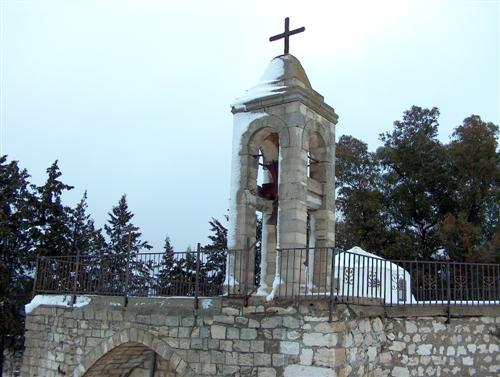
The monastery, which is nestled in a remote valley in the northern Lebanese mountains and dates from the fourth century, is a meeting place for Christians who have fled conflict. “It is the war that did this to us. It is the wars that continue to leave behind destruction and force people to leave,” said Botros, visiting the monastery as part of a gathering of his community’s scout group — their first in the region since the 1950s.The scout group’s roughly 150 members include people living in Lebanon, Iraq, Syria, Egypt, Jordan, the Palestinian Territories and further afield. Lebanon was the only country where they could all meet easily and safely, Botros said. In Iraq, years of conflict, most recently with Daesh, erased much of the Christian heritage in ancient cities like Mosul and Sinjar in the north. In Syria’s civil war, some of the oldest churches in Aleppo, Homs and other cities were damaged. Botros, now 65, is about to retire in Sweden where he made his home years ago. He is father and grandfather to children who know Lebanon only through photos.
by euronews.com —Fifteen-year-old George Bejjani became the youngest contestant to ever win the title in Lebanon’s arm-wrestling championship in the +90kgs category …
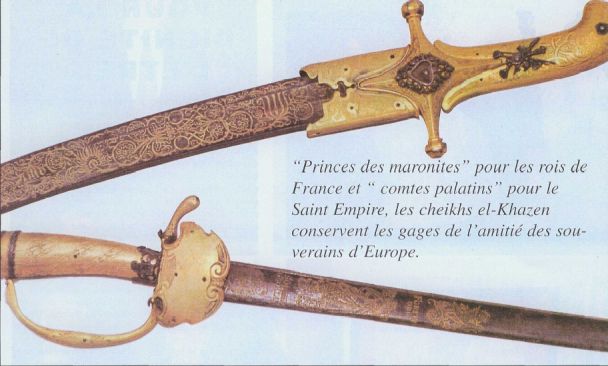
Population Movements to Keserwan - The Khazens and The Maans
ما جاء عن الثورة في المقاطعة الكسروانية
ثورة أهالي كسروان على المشايخ الخوازنة وأسبابها
Origins of the "Prince of Maronite" Title
Growing diversity: the Khazin sheiks and the clergy in the first decades of the 18th century
Historical Members:
Barbar Beik El Khazen [English]
Patriach Toubia Kaiss El Khazen(Biography & Life Part1 Part2) (Arabic)
Patriach Youssef Dargham El Khazen (Cont'd)
Cheikh Bishara Jafal El Khazen
Patriarch Youssef Raji El Khazen
The Martyrs Cheikh Philippe & Cheikh Farid El Khazen
Cheikh Nawfal El Khazen (Consul De France)
Cheikh Hossun El Khazen (Consul De France)
Cheikh Abou-Nawfal El Khazen (Consul De France)
Cheikh Francis Abee Nader & his son Yousef
Cheikh Abou-Kanso El Khazen (Consul De France)
Cheikh Abou Nader El Khazen
Cheikh Chafic El Khazen
Cheikh Keserwan El Khazen
Cheikh Serhal El Khazen [English]
Cheikh Rafiq El Khazen [English]
Cheikh Hanna El Khazen
Cheikha Arzi El Khazen
Marie El Khazen