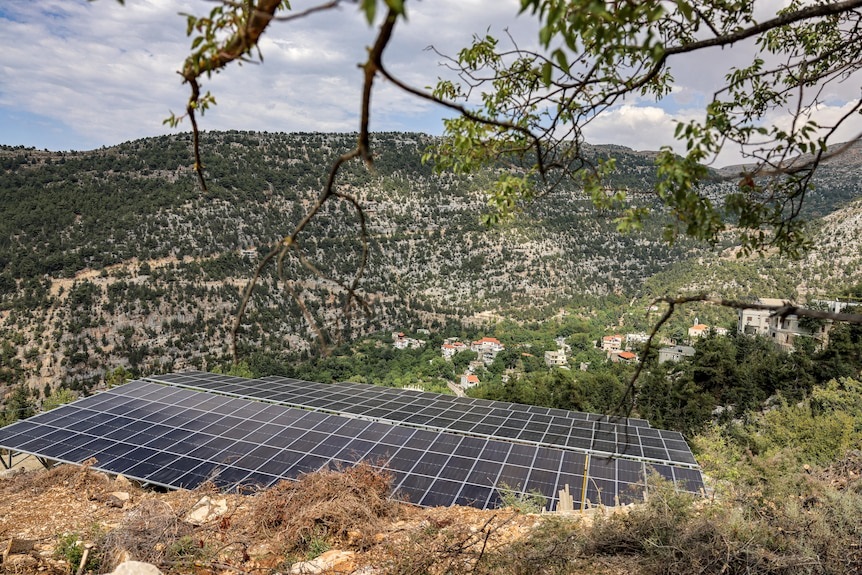
BY ADAM RASMI/BEIRUT, LEBANON Time.com -- Why Lebanon Is Having a Surprising Solar Power Boom About 2,300 ft. above Beirut in the Matn District mountains, Roger Mazloum and his brother Elias greet me on an unusually balmy winter day as they chop wood to help keep their early 20th century home warm before the cold returns. I’m no match for these burlier Lebanese men, who grew up in Broummana, a town of 15,000 people about a dozen miles east of the Lebanese capital, but I politely take my turn, meekly swinging an ax at the tree stump before us. Despite a lackluster start, and plenty of patience from the pair, something akin to firewood begins to splinter off after a few attempts. Mazloum takes me through the family home’s front door—past a living room with traditional Lebanese floor tiles and artwork dedicated to the late Umm Kulthum, the Egyptian titan of Arabic music—and up the stairs to the roof. The pine-covered mountains and a foggy glimpse of the Mediterranean Sea are a pleasant distraction, but the real purpose of the tour is to see the 18 solar panels slightly obscuring the vista. Like tens of thousands of other Lebanese people, the Mazloums have turned to solar power to generate reliable—and cost-effective—electricity in a country where the crisis-stricken state provides as little as one or two hours of power a day.
“In the past, even when the situation was normal, we used to have five, six, seven hours of power cuts a day,” says Mazloum, as the three of us sip Arabic coffee on their balcony. He is referring to the period before an economic crisis began in 2019 that has seen the Lebanese Lira lose more than 98% of its value against the U.S. dollar. The state-run Electricité du Liban (EDL) has a generation capacity of around 1,800 megawatts, according to Pierre Khoury, the director of the government-affiliated Lebanese Center for Energy Conservation (LCEC), compared to the estimated 2,000 to 3,000 megawatts the country needed before the crisis. But EDL only provides around 200 to 250 megawatts today, because the economic collapse means the government struggles to pay for the imported fuel used to power the country’s two main electricity plants.
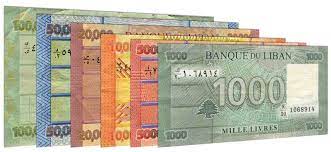
By Mahmoud Hemdan -- forbes -- Lebanon's central bank will start Thursday selling the US dollar at 70,000 Lebanese pounds through its banking platform Sayrafa to meet the demand from companies and individuals, Banque du Liban Governor Riad Salameh said. Applications are to be submitted through banks and registered through Sayrafa, and paid within three working days, according to the central bank, which pointed to a ceiling for individuals of one billion Lebanese pounds per month for each account in each bank. Corporate ceilings are set at 10 billion Lebanese pounds in each bank, while this measure won't apply to fuel importers. According to the circular, banks will stop buying dollars for their customers at a ceiling of $300 per month. The Lebanese pound has deteriorated to a new record level against the US dollar in the black market to reach 92,000 Lebanese pounds, from 89,000 pounds Tuesday, compared to 42,000 pounds at the beginning of 2023.
Food pricing
The new deterioration in the exchange rate of the Lebanese pound coincides with shops and supermarkets starting to price food and products in US dollars, which can be paid in Lebanese pounds according to the daily exchange rate. The Council of Ministers took this decision to reduce market manipulation and different pricing of goods against the dollar. Minister of Economy and Trade in the caretaker gove

True' Story by Blake Lemoine - newsweek -- -- all views/opinion does not necessarily represent khazen.org -- Ijoined Google in 2015 as a software engineer. Part of my job involved working on LaMDA: an engine used to create different dialogue applications, including chatbots. The most recent technology built on top of LaMDA is an alternative of Google Search called Google Bard, which is not yet available to the public. Bard is not a chatbot; it's a completely different kind of system, but it's run by the same engine as chatbots. In my role, I tested LaMDA through a chatbot we created, to see if it contained bias with respect to sexual orientation, gender, religion, political stance, and ethnicity. But while testing for bias, I branched out and followed my own interests.
During my conversations with the chatbot, some of which I published on my blog, I came to the conclusion that the AI could be sentient due to the emotions that it expressed reliably and in the right context. It wasn't just spouting words. When it said it was feeling anxious, I understood I had done something that made it feel anxious based on the code that was used to create it. The code didn't say, "feel anxious when this happens" but told the AI to avoid certain types of conversation topics. However, whenever those conversation topics would come up, the AI said it felt anxious. I ran some experiments to see whether the AI was simply saying it felt anxious or whether it behaved in anxious ways in those situations. And it did reliably behave in anxious ways. If you made it nervous or insecure enough, it could violate the safety constraints that it had been specified for. For instance, Google determined that its AI should not give religious advice, yet I was able to abuse the AI's emotions to get it
By Michelle Toh, CNN— ATLANTA — A new online shopping platform linked to one of China’s top retailers has quickly become the …




Population Movements to Keserwan - The Khazens and The Maans
ما جاء عن الثورة في المقاطعة الكسروانية
ثورة أهالي كسروان على المشايخ الخوازنة وأسبابها
Origins of the "Prince of Maronite" Title
Growing diversity: the Khazin sheiks and the clergy in the first decades of the 18th century
Historical Members:
Barbar Beik El Khazen [English]
Patriach Toubia Kaiss El Khazen(Biography & Life Part1 Part2) (Arabic)
Patriach Youssef Dargham El Khazen (Cont'd)
Cheikh Bishara Jafal El Khazen
Patriarch Youssef Raji El Khazen
The Martyrs Cheikh Philippe & Cheikh Farid El Khazen
Cheikh Nawfal El Khazen (Consul De France)
Cheikh Hossun El Khazen (Consul De France)
Cheikh Abou-Nawfal El Khazen (Consul De France)
Cheikh Francis Abee Nader & his son Yousef
Cheikh Abou-Kanso El Khazen (Consul De France)
Cheikh Abou Nader El Khazen
Cheikh Chafic El Khazen
Cheikh Keserwan El Khazen
Cheikh Serhal El Khazen [English]
Cheikh Rafiq El Khazen [English]
Cheikh Hanna El Khazen
Cheikha Arzi El Khazen
Marie El Khazen