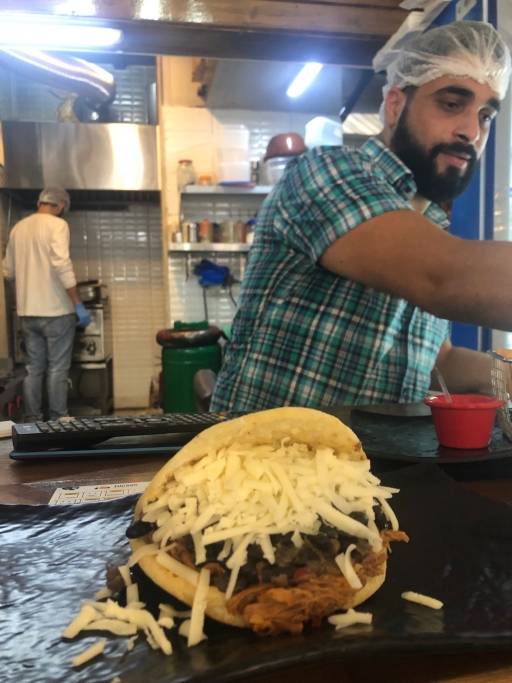
by Rebecca Collard -- PRI's The World -- What finally pushed Firas Yordi to leave Venezuela last year wasn’t the shortage of food and medicine, or the loss of his family’s once-profitable businesses, or rising insecurity. It was a kidnapping attempt on his four-year-old son. In mid-2017, two men on a motorcycle tried to snatch him outside the family’s factory, likely for ransom. “Luckily there were many of us inside and we ran out and stopped them,” Yordi recalls. He sent his family out of the country and looked at options to leave Venezuela.
But unlike most of the 4 million Venezuelans who have sought refuge in neighboring states, Yordi ended up much further afield — in the Lebanese capital, Beirut. He became one of a growing number of Venezuelans of Lebanese descent doing a reverse migration, fleeing Venezuela's financial crisis and finding refuge in the country of their ancestors. Yordi’s father emigrated from Lebanon to Venezuela 50 years ago after fleeing escalating tensions and financial instability. By the time he arrived, Venezuela already had a sizable and successful Lebanese community.
“I never thought I would be living and working in this country,” Yordi says of Lebanon. “My father came from a very humble background. It was tough times in Lebanon back then, and violence was happening.” A history of Lebanon-Venezuela migration The first Lebanese immigrated to Venezuela in the 1860s. Then, in 1915, the Great Famine of Mount Lebanon struck. As many as 200,000 people died, and tens of thousands more fled what had been the Ottoman Empire. Thousands headed for promised lands of Latin America, where many already family. Then, in the 1960s and 70s, a third wave on Lebanese immigration headed toward South America as Lebanon’s neighbors went to war. Today, more people of Lebanese descent live outside Lebanon than within it, and millions of them are in Latin America. Lebanon’s own population is 4 million. Yordi’s family thrived in Venezuela. They had several mechanic shops and a factory that made beds and mattresses. On his phone, Yordi scrolls through pictures of their life before the crisis — scuba diving, family vacations, weddings and their two-story home with a pool. “Business was well and life was very well for years and years, but then it started to deteriorate,” he says. Things got tough, but the Yordis stayed, not wanting to give up everything they had built. Yordi tears up as he tells about his decision to leave.
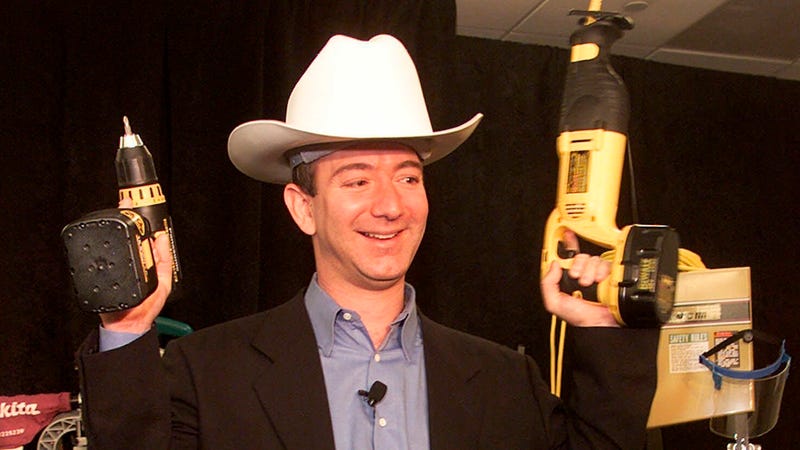
by Matt Novak -paleofuture--- Amazon was founded on July 5, 1994, and launched its online store in 1995, letting people buy books from the comfort of their homes. Twenty-five years after its inception, Amazon now sells everything from taco holders shaped like dinosaurs to tongue brushes that humans can use to lick their cats. And you’d have to be living under a rock to not know about Amazon. But what did people think of Amazon in its early days—the days before the tongue brushes? Today we’ve got a sample from the mid-90s before founder Jeff Bezos was a billionaire. In November of 1995, Knight-Ridder distributed an article that was published in newspapers around the country explaining that you can find almost any book at this “Internet store” called Amazon.
Of course, hooking up to the internet was a much more novel experience in 1995. But if you had a connection, and millions of Americans were getting online in the mid-90s, you had access to over 1 million titles. The Knight-Ridder article noted a few things that might be weird to people in the year 2019. First, you could pay by credit card or you could call a toll-free number and give your credit card number over the phone. You could even fax the credit card info if that was your thing. Secondly, shipping was $3 per order plus $0.95 per book. Today, Amazon has free shipping for all orders over $25 and for anyone who subscribes to the company’s Prime membership. But what did people think of this new service on the so-called Information Superhighway? The first thing almost everyone mentioned was the impressively wide selection of books.
BEIRUT, (Xinhua) — Lebanese Economy and Trade Minister Mansour Bteish on Thursday called on the United Arab Emirates (UAE) to invest in …
by nsider.com — An image outage across Facebook, Instagram, and WhatsApp gives a behind-the-scenes look at how Facebook’s AI sees your photos. …




Population Movements to Keserwan - The Khazens and The Maans
ما جاء عن الثورة في المقاطعة الكسروانية
ثورة أهالي كسروان على المشايخ الخوازنة وأسبابها
Origins of the "Prince of Maronite" Title
Growing diversity: the Khazin sheiks and the clergy in the first decades of the 18th century
Historical Members:
Barbar Beik El Khazen [English]
Patriach Toubia Kaiss El Khazen(Biography & Life Part1 Part2) (Arabic)
Patriach Youssef Dargham El Khazen (Cont'd)
Cheikh Bishara Jafal El Khazen
Patriarch Youssef Raji El Khazen
The Martyrs Cheikh Philippe & Cheikh Farid El Khazen
Cheikh Nawfal El Khazen (Consul De France)
Cheikh Hossun El Khazen (Consul De France)
Cheikh Abou-Nawfal El Khazen (Consul De France)
Cheikh Francis Abee Nader & his son Yousef
Cheikh Abou-Kanso El Khazen (Consul De France)
Cheikh Abou Nader El Khazen
Cheikh Chafic El Khazen
Cheikh Keserwan El Khazen
Cheikh Serhal El Khazen [English]
Cheikh Rafiq El Khazen [English]
Cheikh Hanna El Khazen
Cheikha Arzi El Khazen
Marie El Khazen