khazen.org offers its deepest condolences to the Maronite Church. Today is a great loss for Lebanon, the Maronites around the world and the Catholic Church. Rest in Peace!
by thenational.ae --Church bells rang across Lebanon on Sunday morning to pay tribute to one of the most influential religious figures in the past decades, former Maronite patriarch Nasrallah Boutros Sfeir, who died at dawn on Sunday just days before his 99th birthday. “The Maronite church has lost one of its most prominent patriarchs,” the Lebanese presidency tweeted. In a press release, Prime Minister Saad Hariri paid tribute to Mr Sfeir’s legacy, stressing that he had worked to bring the Lebanese together at “a difficult time in Lebanese history”. Foreign diplomats also spoke highly of Mr Sfeir. “I am sorry to hear of the passing of Patriarch Sfeir, an exceptional man of faith who advocated tolerance and peace”, British ambassador to Lebanon Chris Rampling tweeted. A statement by the Maronite church published in the early hours of Sunday said that he died at 3am and called for churches to ring their bells at 10am.
Born on May 15 1920 in Rayfoun, a village in Lebanon's Kesrwan mountains, Mr Sfeir became the leader of the church in 1986 until he resigned in 2011 due to his declining health. He was considered a respected power broker during the 1975-1990 civil war. “In 1986, Mr Sfeir was the first religious dignitary to cross the demarcation line (between Muslim East Beirut and Christian West Beirut) to meet Sunni Mufti Hassan Khaled”, remembers ex-MP Fared Souaid. Mr Sfeir’s backing of the 1989 Taif agreement that brought the 15-year civil war to an end bolstered Christian support for the accord but reduced the powers of the presidency, a seat reserved for Lebanon's Maronite Christians under the country's confessional power-sharing. “He strived to break down walls between communities and became a symbol of national unity”, said Mr Souaid, a Maronite politician who was one of the founders of the Qornet Shehwan gathering which called for the withdrawal of Syrian troops from Lebanon in 2001. They left four years later, following the assassination of Prime Minister Rafic Hariri. The gathering was launched with the blessing of Mr Sfeir, who was strongly opposed to Syrian control over Lebanon.
During his time as patriarch, he boycotted several prestigious invitations to Syria, including the visit of Pope Jean-Paul II to Damascus in 2001. "His biggest struggle was to end the Syrian presence in Lebanon, which we all thought was impossible because of the divisions in Lebanon," his biographer Antoine Saad told AFP. "But he worked on it steadily, objectively, meticulously and quietly," he said. Mr Sfeir’s is also credited with having brokered the 2001 reconciliation between the Druze and the Christians. The two communities fought during the early 1980s in the mountainous region of Chouf in what became known as the “mountain war”. Druze leader Walid Joumblatt was one of the first to pay homage to Mr Sfeir on Twitter Sunday morning. “Farewell to the patriarch of independence, reconciliation, love and peace”, he wrote.
Mr Sfeir’s health condition had been followed closely by local media since he was hospitalised in a Beirut hospital two weeks ago for a lung congestion. As his health deteriorated earlier this week, the current Maronite patriarch, Bechara Boutros Al Rahi, cancelled a trip to Africa and a vigil prayer was organised by the predominantly Maronite party the Lebanese Forces in front of his hospital. Several prominent politicians such as Sunni Prime Minister Saad Hariri and foreign ambassadors including Saudi ambassador to Lebanon Walid Al Bukhari called him or visited him in person. Maronites represent the largest proportion of Lebanon’s Christian population, which comprises also several other denominations. They used to make up the most powerful single community prior to the civil war, but their influence has since waned as they have been outnumbered by Shiite Muslims in the multi-sectarian country.

BEIRUT, (Rahnuma): Lebanese bankers expressed Friday their worries about the government’s pressure on banks to finance the state in a bid to reduce the country’s budget deficit in 2019. “The government cannot pressure through legislations the banking sector to fund the state, which may negatively impact this sector and Lebanon’s credit rating,” Salim Sfeir, chairman of Bank of Beirut, said during a conference in capital Beirut. The conference was held to discuss the latest financial developments in Lebanon and the negative repercussions that the new state budget may have on banks and on the economy in case the government decides to impose new taxes on the sector. Sfeir said that banks have paid taxes valued at around 2 U.S. billion dollars in 2018.
The government has been calling for more support from banks by subscribing to Treasury Bills at a non-market rate of 1 percent in a bid to reduce the cost of debt servicing which could reach 58.6 percent of the government’s revenues by 2021 if the fiscal deficit maintained the same momentum, according to Moody’s Investors Service. It is worth noting that Lebanese banks are highly exposed to sovereign debt in Lebanon. Also, Finance Minister Ali Hassan Khalil has announced a few days ago the 2019 state budget will witness an increase in the rate of interest tax on deposits in banks from 7 percent to 10 percent. “The increase … will lead many big depositors, especially expatriates, to move their money outside Lebanon,” Sfeir said. He added that small and medium-sized depositors also rely on the interest on their deposits to survive. “All experts are well aware that it is not a healthy policy to increase taxes in times of stagnation because this will negatively impact growth rate in the country,” he explained. Likewise, Nassib Ghobril, economist and head of the economic research department at Byblos Bank, told Xinhua that the measures that the government wants to implement are “terrible.” “It is never advisable to forces banks to subscribe to Treasury Bills at a non-market rate of 1 percent,” he said. He added that increasing interest tax on deposits will worsen the situation because it affected the income of thousands of retirees who depend on their deposits interests to survive. “Also, expatriates have previously complained because they already pay an income tax in the countries in which they work,” he said. Ghobril explained that increasing interest tax on deposits will lead to an increase in the cost for banks because depositors will then ask for higher interest rates on their deposits. “When interest rates on deposits go up, interests on loans also increase … which leads to economic contraction,” Ghobril explained.

by thenational.ae -Sunniva Rose --Lebanon's Cabinet plans to cap salaries for top-earning government employees and may halve the pay of MPs and ministers, after reports of public-sector pay cuts in the 2019 draft budget triggered nationwide protests. The maximum salary in the public sector will be limited to 20 times the national minimum wage, or 13.5 million Lebanese pounds (Dh32,890) a month in the draft budget, which is being discussed by the Cabinet, Information Minister Jamil Jarrah said on Wednesday. Budget discussions are scheduled to end on Friday, after which it will be sent to Parliament for approval. Mr Jarrah has not confirmed reports that the Cabinet was considering cutting the salaries of MPs, ministers and the president by 50 per cent, saying only that “there is an atmosphere tending towards salary cuts because one must start with oneself”.
Lebanese MPs are among the highest paid in the world compared to the national minimum wage, said a report published in 2017 by Lebanese non-profit Legal Agenda. An MP earns 18 times the minimum salary of $450 (Dh1,652) a month. Members in Tunisia, Iraq and Jordan earn 15 times the minimum wage, but only six times as much in Britain. The sum varies depending on the number of terms served. Controversially, MPs continue receiving a salary for life and their family also receive monthly compensation when they die.
The country’s leader also has a salary for life, but that is not considered as problematic because most presidents around the world do. The draft budget states that the president’s salary is equal to 12.5m pounds, but local newspapers report that that it reaches 18.7m pounds. Analysts say that this is because President Michel Aoun accumulates compensation for earlier serving as an MP, Prime minister and army commander. The Speaker of Parliament and Prime Minister each earn 17.7m pounds a month, while ministers’ salaries go as high as 12.9m pounds.
In total, the state spends 58bn pounds a year on MPs, ministers and the president, Al Akhbar daily reported, quoting Beirut consultancy Information International. The idea of reducing politicians' pay has been floated for a long time but has never been introduced. In 2012, one Lebanese party, the Kataeb, also known as the Phalange, suggested cutting by up to 50 per cent the salaries of MPs who did not attend parliamentary sessions, to discourage absenteeism. But lowering salaries would not lead to a significant reduction in the budget deficit, which reached 11.2 per cent of GDP in 2018. Its only aim is to “throw ashes over the eyes of the people and justify any actions that may affect the poor and the middle class", Al Akhbar said.
by DailyStar.com.lb — Joseph Haboush — BEIRUT: Former Maronite Patriarch Mar Nasrallah Boutros Sfeir was in critical condition late Wednesday, prompting current Patriarch Beshara …
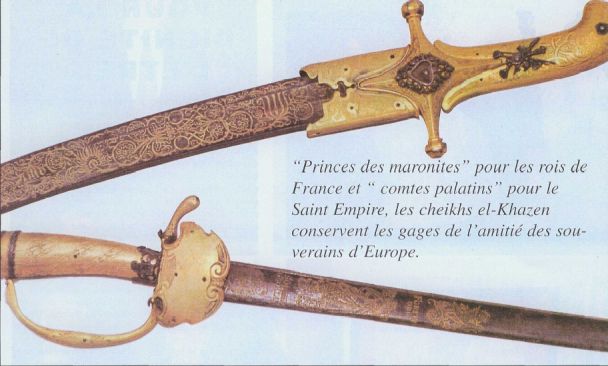
Population Movements to Keserwan - The Khazens and The Maans
ما جاء عن الثورة في المقاطعة الكسروانية
ثورة أهالي كسروان على المشايخ الخوازنة وأسبابها
Origins of the "Prince of Maronite" Title
Growing diversity: the Khazin sheiks and the clergy in the first decades of the 18th century
Historical Members:
Barbar Beik El Khazen [English]
Patriach Toubia Kaiss El Khazen(Biography & Life Part1 Part2) (Arabic)
Patriach Youssef Dargham El Khazen (Cont'd)
Cheikh Bishara Jafal El Khazen
Patriarch Youssef Raji El Khazen
The Martyrs Cheikh Philippe & Cheikh Farid El Khazen
Cheikh Nawfal El Khazen (Consul De France)
Cheikh Hossun El Khazen (Consul De France)
Cheikh Abou-Nawfal El Khazen (Consul De France)
Cheikh Francis Abee Nader & his son Yousef
Cheikh Abou-Kanso El Khazen (Consul De France)
Cheikh Abou Nader El Khazen
Cheikh Chafic El Khazen
Cheikh Keserwan El Khazen
Cheikh Serhal El Khazen [English]
Cheikh Rafiq El Khazen [English]
Cheikh Hanna El Khazen
Cheikha Arzi El Khazen
Marie El Khazen