
by newsweek.com --A powerful Libyan general in charge of much of the country has set out to claim the capital, potentially overthrowing a United Nations-backed government and allied militias. Field Marshal Khalifa Haftar, the commander of the self-proclaimed Libyan National Army, ordered his troops on Thursday via an audio message to begin a new bid to take Tripoli just as U.N. General Secretary António Guterres paid a visit to the disputed city. The military leader said "the time has come" for his forces to "advance," but would do so in "peace" as he'd ordered his forces to not "shoot civilians waving a white flag." As Haftar's men took the town of Gharyan, located about 31 miles south of Tripoli, a joint statement by France, Italy, the United Arab Emirates, the United Kingdom and the United States warned that "military posturing and threats of unilateral action only risk propelling Libya back toward chaos." The country has been beset by frequent bouts of civil unrest since the U.S.-led NATO Western military alliance helped to overthrow Muammar el-Qaddafi in 2011 by backing an insurgency against his 42-year rule.
By Friday, the Libyan National Army had entered the capital's outskirts, taking the nearby town of Al-Aziziyah. Spokesperson Ahmed al-Mismari announced that Tripoli's international airport was "fully under the control" of the faction as part of an operation now officially named Flood of Dignity During a press conference Friday, Mismari outlined the operation, displaying graphics and a cross-country push from nearly 620 miles away, including positions such as the Al-Jufra desert air base. He vowed that the Libyan National Army "has not stopped and will not stop until the completion of the task." Awaiting Haftar in Tripoli was his rival Fayez al-Sarraj, the U.N.-backed chairman of the Presidential Council and prime minister of the Government of National Accord. Both men previously worked for Qaddafi's government—Sarraj as a housing minister and Haftar as a leading military officer who ultimately turned on the longtime leader with support from the U.S., where he later fled and gained citizenship.
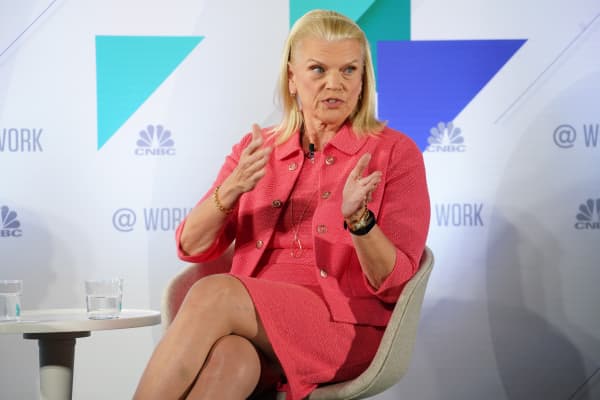
by cnbc -- Lori Ioannou -- IBM's Chair, CEO and President Ginni Rometty has a powerful message for workers and employers in all strata of society: The Fourth Industrial Revolution is underway and it is shaping up to be one of the most significant challenges and opportunities of our lifetime. We are already seeing jobs, policies, industries and entire economies shifting as our digital and physical worlds merge. According to the World Economic Forum, the value of digital transformations in the Fourth Industrial Revolution is estimated at $100 trillion in the next 10 years alone, across all sectors, industries and geographies. "As a result, we face an imminent and profound transformation of the workforce over the next five to 10 years as analytics and artificial intelligence change job roles at companies in all industries," Rometty said while giving a keynote address at the CNBC's At Work Talent & HR: Building the Workforce of the Future Conference in New York on Tuesday, April 2. In February, the executive was appointed to Trump's American Workforce Policy Advisory Board along with 24 other leaders.
While only a minority of jobs will disappear, the majority of roles that remain will require people to work with the aid of analytics and some form of AI and this will require skills training on a large scale, Rometty said. "I expect AI to change 100 percent of jobs within the next five to 10 years," the IBM CEO said. Rometty's call to action comes at a time when the AI skills gap and the future of work exhibit a growing sense of urgency. The technology sector accounts for 10 percent of U.S. GDP and is the fastest part of the American economy but there are not enough skilled workers to fill the 500,000 open high-tech jobs in the U.S., according to the Consumer Technology Association's Future of Work survey. Yet the tech industry is concerned that school systems and universities have not moved fast enough to adjust their curriculum to delve more into data science and machine learning. As a result, companies will struggle to fill jobs in software development, data analytics and engineering. "To get ready for this paradigm shift companies have to focus on three things: retraining, hiring workers that don't necessarily have a four-year college degree and rethinking how their pool of recruits may fit new job roles," Rometty said.
by bbc.com —A top Algerian businessman has been arrested while trying to cross into neighbouring Tunisia, local media say. Ali Haddad is …
BEIRUT, (Xinhua) — Gao Yan, chairwoman of China Council for the Promotion of International Trade (CCPIT), announced on Saturday the opening of …




Population Movements to Keserwan - The Khazens and The Maans
ما جاء عن الثورة في المقاطعة الكسروانية
ثورة أهالي كسروان على المشايخ الخوازنة وأسبابها
Origins of the "Prince of Maronite" Title
Growing diversity: the Khazin sheiks and the clergy in the first decades of the 18th century
Historical Members:
Barbar Beik El Khazen [English]
Patriach Toubia Kaiss El Khazen(Biography & Life Part1 Part2) (Arabic)
Patriach Youssef Dargham El Khazen (Cont'd)
Cheikh Bishara Jafal El Khazen
Patriarch Youssef Raji El Khazen
The Martyrs Cheikh Philippe & Cheikh Farid El Khazen
Cheikh Nawfal El Khazen (Consul De France)
Cheikh Hossun El Khazen (Consul De France)
Cheikh Abou-Nawfal El Khazen (Consul De France)
Cheikh Francis Abee Nader & his son Yousef
Cheikh Abou-Kanso El Khazen (Consul De France)
Cheikh Abou Nader El Khazen
Cheikh Chafic El Khazen
Cheikh Keserwan El Khazen
Cheikh Serhal El Khazen [English]
Cheikh Rafiq El Khazen [English]
Cheikh Hanna El Khazen
Cheikha Arzi El Khazen
Marie El Khazen