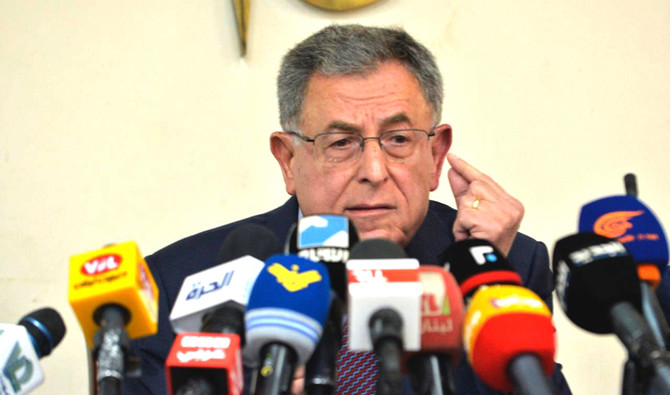
by arabnews.com -- BEIRUT: Former Lebanese Prime Minister Fouad Siniora has responded to a campaign launched by Hezbollah accusing him of corruption and demanding that he should be brought to justice. He said: “The campaign aims to demonize all the governments headed by Rafic Hariri and attack him as well as all the prime ministers who followed him, including Saad Hariri.” “This campaign against Siniora, and therefore against Hariri’s axis, has commenced before the Special Tribunal for Lebanon issues its ruling on the assassination of former PM Rafic Hariri, which five Hezbollah members are accused of and are escaping from prosecution,” a source close to Siniora said. Siniora broke his silence in a press conference on Friday, during which he attacked Hezbollah: “The biggest corruption is political corruption, and everyone who establishes smaller states within the state, controls the state’s facilities, disrupts the constitutional deadline, and denies the course of law is politically corrupt.” He said: “We are looking these days at something similar to what happened during the days of the security regime 20 years ago when I was framed.” Siniora’s speech reminded the Lebanese people of a campaign launched by the Lebanese-Syrian security regime against Rafic Hariri in 1998-2000.
by NAJIA HOUSSARI — arabnews.com — BEIRUT: Lebanese President Michel Aoun pledged the safe return of Syrian refugees, with the European Union (EU) confirming it …
Source: AFP — BEIRUT: Dozens of protesters rallied in the Lebanese capital Beirut on Saturday (Feb 23), calling on the government to …

Go to just about any conference today and you will hear a familiar tale of woe. A once great corporation, which had dominated its industry, fails to adapt and descends into irrelevance. The protagonists of these stories always come out looking more than a little bit silly, failing to recognize business trends that seem obvious. The problem with these stories is that they are rarely true. Make no mistake, it takes a considerable amount of intelligence, ambition and drive to manage a large organization. The notion that these people overlooked what was obvious to everyone else is overly facile and simplistic. It’s also misleading. Great companies do not fail because of a single decision or trend. The roots of disruption are always more complex than that. So by imagining CEOs to be morons, we neglect to look more closely at their demise and learn valuable lessons. The truth is that every business model fails eventually. We need to learn the true sources of failure if we are to overcome them.
What They Don’t Tell You About The Blockbuster Story
A favorite pundit punching bag is Blockbuster. The story, as they tell it, is that Blockbuster was blind to the threat that Netflix represented, subjected its customers to predatory late fees and failed to formulate a strategy to adapt to the digital world. Not surprisingly, the once might company descended into chaos, then bankruptcy. The truth is much more complex, interesting and troubling. As former CEO John Antioco explains in a HBR article (and nobody disputes his facts), after initially dismissing Netflix as a niche player, his team soon saw the writing on the wall and moved quickly to discontinue late fees and invest heavily in an online platform. Eventually, his team came up with a strategy that actually began to beat Netflix at its own game. It was called Total Access and it allowed customers to rent videos online and return them in stores. It immediately gained traction and before long Blockbuster was adding subscribers faster than Netflix was. So what happened? Investors didn’t like the costs associated with the program (about $400 million) and franchisees were wary about the threat to their businesses. Things came to a head in 2007 when, after a salary dispute, Antioco was fired. His replacement, Jim Keyes, reversed the strategy to focus on the retail operation and the company went bankrupt three years later. Notice the difference. The way the pundits tell it, if the silly fat-cat executives were paying attention, all would have been well. The reality is that the senior leadership came up with a viable strategy, but couldn’t manage the internal networks of forces that derailed it. That’s not so simple.




Population Movements to Keserwan - The Khazens and The Maans
ما جاء عن الثورة في المقاطعة الكسروانية
ثورة أهالي كسروان على المشايخ الخوازنة وأسبابها
Origins of the "Prince of Maronite" Title
Growing diversity: the Khazin sheiks and the clergy in the first decades of the 18th century
Historical Members:
Barbar Beik El Khazen [English]
Patriach Toubia Kaiss El Khazen(Biography & Life Part1 Part2) (Arabic)
Patriach Youssef Dargham El Khazen (Cont'd)
Cheikh Bishara Jafal El Khazen
Patriarch Youssef Raji El Khazen
The Martyrs Cheikh Philippe & Cheikh Farid El Khazen
Cheikh Nawfal El Khazen (Consul De France)
Cheikh Hossun El Khazen (Consul De France)
Cheikh Abou-Nawfal El Khazen (Consul De France)
Cheikh Francis Abee Nader & his son Yousef
Cheikh Abou-Kanso El Khazen (Consul De France)
Cheikh Abou Nader El Khazen
Cheikh Chafic El Khazen
Cheikh Keserwan El Khazen
Cheikh Serhal El Khazen [English]
Cheikh Rafiq El Khazen [English]
Cheikh Hanna El Khazen
Cheikha Arzi El Khazen
Marie El Khazen