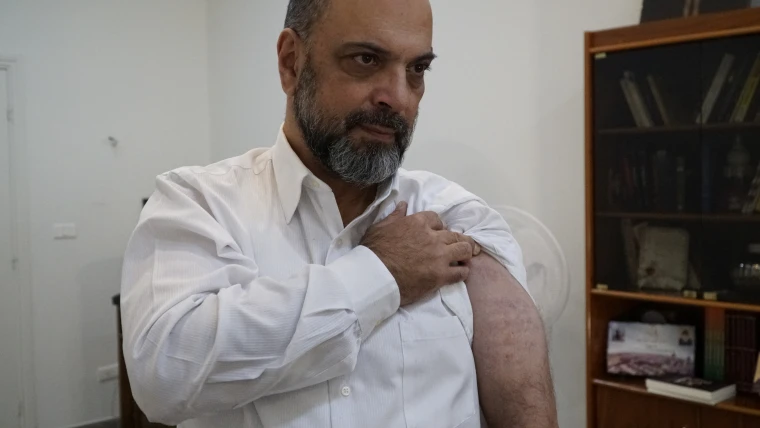
By Hannah Brockhaus Beirut, Lebanon (CNA).- Raymond Nader had spent years searching for the meaning of life, when during a moment of prayer in an old Lebanese hermitage, he says a mystical experience of light left his arm miraculously marked with a burn in the shape of the hand of St. Charbel. Since that moment, on Nov. 10, 1994, the handprint on his upper left arm has faded and reappeared multiple times, Nader told CNA. Dr. Nabil Hokayem, a Beirut plastic surgeon, examined the mark on Nader’s arm three times: first in 1994, soon after its appearance, and subsequently in the spring of 1995 and the summer of 1996. He told CNA that in his professional opinion, the mark is a third-degree burn, in the shape of what appeared “like five fingers, as if someone is holding [Nader] from behind.”
A third-degree burn is severe, and destroys both the upper and lower layers of skin, possibly also affecting underlying tissues. But Hokayem said the burn on Nader’s upper left arm did not go through the stages of healing typical of a severe burn. “I have seen and treated hundreds of burned people; I tell you, I have never seen such a thing,” he said. “I was really astonished.” The doctor said the first time he saw the burn, he wanted to treat and bandage it as usual, but Nader declined, saying it did not bother him. Besides the lack of pain, the doctor explained it was unusual that the burn did not leave a scar, but instead would just slowly fade until it had “healed totally.” Nader said he has continued to have supernatural visions since that first experience in the hermitage nearly 25 years ago, sometimes also seeing a vision of the Lebanese monk and hermit, St. Charbel, “in a halo of light.” He says that each of those times, the fading handprint has turned the dark red of a burn, and again oozed blood and water, as it did when it first appeared. After years of trying to find his purpose through science, this experience “deeply changed everything in my life,” the engineer told CNA, noting that he thinks St. Charbel, who lived as a hermit in the hills of Lebanon for 26 years, “has only one message. He’s pointing to Jesus Christ, pointing to God.”
By Dana Khraiche – bloomberg.com — Lebanon’s Central Bank will reinstate subsidized housing loans, ending an almost year-long freeze of the program, the …
Facebook is planning to merge WhatsApp, Instagram and Facebook Messenger, bringing together more than 2.6 billion users so that they can communicate …

GOOGLE IS POURING an additional $3.1 million into Wikipedia, bringing its total contribution to the free encyclopedia over the past decade to more than $7.5 million, the company announced at the World Economic Forum Tuesday. A little over a third of those funds will go toward sustaining current efforts at the Wikimedia Foundation, the nonprofit that runs Wikipedia, and the remaining $2 million will focus on long-term viability through the organization’s endowment. Google will also begin allowing Wikipedia editors to use several of its machine learning tools for free, the tech giant said. What's more, Wikimedia and Google will soon broaden Project Tiger, a joint initiative they launched in 2017 to increase the number of Wikipedia articles written in underrepresented languages in India, and to include 10 new languages in a handful of countries and regions. It will now be called GLOW, Growing Local Language Content on Wikipedia. It’s certainly positive that Google is investing more in Wikipedia, one of the most popular and generally trustworthy online resources in the world. But the decision isn’t altruistic: Supporting Wikipedia is also a shrewd business decision that will likely benefit Google for years to come. Like other tech companies, including Amazon, Apple, and Facebook, Google already uses Wikipedia content in a number of its own products. When you search Google for “Paris,” a “knowledge panel” of information about the city will appear, some of which is sourced from Wikipedia. The company also has used Wikipedia articles to train machine learning algorithms, as well as fight misinformation on YouTube.
Population Movements to Keserwan - The Khazens and The Maans
ما جاء عن الثورة في المقاطعة الكسروانية
ثورة أهالي كسروان على المشايخ الخوازنة وأسبابها
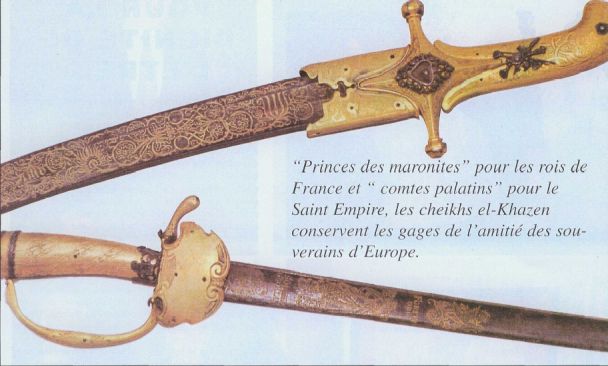
Origins of the "Prince of Maronite" Title
Growing diversity: the Khazin sheiks and the clergy in the first decades of the 18th century
Historical Members:
Barbar Beik El Khazen [English]
Patriach Toubia Kaiss El Khazen(Biography & Life Part1 Part2) (Arabic)
Patriach Youssef Dargham El Khazen (Cont'd)
Cheikh Bishara Jafal El Khazen
Patriarch Youssef Raji El Khazen
The Martyrs Cheikh Philippe & Cheikh Farid El Khazen
Cheikh Nawfal El Khazen (Consul De France)
Cheikh Hossun El Khazen (Consul De France)
Cheikh Abou-Nawfal El Khazen (Consul De France)
Cheikh Francis Abee Nader & his son Yousef
Cheikh Abou-Kanso El Khazen (Consul De France)
Cheikh Abou Nader El Khazen
Cheikh Chafic El Khazen
Cheikh Keserwan El Khazen
Cheikh Serhal El Khazen [English]
Cheikh Rafiq El Khazen [English]
Cheikh Hanna El Khazen
Cheikha Arzi El Khazen
Marie El Khazen