The runner-up was Miss South Africa Tamaryn Green. The second runner-up was Miss Venezuela Isabella Rodríguez. Gray was officially crowned the Miss …

By NPR -- npr.org -- In one of the first scenes in Capernaum, the camera flies above the slums of Beirut. There is no sight of the Mediterranean Sea or the glamour of the so-called Paris of the Middle East. This is another side of the Lebanese capital. "You're seeing dilapidated buildings, children running around playing with pieces of metals and just whatever they could find on the street, not actual toys," film critic Nana Asfour said.
The Jury Prize winner at this year's Cannes Film Festival tells the story of Zain, a streetwise 12-year-old, who flees his abusive parents and later sues them for the "crime" of giving him life. It opens in the U.S. this week, days after earning a Golden Globe nomination and a place on many critics' best-of lists (including NPR's). Lebanese filmmaker Nadine Labaki said the dystopian images in her film are a reflection of Beirut as it is today. It's also captured in the film's title. "Capernaum in French is used usually in French literature to signify chaos, to signify hell, disorder," she said. In recent years, Lebanon has taken in more than a million refugees fleeing the war in neighboring Syria. Labaki said the sight of hundreds of children begging on the streets has become the new normal. She still remembers the night that she decided she had to do something. "I was one day coming back from a party at 1 o'clock in the morning, and I see a mother with her child begging," she said. "He was almost, like, 2, and he was dozing off and he couldn't sleep," she said. "And we were not giving him the right to sleep. And it struck me: Everything that this kid is going to know for the next two, three years is this half-a-meter sidewalk. It's his only playground." Article continues after this message from our sponsor Labaki was pregnant at the time. "How come we got to that point?" she said. "How do we allow for such injustice to happen to the most fragile human beings in our society?" In an attempt to find answers, Labaki began working on the film as a reporting project with her husband and collaborator, the film composer and musician Khaled Mouzanar. After it became evident that nobody would initially finance the story, the couple mortgaged their home and set out to bring the story to screen. "We spent four years with all these people in the poorest and darkest places of Beirut, where all these people end up after going on the streets of rich neighborhoods where they are beggars," Mouzanar said. "They go back to these places where they live, and it is close to hell." Labaki said she always knew she wanted to tell the story from a child's point of view. So she interviewed hundreds of kids living on the streets. "I used to make it a point at the end of the conversation to ask them: Are you happy to be alive?" she said. "And most of the times the answer was no. They just see themselves as insects, as parasites — some of them used those words. 'I'm just an insect. I'm just a parasite. I don't exist. I'm invisible.' So I wanted to translate this anger." Capernaum shows the hunger, suffering and abuse that drove Zain into a courtroom. "And by suing his parents he's also suing a system, a whole society that is not allowing him to have his basic rights," Labaki said.


By SARAH EL DEEB -- MAYS AL-JABAL, Lebanon (AP) — As Israeli excavators dug into the rocky hills along the frontier with a Lebanese village, a crowd of young Lebanese men gathered to watch. The mood was light as the crowd observed what Israel says is a military operation — dubbed "Northern Shield" — aimed at destroying attack tunnels built by the Lebanese Hezbollah militia. The young men posed for selfies, with the Israeli crew in the background, as they burned fires and brewed tea to keep warm. But Lebanese soldiers were visibly on high alert, deploying to new camouflaged posts behind sandbags and inside abandoned homes. About two dozen U.N. peacekeepers stood in a long line, just ahead of the blue line demarcating the frontier between the two countries technically still at war.
The scene highlights the palpable anxiety that any misstep could lead to a conflagration between Israel and Lebanon that no one seems to want. Underscoring such jitters, shadowy figures appearing across the misty hills of the border village of Mays al-Jabal last weekend sparked panic, and Israeli soldiers fired in the air to warn a Lebanese military intelligence patrol, according to Lebanese reports. Israel said it fired at Hezbollah members who came to the site to dismantle sensors installed to detect tunnels. Israel's tunnel search comes at a time when the civil war in neighboring Syria seems to be winding down. Hezbollah had sent hundreds of troops to Syria in 2013 to fight alongside the forces of Syrian President Bashar Assad. With Assad's forces emerging victorious, attention now seems to be returning to the tense Israel-Lebanon border. Israel said its troops have discovered at least three tunnels along the frontier — a tactic used by Hezbollah in previous wars — and called on the international community to impose new sanctions on Hezbollah. The militant group, which fought a bruising but inconclusive war with Israel in 2006, has not commented on the Israeli operation or statements. Lebanese Prime Minister-designate Saad Hariri said Thursday that neither Israel nor Lebanon wanted to go to war, but noted that Israel violates Lebanese airspace and international waters on a regular basis. He said the Lebanese army "will deal with this issue" after receiving a full report from the U.N peacekeeping force, but did not elaborate.

by Asharq Alawsat -- Prime Minister-designate Saad al-Hariri affirmed the Lebanese government’s firm commitment to implementing the necessary legal, financial and economic reforms to improve the business environment and enhance transparency. Hariri was speaking at the opening of the Lebanese-UK Business and Investment Forum at Savoy Palace in London, which was also attended by UK Minister of State for the Middle East and International Development Alistair Burt, caretaker Foreign Minister Gebran Bassil, UK Trade Commissioner for the Middle East Simon Penny and the Lebanese ambassador to UK, Rami Mortada, as well as Lebanese ministers and economic officials. The forum saw the signing of an agreement between Rolls Royce and Middle East Airlines. Stalling in the formation of the Lebanese government imposed itself on the agenda of the forum, as a factor that affects the attractiveness of Lebanon to foreign investors and British private sector companies. In this regard, Hariri said: “The delay in government formation has not halted our progress on the implementation of the CEDRE projects and reforms.” “Admittedly, Lebanon’s economy is under tremendous pressure, due partly to continued regional turmoil. Moreover, our economic and social challenges are compounded by the continued presence of one and a half million Syrians displaced for the eighth year in a row,” he noted.
Population Movements to Keserwan - The Khazens and The Maans
ما جاء عن الثورة في المقاطعة الكسروانية
ثورة أهالي كسروان على المشايخ الخوازنة وأسبابها
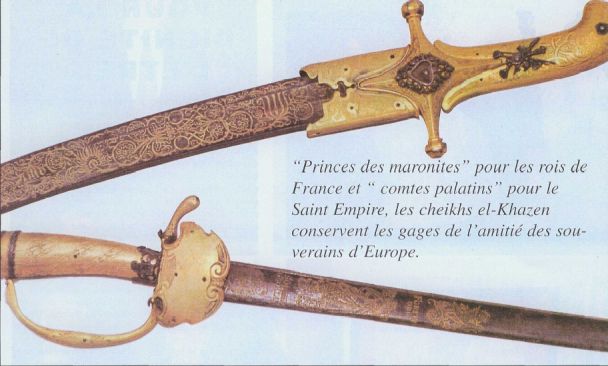
Origins of the "Prince of Maronite" Title
Growing diversity: the Khazin sheiks and the clergy in the first decades of the 18th century
Historical Members:
Barbar Beik El Khazen [English]
Patriach Toubia Kaiss El Khazen(Biography & Life Part1 Part2) (Arabic)
Patriach Youssef Dargham El Khazen (Cont'd)
Cheikh Bishara Jafal El Khazen
Patriarch Youssef Raji El Khazen
The Martyrs Cheikh Philippe & Cheikh Farid El Khazen
Cheikh Nawfal El Khazen (Consul De France)
Cheikh Hossun El Khazen (Consul De France)
Cheikh Abou-Nawfal El Khazen (Consul De France)
Cheikh Francis Abee Nader & his son Yousef
Cheikh Abou-Kanso El Khazen (Consul De France)
Cheikh Abou Nader El Khazen
Cheikh Chafic El Khazen
Cheikh Keserwan El Khazen
Cheikh Serhal El Khazen [English]
Cheikh Rafiq El Khazen [English]
Cheikh Hanna El Khazen
Cheikha Arzi El Khazen
Marie El Khazen