by forbesmiddleeast.com — Lebanon’s first UX and design conference drew international crowds and big names Lebanon’s first user experience conference took place …
Education Minister Marwan Hamadeh announced Monday that 92 percent of students passed the General Sciences Baccalaureate, 83 percent the Life and Sciences …
by lebaneseexaminer.com — Rabih K — Forbes Middle East recently released a list of the top 10 women entrepreneurs in the Middle …

by thenational.ae-- David Enders -- The beaches of Jounieh, a popular Lebanese coastal city 10 miles north of Beirut, are typically reserved for laying in the sun, family days out, and watersports in the bay. But the bacteria levels in the waters around this former fishing village are more than 100 times the amount that would prompt the closure of a public beach in the US state of New York. Further south at Ouzai, a seaside neighbourhood of the Lebanese capital, a grey coat of raw sewage in the Mediterranean sea is clearly visible on Google Maps. “The smell can kill you,” says a 10-year-old boy from the neighbourhood. “We swim over there, instead of here,” he continues, pointing to an inlet adjacent to the one where the sewage enters the sea. The toxic waters of Ouzai and Jounieh are both grim examples of Lebanon's waste disposal problem, which has left the coastline with ever-worsening pollution.
In the 1960s and 1970s, Lebanon’s beaches were a destination for vacationers. But the issue of water safety in Lebanon has descended into such a crisis that authorities now advise against swimming in the sea anywhere along the country’s coastline. “The government must declare a state of emergency for water quality in Lebanon,” Michel Afram, head of the Lebanese Agricultural Research Institute (LARI), told The National. The environmental body says high concentrations of heavy metals have been found off the coast and it is now conducting an assessment of fish caught in the country’s waters. The sewage flow at Ouzai is unique only in that it is readily visible – submarine pipes do most of the direct dumping. “Ninety percent of Lebanon’s wastewater goes untreated to the sea,” says Ziad Abichaker, an environmental engineer specialising in waste management. An inlet at Ouzai is murky brown and opaque. Just metres away, men fish for their catch. The sand on the beach, strewn with garbage, has turned black in places. “It’s been like this for years,” says one resident.
Lebanese Environment Minister Tarek Khatib has previously denied the country is experiencing a waste crisis. He could not be reached for comment. While some newly-elected members of parliament have drawn attention to the waste disposal issue in the last week, Mr Abichaker said he was not optimistic. “It seems this political class is unable to manage the country,” he says. “This is not rocket science, wastewater, treatment – it’s pretty basic. It just needs some integrity and some political willingness.” The mismanagement of Lebanon’s solid waste is an ongoing affliction that has only made the problem worse. Seaside landfills leach directly into the water around Beirut, and a recent ban on burning garbage has placed greater pressure on the government to find ways to dispose of the trash. Dumping has turned most of Lebanon’s rivers into ecological disasters, far more polluted than the sea into which they flow.
Population Movements to Keserwan - The Khazens and The Maans
ما جاء عن الثورة في المقاطعة الكسروانية
ثورة أهالي كسروان على المشايخ الخوازنة وأسبابها
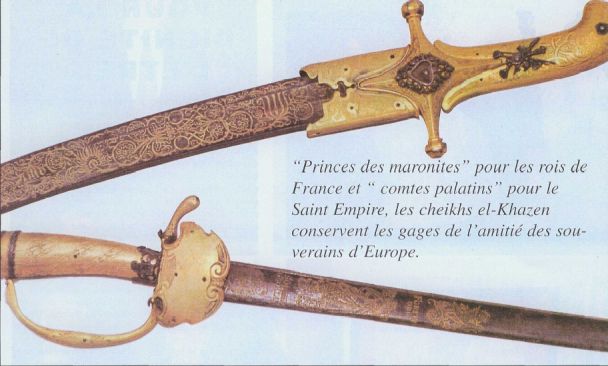
Origins of the "Prince of Maronite" Title
Growing diversity: the Khazin sheiks and the clergy in the first decades of the 18th century
Historical Members:
Barbar Beik El Khazen [English]
Patriach Toubia Kaiss El Khazen(Biography & Life Part1 Part2) (Arabic)
Patriach Youssef Dargham El Khazen (Cont'd)
Cheikh Bishara Jafal El Khazen
Patriarch Youssef Raji El Khazen
The Martyrs Cheikh Philippe & Cheikh Farid El Khazen
Cheikh Nawfal El Khazen (Consul De France)
Cheikh Hossun El Khazen (Consul De France)
Cheikh Abou-Nawfal El Khazen (Consul De France)
Cheikh Francis Abee Nader & his son Yousef
Cheikh Abou-Kanso El Khazen (Consul De France)
Cheikh Abou Nader El Khazen
Cheikh Chafic El Khazen
Cheikh Keserwan El Khazen
Cheikh Serhal El Khazen [English]
Cheikh Rafiq El Khazen [English]
Cheikh Hanna El Khazen
Cheikha Arzi El Khazen
Marie El Khazen