by albawaba.com – A month ago, the streets of Beirut and cities and towns across Lebanon were decorated with posters and flags …
This article does not necessarily represents khazen.org
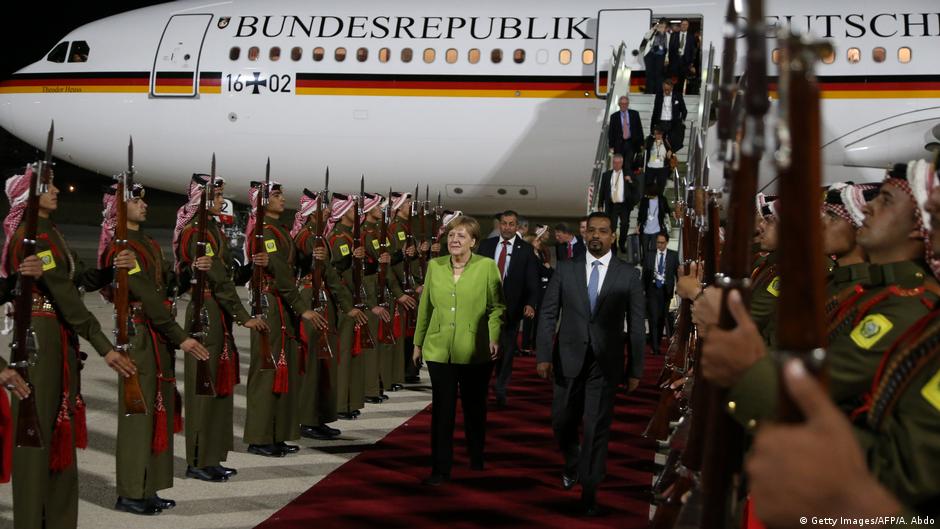
BEIRUT, June 21 (Xinhua) -- German Chancellor Angela Merkel reiterated Germany's support for Lebanon's reforms during her visit to Beirut on Thursday. "Germany supports a prosperous Lebanon where people from different religions live peacefully together," Merkel said following talks with Lebanese Prime Minister-designate Saad Hariri at the Prime Minister's Palace. "We wish success for the Lebanese in the implementation of the reforms that have already started," she added. Merkel arrived at the Rafic Hariri International Airport on Thursday afternoon, accompanied by a high-level delegation. She was received by Hariri who will be holding an official dinner in her honor. The German chancellor is expected to meet Lebanese President Michel Aoun and Parliament Speaker Nabih Berri on Friday. Merkel will also hold talks with Lebanese officials to discuss increasing trade between the two countries and the issue of Syrian refugees.
by dw.com -- Discussions with students in Jordan and Lebanon and talks with Jordan's King Abdullah II and Lebanese Prime Minister Saad Hariri are just a few of the items on German Chancellor Angela Merkel's agenda during her two-day trip to the Middle East. Though education, investment and research are also part of the discussions, no topic will define Merkel's trip more than refugee policy.
Two countries, two approaches
Both Jordan and Lebanon are bearing a heavy burden as a result of the ongoing war in neighboring Syria. These relatively stable states have taken in a large number of refugees. According to the United Nations refugee agency (UNHCR), one out of every six residents in Lebanon is a Syrian refugee and in Jordan that number is one out of 11. In absolute numbers that means that, depending on estimates, somewhere between 1 and 1.5 million Syrian refugees are now in Lebanon. The UNHCR says that 700,000 Syrians were living in Jordan last year. Whereas refugees in Jordan mainly live in large camps, such facilities do not exist in Lebanon. "There are only informal settlements, most refugees live in makeshift tents or they occupy ruins — anywhere they can find space. But they have very little security," says Bente Scheller, who heads the Beirut branch of the Heinrich Böll Foundation, a Green party-affiliated political organization. While accommodation and provisions for refugees are centrally coordinated in Jordan, the situation in Lebanon is much more precarious. Even still, the human rights organization Amnesty International has called the conditions in camps along the Syrian-Jordanian border "catastrophic." The group says food, medical provisions and housing are all in short supply.
Syrians kept away from parts of Jordanian job market Meanwhile, the United Nations says that roughly three-quarters of all Syrian refugees in Lebanon live below the poverty level, and more than half of them are living in overcrowded buildings in very densely populated neighborhoods. All that has led to an increasingly perilous situation for Syrians in Lebanon, says Scheller. The Lebanese government has also prohibited the UNHCR from registering refugees since 2016. Recently, Lebanon's foreign minister caused an uproar by announcing that he would not renew visas for UNHCR employees. Scheller believes that is a clear signal from the Lebanese government. "In the long run they will not tolerate the presence of refugees," she says. "They want more assistance and they want a solution to the problem." Syrian refugees residing in Jordan are now allowed to work at certain jobs, something the German Foreign Ministry pushed hard for. Yet, criticism has grown as a result. Jordanians claim that the Syrians, who are often more highly educated and willing to work for less, are taking jobs away from them. The situation in Lebanon is similar. There, says Scheller, many refugees work illegally because the financial aid they receive from the UN is simply not enough to make ends meet.
This is an opinion article and does not necessarily represents khazen.org
But Alloush, a former MP, would even like to take his optimism into the government. “I told [prime minister designate] Saad Hariri that if I was a minister I would say what I thought was the truth, whatever his reaction. I would not be a ‘yes’ man.” He would like to be a minister of health, sport or culture – he was hoping for the same in the last three Lebanese cabinets. My suspicion is that Mustafa Alloush – one day, not now, you can’t be too careful about these things in Lebanon – would like to be prime minister. “The politicians here represent the same centres of power in Lebanon and have been present for the past 75 years,” he says. “The only democratic aspect of this last election is that the people went to vote. I regard Lebanon as a company, as a partnership. It was originally Sunni [Muslim] and [Christian] Maronite. The new partners are the Shiites and they are coming in without giving new money for the company. They are taking money from those who have been in the company for years.” Lebanon Prime Minister Saad Hariri says resignation on hold awaiting talks Alloush is a Sunni, like Hariri – and the Sunnis hold the prime ministership in this sectarian country – and he is a ferocious critic of the Shiite Hezbollah movement and of Syrian president Bashar al-Assad. But he is also half Alawite – the Shiite sect to which Assad belongs – and when we pass the old Tripoli cemeteries later in the day, he shows me where his Alawite mother is buried.
Before the French chopped up Syria and created the new Lebanese state in 1920, Tripoli’s nearest market town was Homs in present day Syria. Tens of thousands of Tripolitanians are related to Syrians and inevitably the civil wars that consumed first Lebanon (1975-1990) and then Syria – 2011 until god knows when – divided this tough northern Lebanese city. Tripoli is 76 per cent Sunni, 12 per cent Alawite and 12 per cent Christian, according to Alloush. And the front line, irony of ironies, cracked open along Syria Street. I spoke to Palestinians who still hold the keys to the homes they fled Bullet holes still blister the buildings and army checkpoints control the roads up to the Alawite Jabel Mohsen district, but Alloush spots an illusory element about all this. As we drive these crowded streets, he shakes his head. “From the first day of the ceasefire here, it was as if nothing had happened for years and years. This means that the situation here can explode again at any time, at any hour. I remember this Syrian ‘green zone’ when it started, in March 1976. All of a sudden, we saw people separating on both sides. It wasn’t sectarian at first. There were Sunnis and Alawites on the Hafez [al-Assad] side and Sunnis and Alawites on the side of [Palestine Liberation Organisation leader] Arafat. Then it metamorphosed into something sectarian.”
by albawaba.com — General Security will remove the names of these individuals from the decree for “legal” and “other reasons” that invalidate their …




Population Movements to Keserwan - The Khazens and The Maans
ما جاء عن الثورة في المقاطعة الكسروانية
ثورة أهالي كسروان على المشايخ الخوازنة وأسبابها
Origins of the "Prince of Maronite" Title
Growing diversity: the Khazin sheiks and the clergy in the first decades of the 18th century
Historical Members:
Barbar Beik El Khazen [English]
Patriach Toubia Kaiss El Khazen(Biography & Life Part1 Part2) (Arabic)
Patriach Youssef Dargham El Khazen (Cont'd)
Cheikh Bishara Jafal El Khazen
Patriarch Youssef Raji El Khazen
The Martyrs Cheikh Philippe & Cheikh Farid El Khazen
Cheikh Nawfal El Khazen (Consul De France)
Cheikh Hossun El Khazen (Consul De France)
Cheikh Abou-Nawfal El Khazen (Consul De France)
Cheikh Francis Abee Nader & his son Yousef
Cheikh Abou-Kanso El Khazen (Consul De France)
Cheikh Abou Nader El Khazen
Cheikh Chafic El Khazen
Cheikh Keserwan El Khazen
Cheikh Serhal El Khazen [English]
Cheikh Rafiq El Khazen [English]
Cheikh Hanna El Khazen
Cheikha Arzi El Khazen
Marie El Khazen