wagingnonviolence.org — Rayyan Dabbous — Following Lebanon’s parliamentary elections on May 6, more than a thousand Lebanese gathered in front of the Ministry of …

This article does not necessarily represents khazen.org
BY: MONA SUKKARIEH
The comments made by Israel’s Defense Minister Avigdor Liberman at a Tel Aviv conference on January 31 sparked outrage in Lebanon. It brought the issue of the maritime border dispute between Lebanon and Israel back into the spotlight and managed to catch Washington’s attention once again. Little was happening on this front after the change of Administration in the U.S. After a few months, Lebanese officials stopped announcing that a resumption of mediation efforts was imminent. Then, in October, the decision, by a Total-led consortium to place a bid for Block 9 (which includes a disputed area) in Lebanon’s first licensing round, rekindled interest once again in the topic. But the buzz was discreet, confined to experts and diplomatic circles, until it was out in the open when Liberman described Lebanon’s offshore tender as “very provocative” and urged international companies not to bid, about a month and a half after licenses were awarded. The dispute unfolded in December 2010, when Cyprus and Israel signed a maritime border agreement that was denounced by Lebanon because it encroached on parts of its Exclusive Economic Zone (EEZ). On July 10, 2011, the Israeli cabinet approved a map of Israel’s northern maritime border, and two days later, the Israeli mission to the United Nations submitted a list of geographical coordinates for the delimitation of the northern limit of Israel’s territorial sea and EEZ. Some of the points defined in the Cypriot-Israeli agreement and submitted later to the U.N. overlap with the Lebanese EEZ.
But to understand how we got here, we must go back to 2007. On January 17 of that year, Lebanon signed a maritime border agreement with Cyprus. It followed standard procedure outlined in the UN Convention on the Law of the Sea (UNCLOS), marking a series of points that are equidistant from Cyprus and Lebanon (median line). Point 1 was used to mark the southernmost point along this line, while Point 6 marked its northernmost point. The agreement included a standard clause specifying that the geographical coordinates of the first and last markers, in this case Point 1 in the south, and Point 6 in the north, may be adjusted in light of future delimitation of the EEZ with other neighboring States, since a bilateral agreement cannot pretend to define the borders of third states. The agreement was never ratified by the Lebanese Parliament, largely because of pressure from Turkey, which denounces all maritime border agreements signed by the Republic of Cyprus with its neighboring countries. As such, the agreement never entered into force.
But it wasn’t until April 2009 that a Lebanese commission tasked with defining the coordinates of Lebanon’s EEZ completed its work, identifying Point 23, 17 km south of Point 1, as the southernmost point of the EEZ. The coordinates were approved by the cabinet on May 13, 2009, and by the Parliament on August 4, 2011. In accordance with UNCLOS, Lebanon submitted the relevant charts and lists of coordinates to the U.N. in July and October 2010 and in November 2011. Just like the Israeli submissions mentioned above, these are unilateral submissions and do not amount to border delimitation. Israel objects to the southernmost coordinates submitted by Lebanon. Less known is the fact that Syria also objected to the delineation provided by Lebanon in a letter transmitted to the U.N. Secretary-General on 15 July 2014, saying that it does not have “any binding legal effect on other States. It remains only a notification, and one to which the Syrian Arab Republic objects”.
by lebaneseexaminer.com —Greece is expected to welcome more tourists from Lebanon in 2018, according to travel agencies that participated in the recent …
by businessinsider — The opening of the new US embassy in Jerusalem sparked violent protests in both Gaza and the West …

Population Movements to Keserwan - The Khazens and The Maans
ما جاء عن الثورة في المقاطعة الكسروانية
ثورة أهالي كسروان على المشايخ الخوازنة وأسبابها
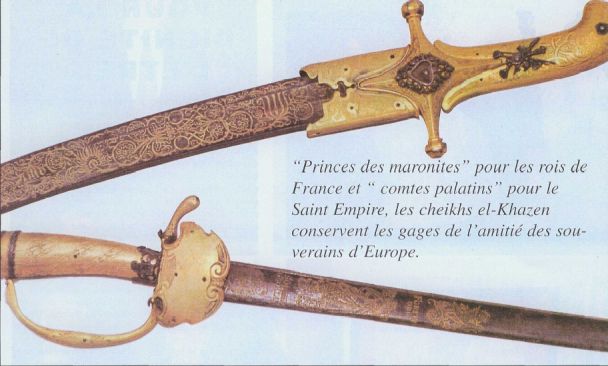
Origins of the "Prince of Maronite" Title
Growing diversity: the Khazin sheiks and the clergy in the first decades of the 18th century
Historical Members:
Barbar Beik El Khazen [English]
Patriach Toubia Kaiss El Khazen(Biography & Life Part1 Part2) (Arabic)
Patriach Youssef Dargham El Khazen (Cont'd)
Cheikh Bishara Jafal El Khazen
Patriarch Youssef Raji El Khazen
The Martyrs Cheikh Philippe & Cheikh Farid El Khazen
Cheikh Nawfal El Khazen (Consul De France)
Cheikh Hossun El Khazen (Consul De France)
Cheikh Abou-Nawfal El Khazen (Consul De France)
Cheikh Francis Abee Nader & his son Yousef
Cheikh Abou-Kanso El Khazen (Consul De France)
Cheikh Abou Nader El Khazen
Cheikh Chafic El Khazen
Cheikh Keserwan El Khazen
Cheikh Serhal El Khazen [English]
Cheikh Rafiq El Khazen [English]
Cheikh Hanna El Khazen
Cheikha Arzi El Khazen
Marie El Khazen