Khazen

Lebanon’s Health Minister fears that hospitals are reaching capacity

Lebanese Health Minister, Hamad Hassan

by euroweeklynews — Following the explosion that tore through Beirut’s Karantina district on 4th August, local health services and hospitals are reaching maximum capacity. Lebanon has suffered a sharp rise in COVID-19 related cases and subsequent deaths in recent weeks. Cases continue to rise to a new high in the aftermath of the explosion that devastated Beirut earlier this month. At a recent press conference, the Health Minister, expressed his fear that: “Public and private hospitals in the capital, in particular, have a very limited capacity, whether in terms of beds in intensive care units or respirators”. The Health Minister is of the firm belief that the government should impose a new two-week lockdown to curtail the rise in cases stating, “We are on the brink, we don’t have the luxury to take our time”.

Read more
Why power-broker Hezbollah is still rocked by Beirut blast

by csmonitor.com — Scott Peterson —For the veteran Hezbollah fighter, there was one silver lining – but only one – in the massive explosion at Beirut’s port that devastated swathes of the Lebanese capital Aug. 4. Overnight, the price of an AK-47 assault rifle quadrupled from $200 to $800. But for the mechanic-turned-gun dealer, that scrap of relatively good news is far outweighed by what the demand for weapons signals about spreading insecurity in Beirut, and the challenge now faced by Hezbollah amid popular demands to reform a corrupt and sectarian ruling system in which the Shiite movement has become deeply entwined. “We are living in a very, very dangerous time. … Everybody is buying a gun to protect his family,” says the Hezbollah fighter, a former unit commander in Syria who devoted his life to the Shiite “Party of God.” He survived multiple tours in Syria but has become disillusioned as quality of life for all Lebanese has deteriorated.

Public anger over systemic corruption and incompetence erupted last October in protests nationwide that included traditional Hezbollah strongholds. But even as Beirutis replace windows and doors smashed by the blast – their anger grown even deeper – there appear few easy solutions to decades of entrenched sectarian rule that most recently has been brokered by Hezbollah. An image of Sheikh Hassan Nasrallah, the Hezbollah leader, was among those hung by a noose by Lebanese protesters furious about the blast and the collapsing state of their nation. Protesters have for months called for the toppling of the entire political elite, chanting “‘All of them’ means all of them,” in a dig that deliberately includes Hezbollah.

Hezbollah’s warning

In a speech soon after the blast, Sheikh Nasrallah warned Lebanese not to blame Hezbollah, or it would “start a battle” that the militia would win – and that Lebanese demanding reforms, presumably, would lose. “We are living in the worst chaos ever witnessed in Lebanon. People are accusing Hezbollah more than ever,” says the veteran fighter, speaking in his cramped workshop in Beirut’s southern suburbs. Many of Iran-backed Hezbollah’s thousands of core fighters no doubt remain devoted to the cause of “resistance” against Israel and against American influence. But this officer – who is not alone in his disenchantment – refused last fall to return to Syria, where Hezbollah and Iran have helped support President Bashar al-Assad, citing to the Monitor leadership “corruption,” fighting on too many front lines across the Middle East, and a fury that “we drowned with their lies.”

Read more
Lebanese schools likely to reopen late September: Education minister

by NAJIA HOUSSARI — arabnews — BEIRUT: Lebanese schools are likely to reopen in the last week of September, said Minister of Education and Higher Education Tarek Majzoub. Amid a rise in COVID-19 cases, the Education Ministry is finalizing a health protocol that will be presented to the Health Ministry for its opinion this week. “Blended education will be adopted, and if conditions worsen we will return to distance learning,” said Majzoub.

But anxiety among students and their families is growing due to the absence of logistical equipment required to undergo distance learning. In addition, the massive explosion at the Port of Beirut earlier this month destroyed many schools in the capital. The numbers destroyed or damaged reached 92 public schools in and around Beirut, 67 private schools and 20 public vocational institutes, according to statistics from the Education Ministry. UNICEF said in a report: “Schools should not reopen except when they are safe for students … The authorities must be flexible and prepared to adapt to verify the safety of every child.”

Read more
Kuwait to rebuild Lebanon’s only large grain silo after blast

by dailysabah.com — Kuwait said it will rebuild Lebanon’s only large grain silo that was destroyed by the massive Beirut port explosion, raising fears of food shortages in a country already in a financial meltdown. The destruction of the 120,000-ton capacity structure at the port, the main entry point for food imports, meant buyers must […]

Read more
Lebanon continues to receive foreign donations after Beirut’s blasts

by siasat.com — Beirut, Aug 23 : Lebanon continued to receive donations from foreign countries following the explosions that rocked Beirut’s port on August 4, LBCI local TV channel reported. An aircraft arrived in Beirut from Australia and another one from Belgium carrying medical equipment for Lebanese hospitals, Xinhua news agency reported on Saturday. Lebanon […]

Read more
S&P downgrades Lebanon bonds after missed payments

by AFP — WASHINGTON: Credit ratings agency S&P downgraded more Lebanese government debt issues after missed payments, citing the country’s worsening economic crisis following the devastating explosion in Beirut earlier this month. S&P Global Ratings maintained the “selective default” or “SD” rating for Lebanon’s foreign debt, after the country first defaulted in March, but three more bonds were cut to “D” from “CC,” the agency said. “The recent catastrophic explosion in Beirut is deepening the country’s economic crisis,” S&P said in a statement. “A protracted political vacuum or weak new government could further delay policy reforms, external aid and debt restructuring negotiations.” The capital was ravaged by a massive explosion at Beirut’s port on Aug. 4 that killed 181 people and wounded thousands. That was followed by protests against the government, leading the Cabinet to resign. Still reeling from the deadly blast, the country also entered into a new coronavirus lockdown Friday after a string of record daily infections tallies. “Even before these recent events, Lebanon had made limited progress in engaging creditors on debt restructuring negotiations,” S&P said.

Read more
Death stalks Lebanon as anger continues to boil

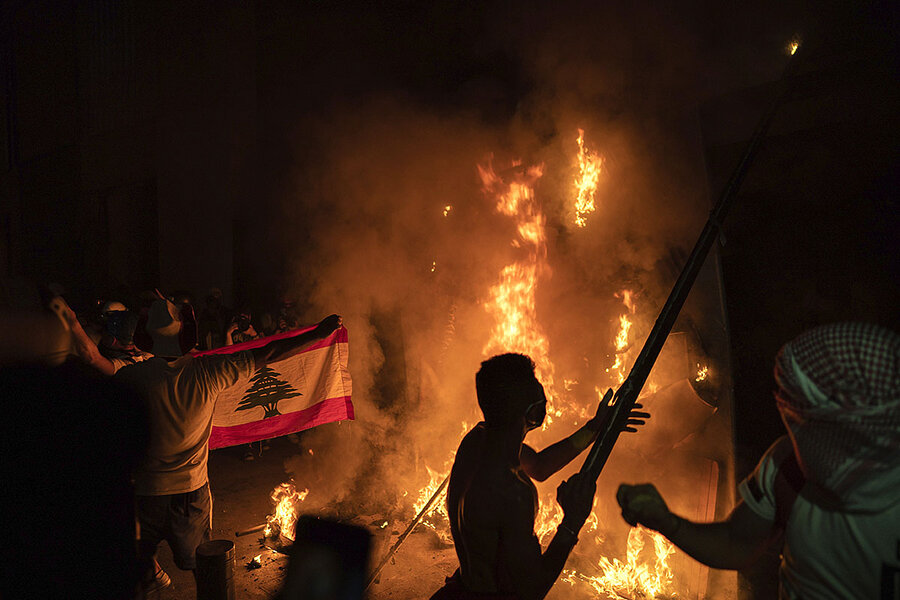
by NAJIA HOUSSARI — arabnews. — BEIRUT: The Lebanese footballer Mohammed Atwi is in intensive care at Al-Maqasid Hospital, battling for his life after he was hit in the head by a bullet on Friday, in the Cola district of Beirut. The incident coincided with the last of the funerals for members of the Beirut Fire Brigade who died in the recent port explosion. Joe Bou Saab’s funeral was taking place in the Ain El-Remmaneh area east of Beirut, as armed men began shooting into the air. Atwi, 33, had played for Al-Tadhamon Football Club in Tyre, and previously for Al-Ansar FC and Akhaa Ahli Aley FC. He had been driving his motorbike wearing a helmet in the Cola district when he was struck by a stray bullet, causing severe bleeding and a fracture of the skull. Sources told Arab News that Atwi “needed 16 units of blood, and although he underwent surgery, the bullet was still in his head and doctors could not pull it out because it was in a very critical place behind the ear.” Atwi was not the only victim that day. A security guard, whose name has not been released, was also hit by a stray bullet in the shoulder in front of an embassy near the Cola area, and underwent surgery. He is in stable condition.

In recent years, there has been a campaign to stop shooting in the air during funeral ceremonies, when political leaders appear on television, at weddings, and even to celebrate passing a high school diploma. There were 147 victims (including 45 fatalities) as a result of stray bullets between 2013 and 2019 in Lebanon. Often, Lebanese people also resort to settling disputes by using weapons, but in the past two days, it seems the use of firearms has escalated. Tension between supporters of the Amal Movement and supporters of Hezbollah, against the background of raising religious tension, has led to gunfire, resulting in the injuring of four people, one of whom, Hussein Khalil, died later from his wounds. During his funeral, there were chants against the secretary-general of Hezbollah, Hassan Nasrallah, describing him as an “enemy of God.”

Read more
Lebanese experts capable of leading nation’s reforms

by ZAID M. BELBAGI — arabnews — For Lebanon — a country facing a perfect storm of hyperinflation, food shortages and an acute political crisis — the notion that circumstances could worsen seemed impossible to countenance. However, the Aug. 4 explosion of 2,750 tons of ammonium nitrate in Beirut port proved that things could indeed get worse. Who was responsible for the storage of such quantities of the explosive will remain the subject of speculation, but it must not be allowed to distract from the very real challenges Lebanon faces. A country urgently in need of a bailout, it must look to its talented citizens, not its disconnected elites, for a way out. If anything, the explosion served to underscore the negligence of a nomenklatura that has always put its own financial interests ahead of those of the Lebanese people. As one of the world’s most indebted nations, which now finds itself without a government, the uphill struggle could not be steeper. Whereas disasters elsewhere in the world are met with a period of investigation, in Lebanon crises provide an excuse for those in power to entrench themselves further.

Lebanon’s political elite, unabated by popular anger, is jockeying to form another sham government of self-interest and avoid any sort of investigation. Perhaps more worryingly, an important audit of the country’s central bank is being all but averted. The institution that was complicit in the laundering of billions of dollars stands at the center both of what has plagued Lebanon and any attempt to find a resolution. The lackluster President Michel Aoun has once more deemed that his own political future, as a man of 85, supersedes that of his nation. Ignoring calls to resign, he and MPs must now agree on a new government — though, given the fate of Lebanon’s outgoing prime minister of just a few months, such efforts seem unlikely to succeed.

Read more
Lebanese hospitals need urgent rehabilitation after Beirut’s blasts

(MENAFN – Trend News Agency) Head of Lebanese Order of Physicians Charaf Abou Charaf Friday urged donor countries to accelerate their financial support for hospitals destroyed in the explosions in early August to prevent doctors’ leave, Trend reports citing Xinhua. Abou Charaf’s remarks came during his visit to hospitals including Geitawi hospital and Saint George […]

Read more
Pressure grows for Hariri’s return as Lebanon leader

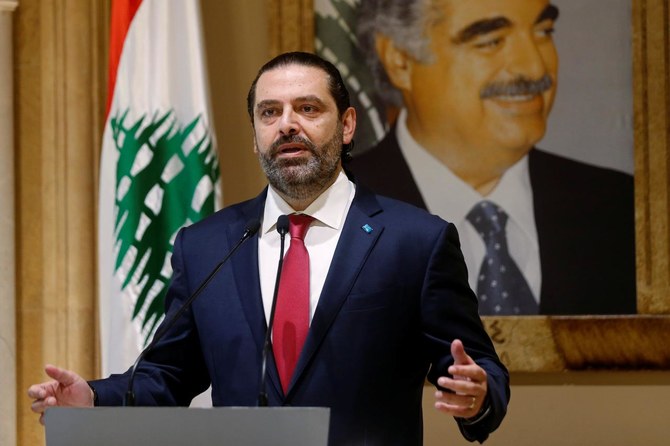
by NAJIA HOUSSARI — arabnews — BEIRUT: Lebanese President Michel Aoun said on Thursday that he plans to include “competent figures representing the voice of the street” in the new government. Ten days after Prime Minister Hassan Diab’s government resigned in the wake of the Beirut port blast, Aoun is yet to set a date for parliamentary consultations to name a leader for the next government. In a tweet on Thursday, he added that it is not clear if talks will take place soon. Diab’s government stepped down amid widespread public anger following the port explosion that devastated Beirut, killing 180 people and causing widespread damage. Opponents of Diab’s leadership claim it was a “shadow government” dominated by Hezbollah that failed to carry out reforms demanded by the international community.

Parliament Speaker Nabih Berri is fighting to restore Saad Hariri as prime minister. Hariri’s government of national unity resigned in October, 2019, after violent protests broke out amid claims of growing government corruption. Protesters called for a transitional government to implement reforms demanded by the global community to help Lebanon overcome its economic crisis. Aoun and Berri held a meeting two days ago in which the parliament speaker suggested Hariri return to the leadership. MPs have reported Berri saying that he considers Hariri “the perfect man for the stage.” Berri also claims that he has Hezbollah’s backing for Hariri. Sources say he is insisting on a political government, not a technocratic one, and wants Hariri to provide it with an acceptable cover in light of the political and economic crises facing Lebanon.

Read more