Khazen

Hassan Diab, Lebanon’s fallen ‘technocrat’ premier


by Hussein Dakroub — The Daily Star — BEIRUT: Prime Minister Hassan Diab resigned Monday under mounting public pressure in the wake of a devastating explosion that rocked Beirut last week, in a move effectively clearing the way for a national unity government backed by France, the US, and Arab countries, an official source said. “The resignation of Diab’s Cabinet is bound to smooth the path for a political settlement to resolve Lebanon’s multiple political, economic and financial crises, and cope with the aftermath of the Beirut blast,” the official source told The Daily Star. “Sponsored by France and backed by the United States and Arab countries, this settlement calls basically for the formation of a national unity government embracing all the main parties in the country,” the source said.

In a televised speech to the Lebanese announcing his government’s resignation, Diab lashed out at what he called the “system of corruption” that is controlling the country. “We want to open the door to national salvation, a salvation that the Lebanese will participate in achieving. Therefore, today I announce the resignation of this government,” Diab said. “May God protect Lebanon … ” Without identifying corrupt politicians largely blamed for the country’s worst economic and financial crisis in decades, Diab said: “I previously said that the system of corruption is deeply rooted in all the functions of the state; nevertheless I discovered that the system of corruption is bigger than the state, and that the latter is constrained by this system and cannot confront it or get rid of it.” “We are still under the shock of the tragedy that struck Lebanon. This disaster which has hit the Lebanese at the core occurred as a result of chronic corruption in politics, administration and the state,” he added.

Diab said one of the many examples of corruption exploded in Beirut Port, and the calamity befell Lebanon. “But corruption cases are widespread in the country’s political and administrative landscape; other calamities hiding in many minds and warehouses, and which pose a great threat, are protected by the class that controls the fate of the country, threatens the lives of people, falsifies facts, survives on seditions and trades in people’s blood during periods of relinquishment which have become a pattern that repeat itself according to interests, impulses, calculations and fluctuating dependencies,” he said. Calling the Beirut blast an “earthquake” that struck the country, with all its humanitarian, social, economic and national repercussions, Diab said: “Today we are appealing to the people, to their demand to hold accountable those responsible for this disaster that has been concealed for seven years, to their desire for real change, for a shift from the state of corruption, waste, brokerage and thefts, to a state based on the rule of law, justice, and transparency, a state that respects its citizens.”

Read more
Mika Shares Letter to the Lebanese People ‘Devastated by the Apocalypse’

Mika

by Billboard Staff  — The British singer, who has Lebanese roots, shared in the country’s grief over the deadly Beirut blast. British glam-pop star Mika (real name Michael Holbrook Penniman Jr.), who was born in Beirut and whose mother is of Lebanese descent, wrote a letter to the Lebanese people to share in their grief and anger over the incident. Billboard was sent an English-language transcript:

My dear Lebanon, My dear Beirut,

It’s still early in the morning on the other side of the Mediterranean and I feel so close and yet so far away from you. So close to you, as you lie devastated by the apocalypse, I can’t stop staring, transfixed, at the battered expressions of my brothers and sisters. In their eyes, I sense their fright, their tears. I shudder as I see a wounded person carried out through the rear window of an old car, a young girl covered in blood in her father’s arms, shell-shocked inhabitants running through streets littered with rubble, broken glass and shattered buildings… So far away from you, haunted by the desolation, I hear in my head the deafening noise of the two explosions that haunted the residents of Beirut. The screams of the grieving families and stunned victims merge in the middle of the night with the screeching sirens of ambulances. I’ve also been told of the silence in the early hours of this morning, of the smell of the smoking ruins.

Read more
Macron Hosts Trump for Virtual Donor Conference on Lebanon

  FORT BREGANCON, France (Reuters) – An emergency donor conference on Sunday for blast-stricken Lebanon raised pledges worth nearly 253 million euros ($298 million) for immediate humanitarian relief, the French presidency said. Those commitments would not be conditional on political or institutional reform, President Emmanuel Macron’s office said. There were also pledges made for longer-term […]

Read more
Electric night of Lebanon protests after blast

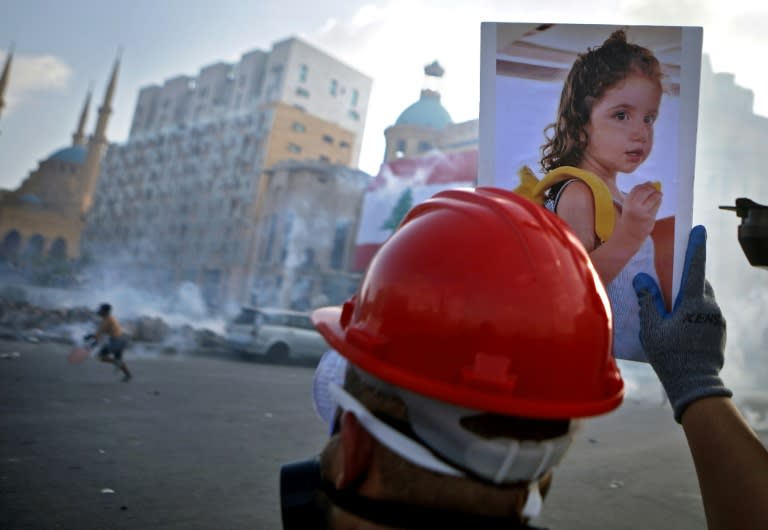
A Lebanese protester carries a photo of 3-year-old Alexandra Najjar, who was wounded in the port explosion and later succumbed to her wounds

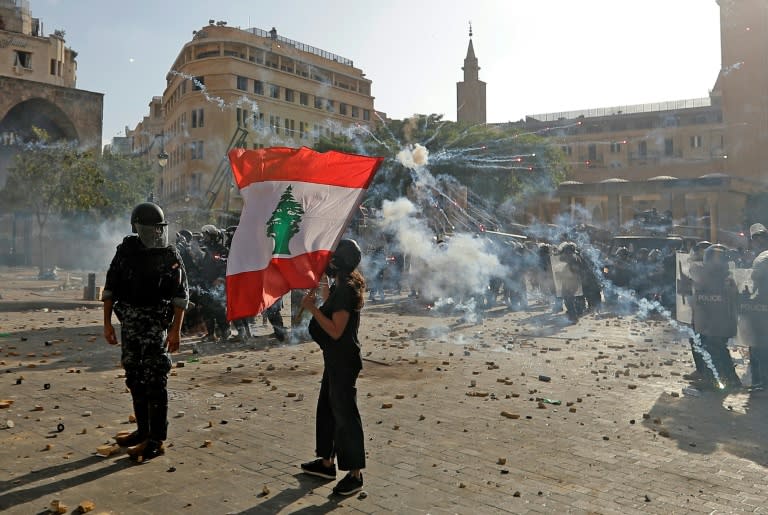
Security forces lobbed tear gas at protesters in downtown Beirut during demonstrations sparked by fury over the massive port blast in Beirut


With security forces focused on a large gathering at the Martyrs' Square protest hub, a group led by retired army officers snuck into the foreign ministry and declared the building a 'headquarters of the revolution'

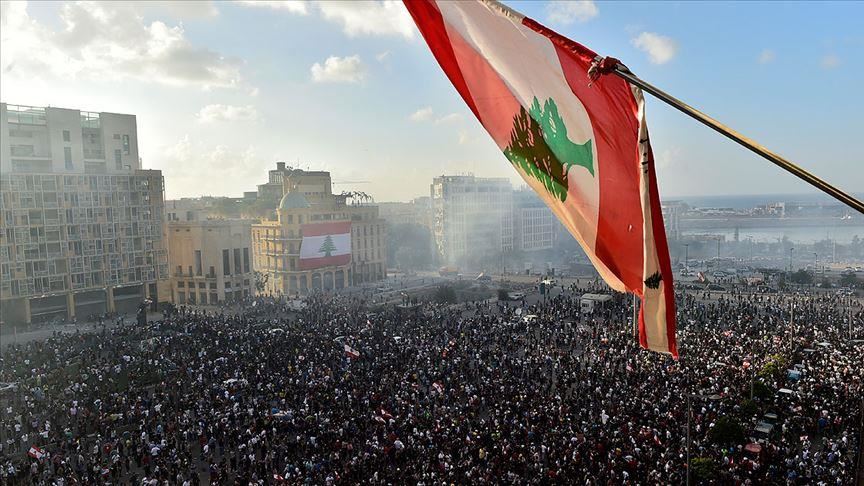
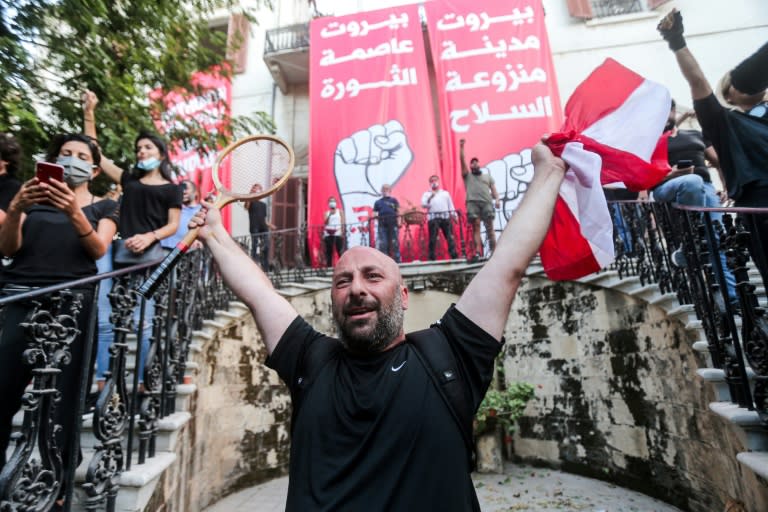
by AFP — Layal Abou Rahal and Tony Gamal-Gabriel — Lebanese protesters stormed several ministries Saturday in apparently planned raids after an explosion blamed on government negligence at Beirut port devastated the city and ignited unprecedented popular rage. The day started with funerals for some of the 158 people killed by Tuesday’s monster blast but turned to rage when the largest anti-government protest in months escalated. With security forces focused on a large gathering at the Martyrs’ Square protest hub, a group led by retired army officers snuck into the foreign ministry and declared the building a “headquarters of the revolution”. The stunt, which marked a new development in the strategy of a protest camp whose October 17 uprising had lost steam lately, was facilitated by the damage the port blast shockwave had inflicted to the building. But the takeover lasted barely three hours.

Large army reinforcements using rubber bullets and tear gas drove out the roughly 200 protesters, who only had time to chant celebratory slogans against the government and burn a portrait of President Michel Aoun. At one point, protesters had stormed or taken over four key official buildings. “We are officially at war with our government,” said activist Hayat Nazer, as tear gas filled the air in downtown Beirut. “This is war.” – ‘Lebanon is ours’ –

Separate groups of protesters also stormed the economy ministry, the Association of Banks in Lebanon and the energy ministry before being forced out by the army shortly afterwards. The latter is the focus of particular anger from the population, which has in recent months been subjected to worse than ever power cuts due to the de facto bankruptcy of the state. “They ruled Lebanon for 30 years, now Lebanon is ours,” said one protester speaking on live Lebanese television broadcasts. “We entered the energy ministry and we are here to stay. They will be surprised by our actions,” he said, referring to the ruling political class protesters want to remove.

Read more
United States Provides Humanitarian Assistance in Response to Explosions in Lebanon

Remarks by President Trump and Prime Minister Hariri of Lebanon in ...

by politico.com — ELISA BRAUN — PARIS — President Donald Trump and his French counterpart Emmanuel Macron spoke over the phone Friday about working with other countries to send immediate aid to Lebanon, the White House and the Élysée said. The two leaders “expressed their deep sadness over the loss of life and devastation in Beirut,” according to White House spokesman Judd Deere. Advertisement Later Friday, Trump tweeted: “Had a lengthy discussion this morning with President Macron of France concerning numerous subjects, but in particular the catastrophic event which took place in Beirut, Lebanon… “..At 3pm this afternoon, spoke to President Aoun of Lebanon to inform him that 3 large aircraft are on the way, loaded up with Medical Supplies, Food and Water. Also, First Responders, Technicians, Doctors, and Nurses on the way… “…We will be having a conference call on Sunday with President Macron, leaders of Lebanon, and leaders from various other parts of the world. Everyone wants to help!”

by reliefweb.int — The United States, through the U.S. Agency for International Development (USAID), is providing more than $15 million in humanitarian assistance to aid the people of Lebanon following catastrophic explosions at the Port of Beirut. These funds bring the humanitarian aid provided by the American people in Lebanon since September 2019 to a total of $403 million. With the funds announced today, the United States is financing life-saving medical responses and providing humanitarian assistance to meet the immediate needs of families affected by this tragic disaster, including food aid for 50,000 people for three months. USAID has also requested the unique capabilities of the U.S. Department of Defense to transport emergency supplies to Lebanon, including enough medical supplies and pharmaceuticals to support up to 60,000 people for three months.

Read more
Lebanon mourns victims of Beirut blast, even as more dead are found

Sachin Jose's tweet - "This is Joe Akiki, a young Christian hero ...

Joe Akiki cross in the rubble 

Warnings flashed for years of explosives at heart of Beirut ...

by washingtonpost.com — Miriam Berger — Joe Akiki, 23, called his mother Tuesday afternoon to tell her he was about to start a 24-hour shift at his job as an electrician at Beirut’s port. Three hours later, he shared to a group chat a video of a fire at the port. Then he went silent. Three days after massive explosions that leveled a section of Beirut on Tuesday, he was still missing. His distraught mother pleaded on Lebanese TV for his return. “I will keep on waiting because I know that Joe Akiki is strong, Joe Akiki is a hero,” she told MTV, a Lebanese broadcaster. “Joe Akiki has been through worse things and has been able, with the help of God, to overcome them.” She decried Lebanon’s politicians, saying their children would be home by now. Akiki had taken the job, she said, to pay off university fees. He had wanted to leave Lebanon, but she had told him to stay and “water the cedar trees” — the country’s symbol. Hours later, civil defense workers pulled Akiki’s body out of the rubble. On social media, tributes poured in for the port worker. He had watered the cedars, one user wrote, with his blood.

The sister of Nicole al-Helou, who was... - China Plus America ...

the sister of Nicole el Helou

The explosions left at least 154 people dead and thousands injured. Lebanese Prime Minister Hassan Diab said they were caused by the ignition of 2,750 metric tons of ammonium nitrate, a fertilizer and bombmaking ingredient, improperly stored since 2014. In Lebanon, already beset by the novel coronavirus pandemic, along with political and economic crises, many people are seething over the apparent negligence that allowed the material to remain in the center of the city. As bodies continue to be pulled from rubble and identified at morgues, the country grieves for and has begun to memorialize the departed. Victims of the blasts in Beirut, a city beloved for its cosmopolitanism, span nationalities There are the 10 firefighters who snapped a group photo before heading to extinguish the first of the flames at the port, only to be engulfed in the explosions that followed. The husband and wife killed while eating at a restaurant in the trendy Gemmayzeh neighborhood. The three young military service members at the port who never made it home. One of them was a father of two young children, according to local media.

There is the Armenian Lebanese nurse killed while on the job at Al Roum hospital, as the Armenian Foreign Ministry told local media. Bank employee Nicole al-Helou, whose sister draped herself over her coffin during a funeral Thursday in southern Lebanon. Across the country of about 5 million, some bereaved families are burying their loved ones. Others continue frantic searches for the missing. Some, as Akiki’s mother did, hold on to hope that their son or daughter will turn up alive, even as the chances dim. Adding to the trauma, residents have taken on much of the cleanup themselves, expecting little support for rebuilding from their cash-strapped and indebted government. “Today we are distraught and lost for words, but we are also angry and furious at the monsters responsible for this unfathomable madness!” wrote one grieving family member in a tribute on Facebook.

Read more
Amid Deadly Blast in Beirut, Lebanese Turn to Maronite Catholic Saint for Healing

By Alexandra Moyen ROSEDALE — thetablet.org — — After a deadly blast in Beirut, Lebanon injured more than 5,000 and killed roughly 135, Christian Lebanese are likely to turn to St. Charbel for his miraculous healing. In a country where 60 percent of the population is Muslim and nearly thirty-five percent are Christian, most of whom are Maronite Catholics, St. Charbel is a powerful saint to pray to. The Shrine of St. Charbel in Annaya receives roughly four million visitors a year. Here, lies the remains of the renowned priest-monk and his artifacts and relics. Pilgrims can also visit a monastery within the shrine where the saint was known to live and work for roughly 20 years. Since 1950, when the monastery began to formally record miraculous healings, they have archived over 29,000 miracles. The miraculous Lebanese saint, revered by Christians and Muslims alike, was born Youssef Antoun Makhlouf on May 8, 1828, in Bekaa Kafra, North Lebanon where he was also baptized as a Catholic Maronite. Attracted from a young age to hermit life and saints became his first-year novitiate at Our Lady of Mayfouk Monastery in Mount Lebanon in 1851. After being ordained a priest in 1859, St. Charbel became a hermit in 1875 and entered the Hermitage of St. Peter and St. Paul in Annaya, Mount Lebanon where he died on December 24, 1898. The next day, he was buried at St. Maroun’s Monastery but his tomb was opened due to a bright and dazzling light coming out of the tomb. When opened on April 15, 1899, St. Charbel’s body was found to be intact and to be exuding blood-like moisture for the next 67 years.

Read more
Beirut port manager among 16 held in blast probe, judicial source say

A drone picture shows the scene of an explosion that hit the seaport of Beirut, Lebanon, Wednesday.

French President Emmanuel Macron visits the devastated site of the explosion at the port of Beirut.

by bloomberg.com — Dana Khraiche and Ania Nussbaum — As French President Emmanuel Macron walked through downtown Beirut to express solidarity with a nation reeling from its worst peacetime disaster, he was hailed as a savior. The images, broadcast live around the world, are bound to stir conversation back in France, where Macron is frequently under fire for being tone deaf and his popularity is only just recovering from Yellow Vests protests and controversial reform plans. Wearing a black tie to honor those killed by a devastating explosion at the country’s main port, the French leader visited Gemmayzeh, a popular residential and commercial street where centuries-old buildings suffered extensive damage. Throngs of men and women crowded round, begging him to help lift their country, a former French protectorate, out of its misery. At one point, Macron — wearing a mask in a nation experiencing a coronavirus surge — pushed aside a bodyguard to hug a woman. “Help us. Please help us, what are you going to do to help us,” shouted one man, as he wept.

Emmanuel Macron visits the site of the explosion at the Port of Beirut, on Aug. 6.

A vast consignment of ammonium nitrate stored at the port ignited Tuesday in an explosion so powerful it left behind a trail of destruction that stretched for miles. At least 135 people were killed, thousands more wounded and 300,000 are now homeless. The damage is estimated at $5 billion, money Lebanon doesn’t have. Speaking to reporters at the end of his visit, Macron called for an international investigation to determine the causes of the blast. “We need an open, transparent international probe to make sure nothing remains hidden and no doubts linger,” he said. The French leader is trying to show solidarity with the Lebanese people without endorsing a political class that led the country into financial meltdown through decades of corrruption and mismanagement — customs authorities warned long ago against keeping such flammable material in the warehouse and the fury against the administration was palpable. “Please don’t give money to our corrupt government,” one woman yelled. Macron turned to her and replied, “Don’t worry about that.” Macron promised he’ll be organizing international aid while also pushing for political change. “I came this morning to help, and I will speak to all political factions to ask them for a new pact,” he said. He refused to rule out sanctions against the Lebanese government, though he emphasized that’s not a priority at this point. He said Lebanese banks need to come clean about their losses to release international loans that are critical to maintaining food supplies. A group of seven explosive experts are in the country to aid investigators in their probe into the blast. Medical aid and civil defense teams are in place. The French helicopter carrier `Le Tonerre’ will arrive next week with more supplies.

Large Explosion In Lebanon's Capital

Macron’s welcome speaks volumes about the ruling elite of Lebanon that’s largely shied from such highly publicized walkabouts, and couldn’t be more different from how Macron’s been greeted in other former colonies on recent visits. It points up the French president’s ambition to position himself as a global leader in a region where Russia and the U.S. have held the balance of power in recent years and Turkey is flexing its muscles. When former Prime Minister Saad Hariri toured the downtown area to see the damage for himself, he met with a group of angry people cleaning up rubble and helping those in need. And Justice Minister Marie-Claude Najm was met with shouts of “resign, resign, don’t you have dignity?” as she attempted to visit shattered homes. As residents followed her, she tried hiding in one of the damaged buildings before the army came to her rescue. Other officials, including President Michel Aoun, inspected only the port.

by Reuters — Lebanese authorities investigating a Beirut explosion that killed more than 150 people have taken the general manager of a port and 15 others into custody, sources say. State news agency NNA said 16 people were taken into custody, with a judicial source and local media saying Beirut Port general manager Hassan Koraytem was among them. The Prime Minister and presidency have said 2,750 tonnes of ammonium nitrate, used in fertilisers and bombs, had been stored for six years without safety measures at the port warehouse that blew up. Judge Fadi Akiki, a government representative at the military court, said authorities had questioned more than 18 port and customs officials and others involved in maintenance work at the warehouse, NNA reported. “Sixteen people have been taken into custody as part of the investigation,” NNA quoted Mr Akiki as saying. He said the investigation was continuing. Earlier, the central bank said it froze the accounts of seven people including Mr Koraytem and the head of Lebanese customs.

The directive, dated August 6, from the central bank special investigation commission for money laundering and terrorism fighting said the decision would be circulated to all banks and financial institutions in Lebanon, the public prosecutor in the appeals court and the head of the banking authority. It said the freeze and lifting of banking secrecy would apply to accounts directly or indirectly linked to Mr Koraytem, Lebanese customs director-general Badri Daher and five others, including present and former port and customs officials. State Prosecutor Ghassan Oueidat ordered a travel ban on the same seven individuals, a judicial source and local media reported. Mr Koraytem and Mr Daher had both told Lebanese broadcasters on Wednesday that several letters had been sent over the years to the country’s judiciary requesting the removal of highly explosive material stored at the port, which blew up on Tuesday.

A woman yells at Lebanese soldiers as a sea of soldiers and people gather in the street.

Anger mounts on the streets of Beirut.

Read more
Beirut explosion: Lebanese people scramble to find missing people online


by thenational.ae — The US government on Wednesday announced it sent an aid flight to the Lebanese people after the Beirut port explosion that killed at least 135 people. A US military aircraft is expected to arrive in Lebanon in the next 48 hours, carrying much-needed supplies for the humanitarian effort. The aid will be substantial and directed to Lebanese relief organisations, not the government, sources said. The death toll from the enormous explosion in Lebanon’s capital rose to 135 on Wednesday, as international rescuers began to arrive to help sift through the wreckage. Prosecutors in France have opened an investigation into the disaster after 21 French citizens were injured, the Paris prosecutor said. Beirut Governor Marwan Abboud says more than 100 people are still missing, 300,000 are now homeless and nearly 50 per cent of Beirut is damaged.

by middleeasteye.net — Tuesday’s devastating explosion at Beirut’s port ravaged homes across the capital of Lebanon and destroyed much of the surrounding area. At least 100 people have been killed and 4,000 injured, with many more still unaccounted for. The blast has been blamed on explosive materials being stored at the port. Rescue teams have been searching through the rubble of ruined neighbourhoods for the missing. Online groups have been set up to find those who have gone missing in the aftermath of the blast. Hours after the explosion took place, an Instagram page called “Locate victims Beirut” was set up to share photos of missing people.

The page quickly garnered over 70,000 followers, many frantically providing information that could help or sending in images of loved ones who had not yet been found. The page was able to locate around 40 people, who were found undergoing surgery at the American University of Beirut Medical Center (AUMBC). The head of the Lebanese Red Cross told local broadcasters on Wednesday that more than 100 people had died following the blast at a warehouse in the city’s port. In a show of solidarity, many people also took to social media to offer rides to hospitals outside of Beirut, as hospitals became inundated with patients injured by glass and materials from buildings. Careem, a service App offering car and taxi rides operating in Lebanon, offered free rides to hospitals for those donating blood as the number of injuries spiked.

Read more