by Daily Star BEIRUT: The American University of Beirut announced Tuesday that its staff would endure significant pay cuts and potential layoffs resulting from the rapid decline of Lebanon’s economy and the establishment’s “greatest crisis since the university’s foundation in 1866.” “Everyone will be affected,” a statement from the university said. “From our senior leadership, […]
arabnews.com — NAJIA HOUSSARI — BEIRUT: Lebanon eased restrictions on social distancing on Monday, allowing barbershops to open for haircuts for the first time in weeks. Habib Khalifa, a 40-year-old salon owner in Beirut, told Arab News that he had received clients “who had not had a hair cut for 50 days — this is the first time in my career that I have received this number of men whose hair was so long. Some of them had misshapen (hair) because their wives gave them haircuts during home isolation! “We applied strict preventive measures, and a rigorous sterilization process,” he added. “Our work does not include shaving because it has not been included yet in the circulars for the gradual reduction of isolation procedures.” Many restaurants have also reopened their doors, setting opening times between 9 a.m. and 9 p.m. The Ministry of Interior required that restaurants fill only 30 percent of their capacity, to maintain a safe distance between customers. As with barbers, restaurants have struggled due to the collapse of the Lebanese pound. Khalifa said: “Today I did not charge the clients with a higher price — they are unable to pay, nor am I able to keep the old prices because the prices of all the materials that I use have vastly increased.”
The high prices are due to the fact that the US dollar now has a purchase price of 3,900 Lebanese pounds ($2.56), and sells for LBP 4,200. Licensed money exchangers are in the second week of a strike in protest against several arrests for failure to comply with the price set by the Lebanese Central Bank, which values the dollar at LBP 3,200. People stood in long queues in front of banks across Lebanon on Monday to receive their salaries in Lebanese pounds, at a time when banks themselves have been practicing “haircuts” on their deposits in dollars, in light of the of semi-bankruptcy of the state and financial institutions. As a result of the collapse of the pound, many business owners have started to raise prices in line with the exchange rate. The Gas Station Owners Syndicate has asked the minister of energy, Raymond GHajjar, to “fix the price of gasoline due to the heavy losses incurred by the owners of the stations.” The heads of workers’ union and distributors in the gas sector in Lebanon, meanwhile, have demanded royalties for the distribution of domestic gas be raised by LBP 3,000.
![A street is seen empty in Beirut, Lebanon on March 16, 2020, after Lebanese Prime Minister Hassan Diab declared a state of emergency due to the novel coronavirus (Covid-19) outbreak [Hussam Chbaro / Anadolu Agency]](https://i2.wp.com/www.middleeastmonitor.com/wp-content/uploads/2020/03/20200316_2_41398893_53148727.jpg?resize=1200%2C800&quality=85&strip=all&ssl=1)
by middleeastmonitor.com — An economic rescue plan that will form the basis of Lebanon’s talks with the International Monetary Fund (IMF) was panned by banks on Friday as one that would “further destroy confidence” in the country, reports Reuters. The comments, which could hold sway with the IMF given banks are among the largest holders of Lebanon’s debt, coincided with Beirut signing a request for assistance from the Fund on Friday in what Prime Minister Hassan Diab described as “a historic moment in the history of Lebanon”. The rescue plan, approved by Diab’s government on Thursday, sets out tens of billions of dollars in financial sector losses and tough measures to claw out of a crisis that has seen the currency crash, unemployment soar, Lebanon default on its sovereign debt and street protests.
The government is hoping that with an IMF programme in hand, foreign donors will release about $11 billion pledged at a Paris conference in 2018 which was tied to long-stalled reforms. The rescue plan, which calls for an additional $10 billion in external support over five years, also forms the backbone of talks with foreign bondholders that have yet to start after Beirut defaulted on $31 billion in Eurobonds in March. Some economists and diplomats welcomed the plan as a critical first step to recovery, but they were sceptical that ambitious reforms to cut public sector spending and overhaul the banking sector could be enacted after years of feet dragging. “This means the onset of serious negotiations with the IMF so this is very important and good news because it removes a lot of uncertainty. Having said that, the issue in Lebanon has always been one of execution,” former economy minister Nasser Saidi said of the 53-page plan.

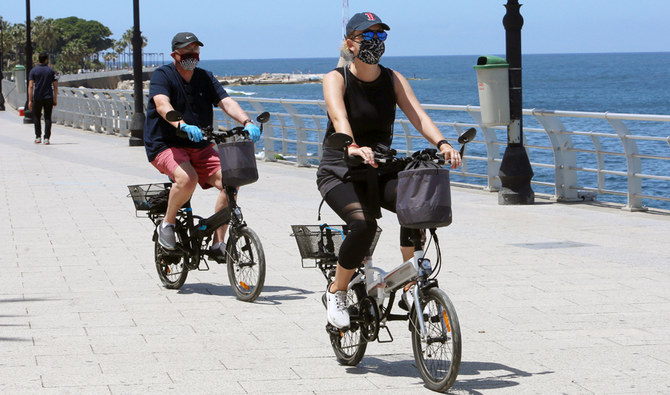
by arabnews.com — NAJIA HOUSSARI — BEIRUT: People in Lebanon will be able to go for walks on the seaside promenades along the Lebanese coast starting Monday, provided they commit to wearing masks and maintaining safe distances. This move comes following a ban imposed since March 15 due to the spread of the coronavirus disease (COVID-19). Lebanon on Sunday reported four new cases, two of whom had returned from Guinea. Lebanon will enter its second week of relaxed measures, with restaurants allowed to resume receiving customers until 9 p.m., provided they do not offer hookah services, which spread COVID-19. Barbers will be allowed to reopen salons for pre-booked appointments. Protesters are violating measures by continuing to take to the streets and staging sit-ins against the corrupt government. A number of protesters in Tripoli raised a banner on which they wrote: “You are the thieves and you are the disease.” The Lawyers’ Committee to Defend Protesters claimed that a number of activists who had been arrested by the security forces last week have been tortured. The committee protested “enforced disappearance.”
The committee said in a statement that the military prosecution released six detainees, including a child, who were arrested in Sidon. According to the committee, “some of the detainees confirmed that they were subjected to beatings and torture by the intelligence branch through various means, especially via electrocution,” and some detainees had to be hospitalized upon their release. Attention has been drawn to the invitation extended by President Michel Aoun to political and parliamentary leaders for a meeting in the Baabda Palace on Wednesday. During the meeting, Aoun will brief the participants about the reform plan approved by the government that represents Hezbollah, the Amal Movement, the Free Patriotic Movement and their allies. The Future Movement’s parliamentary bloc announced on Sunday that it will not attend the meeting. It said that “the natural place for briefing the parliamentary blocs on the government’s reform program is the parliament.” It warned of “political and legal practices and advisory opinions that cross the lines of the constitution to establish the concept of a presidential system at the expense of the parliamentary democratic system.”
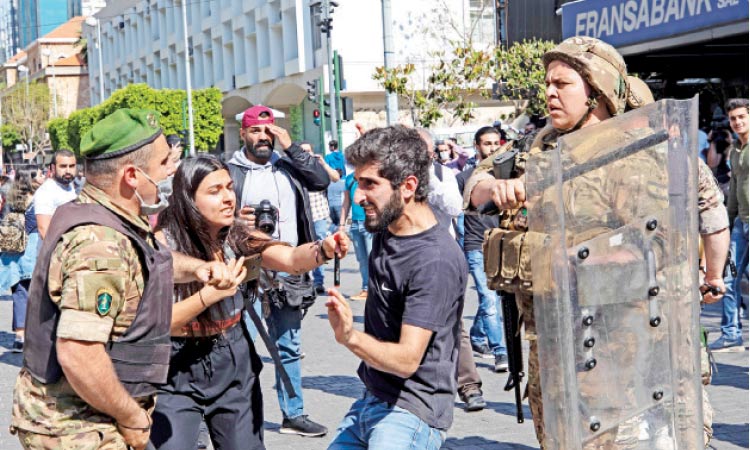
by gulftoday.ae — Michael Jansen — After four days of violent confrontations between Lebanese soldiers and civilians protesting the government’s failure to tackle the country’s economic collapse, Beirut finally adopted an economic rescue plan. There was no time to lose. While shouting protesters gathered outside the Central Bank in Beirut, angry mobs armed with stones and Molotov cocktails attacked banks in the port cities of Tripoli, Sidon and Tyre. For most Lebanese, banks have become symbols of inequality and privation because the Lebanese lira has plunged from 1,500 to 4,000 to the US dollar, devastating savings and salaries of the employed. The return to the streets in Beirut and a dozen other cities and towns followed the lifting of coronavirus restrictions on movement and easing of commercial closure.
Demonstrations morphed into riots when troops attempted to quell protesters with tear gas and rubber bullets and live fire. Fearful of violent escalation, the government of technocrats announced the plan after the politicians — who brought about the country’s collapse — made minor amendments. Perhaps to show they remain relevant. The government had consulted with the International Monetary Fund (IMF) on the shape of the plan with the aim of securing $10 billion in finance and has formally requested $10 billion from the IMF. Beirut also hopes the plan will free up $11 billion in aid pledged by international donors in 2018. Receipt of funding could put the country on the way to recovery. Economists predict that the country will need $80 billion to exit the crisis. Funding depends on the adoption of major economic and political reforms and anti-corruption measures. In a bid to meet requirements, the parliamentary Finance and Budget Committee has adopted two reform bills which failed to receive the approval of the House last month. This legislation will have to be not only passed by deputies but also implementation must proceed before Lebanon will receive funding. No one is going to put money into Lebanon – where aid money simply disappears — until this happens however dire the situation.
by cnn.com — Tamara Qiblawi and Ghazi Balkiz, CNN — Tripoli, Lebanon (CNN) — A large bag of the thistly gundelia plant arrives at Um Ahmad’s door as it does nearly every day. Wearing a double layered headscarf, she settles into a blue armchair. She has until the afternoon to trim the spines off the wild plant for her customers to cook. “We work on the akoub (gundelia) so that we can live,” says Um Ahmad, using a pseudonym. When visitors walk into her dark, cavernous room to meet her, she doesn’t even look up. A drama series blasts from an old TV. “I get paid 10,000 liras for five kilograms of this,” she mumbles, peeling the stems of the spiny plant with a small curved knife. Because the Lebanese lira is in free-fall, her payment is worth just over $2. “The akoub doesn’t even come every day,” says Um Ahmad, never meeting her guests’ eyes. Um Ahmad lives beneath a centuries-old souk (or marketplace) in Lebanon’s northern city of Tripoli.
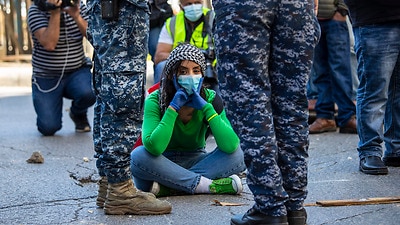
Outside, the city roils with violent demonstrations, known as the “hunger protest.” These started just as Lebanon was loosening its coronavirus lockdown, and beginning to contend with poor living conditions exacerbated by the near shutdown of the economy. Nightly confrontations between demonstrators and the Lebanese army have rocked Tripoli over the last week, turning it into the epicenter of the country’s renewed uprising against its political elite. Protests against Lebanon’s political class, which has ruled the country since its civil war and is widely accused of corruption, engulfed its main urban centers in late 2019. At the time, tens of thousands of Tripoli’s protesters flocked onto the streets. The city was dubbed “the bride of the revolution,” both because of its energetic protests and because it was believed to have borne the brunt of political corruption. Tripoli is the poorest city in Lebanon, despite being home to some of its most high-profile billionaires. A slum stretches across the banks of the city’s Abu Ali river, just minutes from pockets of extravagant wealth. The income disparity was always stark, but these days, Tripoli’s locals say it is unbearable. “No one has trust in the banks. No one has trust in the state. There’s injustice, there’s shame and there’s oppression,” says Ahmad Aich, who runs a shoe stand. Aich’s voice rises to a crescendo. As with many Tripoli natives, the conversation begins with the soft tones of a city folk known for their kindness to strangers, but quickly turns into a tirade about living conditions.
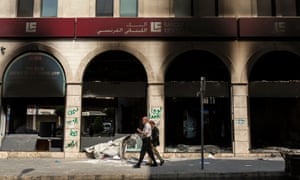
by theguardian.com — Martin Chulov — In the heart of the city that used to drive Lebanon’s economy, workers were busy with a rare jolt of enterprise, bolting steel plates to the ruins of its scorched banks. By dusk on Thursday, all of Tripoli’s ransacked branches were encased in armour, shielding piles of smouldering ash and rubble, but coming far too late to protect what had been inside. Over two earlier, violent nights, rioters had looted what they could. Six months after a revolution demanding action from a corrupt ruling class, and with a global pandemic now thrown in, its people are returning to the streets in rage at an enfeebled state that has largely left them to fend for themselves as the middle class sinks into poverty. Tripoli, a hub of a nationwide peaceful uprising last October that electrified the country, is now at the centre of something more raw and desperate – an increasing struggle to survive. The extent of the economic predicament has been laid bare in unusually transparent financial statements that have cast new light on Lebanon’s political structures and left many pondering the viability of a state that has withstood decades of war, occupation and chaos, but now appears adrift.
“We have been executing something like this for 20 years, but not as bad as what we’re living,” said Fida Jundi Hajjeh, the manager of a Tripoli-based NGO, Sanabel Nour, which provides food and other aid to orphans and the impoverished. “The middle class has been demolished. In Tripoli, we’re all from the low socio-economic classes these days.” “As much as we can give is not enough,” she said as small crowds waited silently outside her office for food coupons. “The needs are so great that we sometimes feel we are not doing anything. There are so many employees who have stopped working.” Tripoli during daylight hours in Ramadan is usually subdued, but with the coronavirus closing shops and cafes and most arms of government shut down, its streets are sullen and still. That changes as night draws near, bringing with it the bustle of a normal day. There is no social distancin, and very few face masks to shield people from the virus. “You think we care about that when people can’t feed themselves?” asked Linda Borghol, as she stirred a large vat in a makeshift food kitchen. “Nobody has anything in Tripoli. Nobody can send money. Even if you can send, it’s not easy to collect it. People are literally starving.”
by naharnet.com — Prime Minister Hassan Diab said on Thursday that his government will go ahead and seek financial assistance from the International Monetary Fund based on an economic and financial reform plan approved earlier in the day. In an address to the nation, Diab described the plan adopted unanimously by the Cabinet as a comprehensive “roadmap” for dealing with the country’s spiraling financial crisis, the worst since the 1975-90 civil war. “Today, I can say that we are going the right way to pull Lebanon out of its deep financial crisis,” he said. International donors have long demanded that Lebanon institute major economic changes and anti-corruption measures to unlock billions in pledges made in 2018. “We want contributions from the fancy interests that were paid, from those who reaped profit from financial engineering operations and from those who violated the law and stole pubic funds,” Diab said. “The plan will restructure the banking and financial sectors…, decrease the current account deficit to 5.6 percent and achieve a return to positive growth as of 2022,” he added. Noting that the government will seek “more than $10 billion in foreign aid,” Diab said the plan calls for “the instant implementation of the long-awaited reforms.” “I call on all Lebanese to consider today a turning point for the future of our country,” he said. “The central bank must address the spike in the US dollar exchange rate, because it is responsible for the national currency’s stability,” Diab suggested.
by scoopempire.com — Rima Fakih, a former beauty queen who made history a decade ago by becoming the first-ever Arab-American woman to be crowned Miss USA. Rima is internationally recognized not only for her beauty but also for her determination to become a global voice to proudly represent and shed a spotlight on her beloved […]

by thenational.ae — Lebanon’s central bank head Riad Salameh on Wednesday defended his record after being accused by the prime minister of failing to take action to stop a dire economic crisis and allowing a massive slide in the national currency. In a rare, hour-long live television speech, the head of Banque Du Liban complained that there was a coordinated campaign against him, arguing that the bank’s role was to finance the state but that ultimately, politicians controlled how it was spent. Mr Salameh called on politicians to take overdue economic reforms but said it was not BdL’s fault if successive governments have failed to take action. Lebanese law states that the central bank must finance the government at its request, he said. “We have contributed to reducing the cost of public debt by lending to the state at low-interest rates… The central bank has funded the state but not spent its money,” he said. He said that BdL is attempting to stabilise the price of the Lebanese pound as much as possible as it trades at exchanges at nearly 60 per cent below the official peg. He added that it wasn’t the bank’s actions that had driven up the price of medicine, wheat or fuel and assured banks that their deposits with BdL are still there.
The central bank was not the only one to finance successive Lebanese governments, he pointed out. Lebanon has received financial support from international institutions and foreign countries in the past decades. While this might be Mr Salameh’s strongest argument, it does not explain who will bear the losses caused by the current financial crisis, Lebanese economist Sami Nader said. “Who will bear the losses of a state accused of corruption, depositors?” Rumours of a “haircut” – a reduction on holdings – on bank accounts have been circulating these past months in Lebanon, increasing fears that people’s hard cash has evaporated. Banks have restricted access to cash and banned international transfers since to the public since last October. The crisis sparked nation-wide demonstrations, with protesters accusing politicians of corruption.
Population Movements to Keserwan - The Khazens and The Maans
ما جاء عن الثورة في المقاطعة الكسروانية
ثورة أهالي كسروان على المشايخ الخوازنة وأسبابها
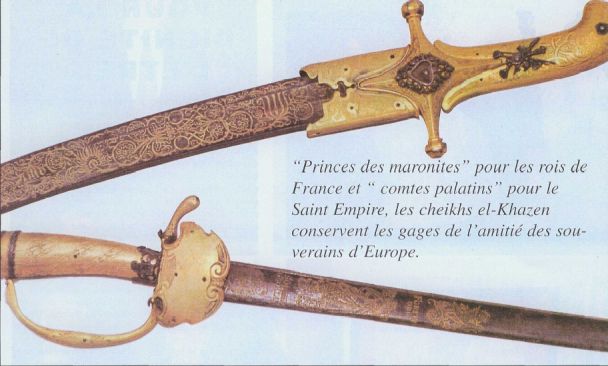
Origins of the "Prince of Maronite" Title
Growing diversity: the Khazin sheiks and the clergy in the first decades of the 18th century
Historical Members:
Barbar Beik El Khazen [English]
Patriach Toubia Kaiss El Khazen(Biography & Life Part1 Part2) (Arabic)
Patriach Youssef Dargham El Khazen (Cont'd)
Cheikh Bishara Jafal El Khazen
Patriarch Youssef Raji El Khazen
The Martyrs Cheikh Philippe & Cheikh Farid El Khazen
Cheikh Nawfal El Khazen (Consul De France)
Cheikh Hossun El Khazen (Consul De France)
Cheikh Abou-Nawfal El Khazen (Consul De France)
Cheikh Francis Abee Nader & his son Yousef
Cheikh Abou-Kanso El Khazen (Consul De France)
Cheikh Abou Nader El Khazen
Cheikh Chafic El Khazen
Cheikh Keserwan El Khazen
Cheikh Serhal El Khazen [English]
Cheikh Rafiq El Khazen [English]
Cheikh Hanna El Khazen
Cheikha Arzi El Khazen
Marie El Khazen